
Shift Work Sleep Rhythm: The 5 Levers for Early, Late and Night Shifts – and How to Plan Them
When to go to bed, when to nap, when to seek light, when to have the last coffee? We explain the five levers for better sleep on shift work and how our free shift work sleep optimizer turns your roster into a sleep plan – with commute, kids, family dinner and calendar export.
 Autors:Michael Lohrberg
8 min lasīšanai

Šis raksts vēl nav pieejams latviešu valodā. Tas tiek rādīts valodā: English.
Īsumā
On shift work, five levers decide your sleep: the timing of your main sleep, naps, light, caffeine and food. Our free shift work sleep optimizer takes your 14-day roster, shift times, commute, chronotype, sleep need and fixed family times and calculates for each day: when to go to bed, when the alarm rings, when a nap helps, when to seek and when to avoid bright light, when the last coffee is due and when to have main meals. It finds your anchor-sleep window, warns about less than 11 hours of rest, backward rotation, more than three nights in a row and long drives after nights – and exports everything as a calendar file and PDF. No sign-up.
Saturs
If you work shifts, you know the advice: "keep fixed sleep times", "no screens in the evening", "get eight hours". It's well meant and doesn't fit. Fixed sleep times don't exist when two early shifts are followed by two nights. And going to bed at 7 am while the kids need to get to school isn't in any sleep guide.
That's why we built the shift work sleep optimizer. It starts with your roster and calculates for each day when you should sleep, nap, seek or avoid light and have your last coffee – around your commute, kids and family dinner. Here I explain what's behind it.
The five levers for sleep on shift work
Your body clock can't be shifted at will. But it can be steered – with five levers you control every day.
How the optimizer works
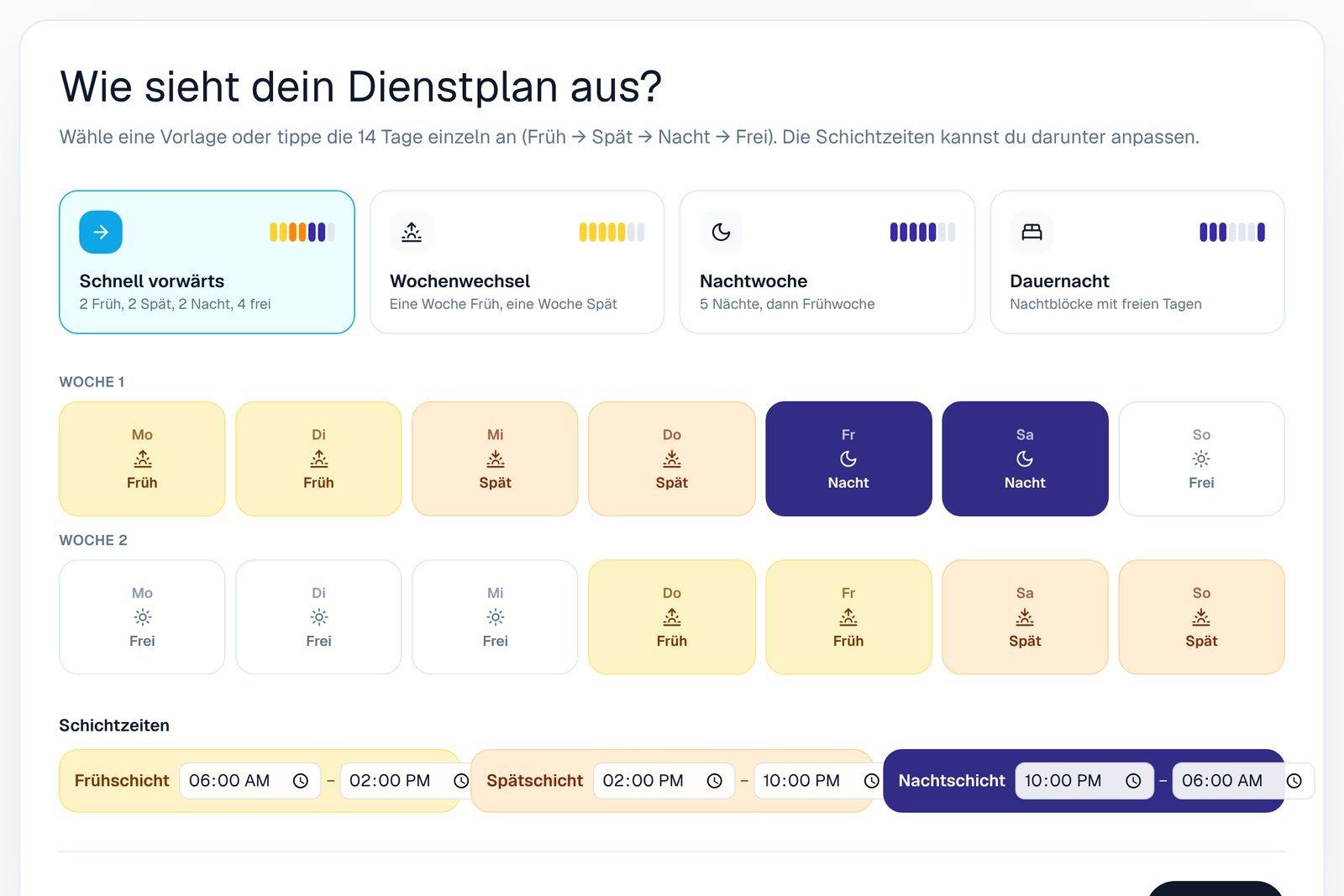
1. Roster. 14 days, each early, late, night or off. Templates cover fast forward-rotating systems (two early, two late, two nights, four off), weekly rotation, a night week and permanent-night blocks. Set your shift times below – the default is 6–14, 14–22 and 22–6.
2. You. Your chronotype via one simple question: on days off without an alarm, when would you wake up – before 7, between 7 and 9, or after 9? Plus your sleep need (default 7.5 hours), age and coffee per day.
3. Daily life. Commute in minutes and how you travel, whether you may nap on your night-shift break, whether you look after kids in the morning (with a time window, Monday to Friday) and whether family dinner matters to you. Plus the start date – for the calendar.
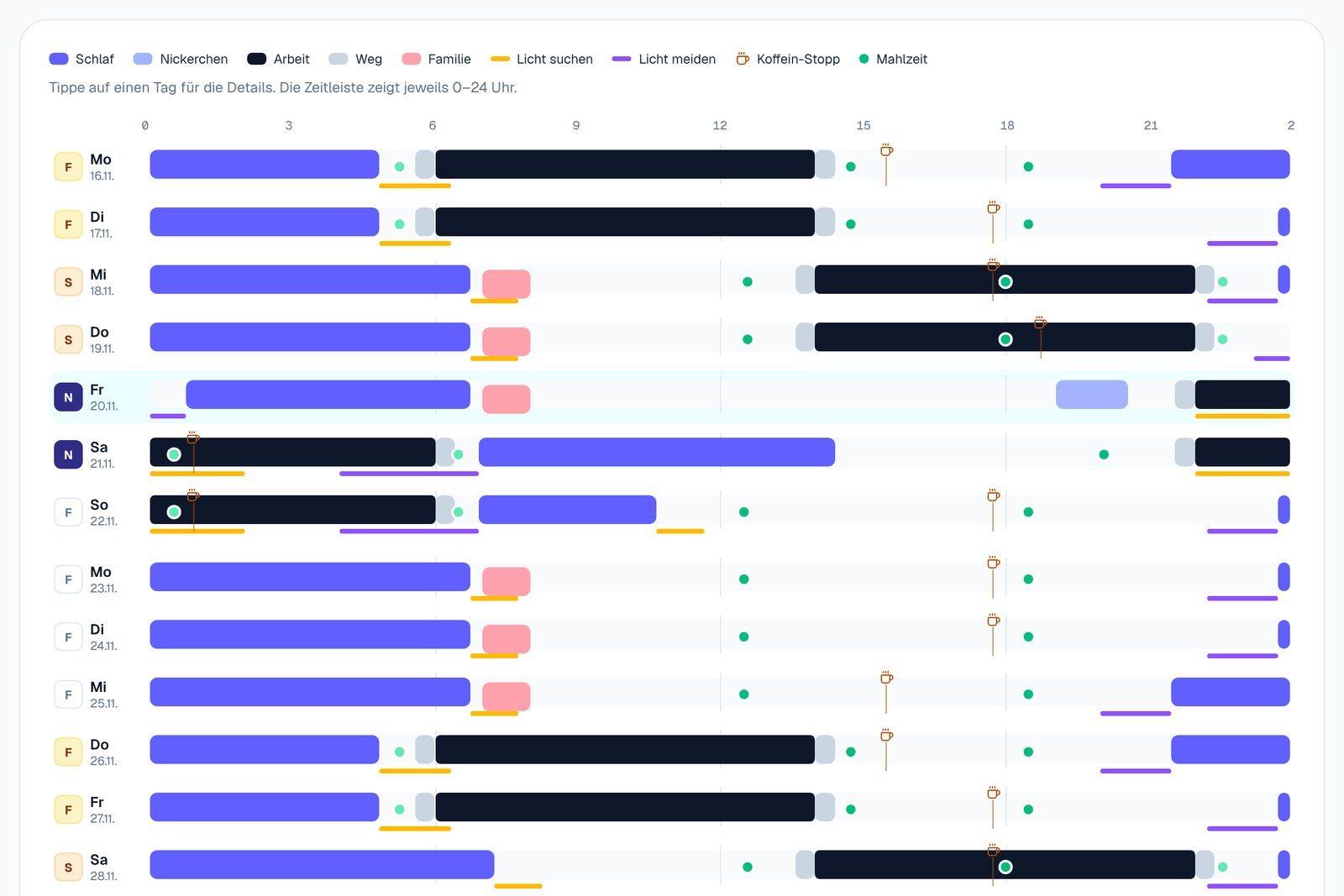
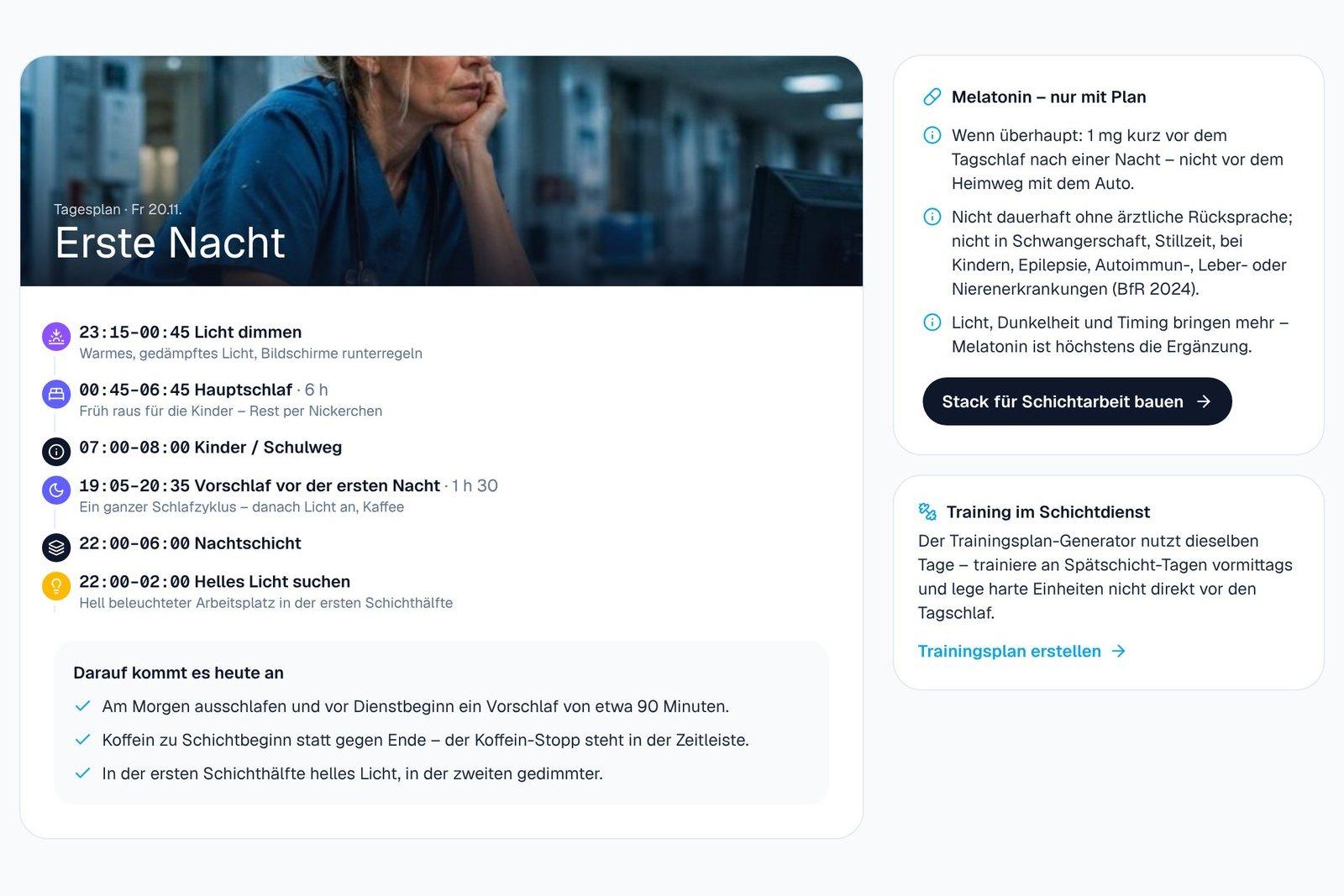
4. Sleep plan. A timeline over 14 days, and below it the day plan with times and the key rules for that day.
What gets calculated behind the scenes
Main sleep: backwards from the shift
Before an early shift the maths is simple: shift start minus commute minus 45 minutes to get ready gives the wake time; subtract your sleep need and you get bedtime. With a 6 am start, a 25-minute commute and a 7.5-hour need, that would be 9:20 pm.
That's the catch: hardly anyone falls asleep at 9:20 pm, least of all an owl. So the optimizer uses a realistic earliest bedtime per chronotype – 8:30 pm for larks, 9:30 pm for neutral types, 10:30 pm for owls. Whatever is missing is scheduled as an early-afternoon nap. That's more honest than a plan showing eight hours on paper and five in reality.
After late shifts it adds the commute and wind-down; before the first night it moves sleep one hour later and lets you sleep in. And if you look after kids in the morning, sleep ends before that window – the rest becomes a nap.
After the night: full sleep or short sleep
If more nights follow, you sleep the full length after getting home – limited by family dinner and the lead time to the next shift. After the last night, though, only three to four and a half hours. That way you're tired enough to fall asleep at your usual time in the evening, and your rhythm resets faster. How to improve day sleep itself is covered in Sleeping after a night shift.
Naps with a plan
A systematic review by Ruggiero and Redeker (2014) found that naps before or during night shifts reduce sleepiness and performance deficits. The optimizer plans three kinds:
- Pre-shift nap before the first night: about 90 minutes, ending roughly an hour before you leave.
- Power nap on break: 20 minutes around the middle of the night shift – only if you say it's allowed at your workplace.
- Catch-up after a short night: 25 minutes for a small deficit, a full cycle for a large one – with distance to the next main sleep.
Light: the strongest signal
In the study by Smith, Fogg and Eastman (2009), the body clock of participants working blocks of night shifts shifted in the desired direction when they got bright light at night, wore dark sunglasses outside and slept in darkness during the day. The optimizer turns this into two stripes under each day: seek light in the first half of the night and after waking on early and late days, avoid light towards the end of the night, on the way home and in the 90 minutes before each main sleep.
Caffeine: six hours of distance
In the study by Drake and colleagues (2013), 400 mg of caffeine six hours before bed cut measured sleep by more than an hour – without participants noticing. So the optimizer puts a caffeine cut-off six hours before each main sleep. Before day sleep after a night, that lands in the middle of the shift. If you enter more than four cups a day, it reminds you of the 400 mg per day EFSA considers safe for adults.
Food: full by day, light at night
In the lab study by Chellappa and colleagues (2021), glucose tolerance of simulated night workers stayed stable when they ate only during the day; with night-time eating it got worse. So the optimizer puts the main meal before the night shift, plans only a light snack during the night and a small breakfast before day sleep. On early and late days, meals follow the shift.
Anchor sleep and the roster check
The optimizer looks for a four-hour window in which you sleep on as many days as possible – your anchor sleep. In many rotating rosters it falls between midnight and 4 am. The more days it covers, the more stable your body clock.
It also checks your roster against the occupational recommendations summarised by Germany's DGUV and the German Working Hours Act:
| Check | Basis | What the optimizer reports |
|---|---|---|
| Less than 11 hours between two shifts | German Working Hours Act, § 5 | Quick return with exact time |
| Late → early or night → late | Recommendation: rotate forward quickly | Backward rotation |
| More than three nights in a row | Recommendation: no more than three | Number of nights |
| Early shift before 6 am | Recommendation: start as late as possible | Note on sleep loss |
| Long drive home after nights | Risk of microsleep | Nap before driving or take transit |
You usually can't change your roster. But you can talk to your works council or scheduling team about it – with concrete numbers.
Melatonin – only with a plan
Melatonin is the most-asked-about aid on shift work. The facts:
- EU claim: melatonin contributes to reducing the time taken to fall asleep – with 1 mg taken close to bedtime.
- Effect on shift work: in a Cochrane review melatonin lengthened day sleep after nights by about 24 minutes – with low-quality evidence.
- Caution: Germany's BfR advises against uncontrolled long-term use. Children, adolescents, pregnant or breastfeeding women, women trying to conceive and people with liver or kidney disease, autoimmune disease or epilepsy should not take it; anyone on medication should check with a doctor first. The effect can last into the next day – so never before driving.
If you pick the "shift work" goal in the supplement stack builder, you'll see the same restrictions there. And if you train, the workout plan generator uses the same days – tip: train in the morning on late-shift days and don't put hard sessions right before day sleep.
Into the calendar, onto paper, to the family
Add to calendar (ICS) downloads a file with all sleep times, naps and caffeine cut-offs – with a reminder 30 minutes before main sleep. It imports into Google, Apple and Outlook. PDF gives you the timeline with the key rules on one page, for the fridge door. And Copy link sends the plan to your partner – so everyone at home knows when you sleep.
The limits of the tool
The optimizer is a planning tool for healthy adults, not a diagnosis. If you sleep badly despite good planning, can hardly stay awake during the day or snore loudly with breathing pauses, get it checked by a doctor – signs of sleep apnoea are covered in Sleep apnoea signs. And the rules are averages: if your body reacts differently, your body wins.
Conclusion
Shift work will never be as restful as a regular day rhythm. But the difference between "sleeping somehow" and "sleeping with a plan" is big – often an hour a day or more. The shift work sleep optimizer does the maths for you. Enter your roster, import the calendar and try it for two weeks. And tell us what's still missing from your shift life.
Sources: Smith, Fogg & Eastman: A compromise circadian phase position for permanent night work (2009) · Drake et al.: Caffeine effects on sleep taken 0, 3, or 6 hours before going to bed (2013) · Chellappa et al.: Daytime eating prevents internal circadian misalignment and glucose intolerance in night work (2021) · Ruggiero & Redeker: Effects of napping on sleepiness and sleep-related performance deficits in night-shift workers (2014) · Liira et al.: Pharmacological interventions for sleepiness and sleep disturbances caused by shift work, Cochrane (2014) · BfR: Melatonin food supplements, opinion 038/2024 · DGUV: Timing of working hours · Regulation (EU) No 432/2012
Biežāk uzdotie jautājumi
How should you sleep on shift work?
Plan your main sleep backwards from the next shift, make up missing sleep with naps and control light: after early and late shifts get daylight in the morning and dim the evening; at night keep it bright in the first half, dimmer towards the end and wear sunglasses on the way home. Add a caffeine cut-off about six hours before sleep and main meals at daytime hours.
How long should you sleep after a night shift?
If more nights follow, as long as your usual sleep need – in a dark, cool, quiet room. After the last night, though, only about three to four and a half hours so you can fall asleep at your usual time in the evening.
When is a nap useful on shift work?
Above all before the first night shift as a pre-shift nap, on your night-shift break if allowed, and after a short night before an early shift. Ideally short (up to 30 minutes) or a full cycle of about 90 minutes.
Does melatonin help with shift work?
The effect is small. In a Cochrane review melatonin lengthened day sleep after nights by about 24 minutes, with low-quality evidence. Germany's BfR advises against uncontrolled long-term use; check with a doctor first and never take it before driving.
Is the shift sleep optimizer free?
Yes. No sign-up, no data on our servers. You can share the plan via a link, save it as a PDF and import it as a calendar file into Google, Apple or Outlook.
Birkas
- Shift work
- Sleep
- Night shift
- Tool
- Light
- Caffeine
- Melatonin
Par autoru
Michael Lohrberg· Syrax dibinātājs
Michael Lohrberg dibināja Syrax 2026. gadā. Militārais dienests ar misiju ārzemēs, rūpniecībā kopš 2010. gada, maiņu darbs un divi darbi vienlaikus – LEEK Pulse Pro radās no jautājuma, cik daudz atjaunošanās ikdienā patiesībā paliek. Žurnālā viņš raksta par treniņu, miegu un reģenerāciju – praktiski un balstoties pētījumos.
Vairāk par MichaelŠis raksts ir vispārīga informācija un neaizstāj ārsta padomu. Ja tev ir slimības, sāpes vai šaubas, pirms treniņa vai uztura maiņas konsultējies ar ārstu.
Syrax Žurnāls
Lasi tālāk
 Lielais ceļvedis
Miegs un maiņu darbs
Shift Work and Sleep: The Guide for Rotating and Night Shifts
How to get enough restful sleep despite early, late and night shifts: understanding your body clock, using light deliberately, sleep times for every shift, naps, caffeine, eating at night and training on shifts.
8 min lasīšanaiEnglish

Miegs un maiņu darbs
Sleeping After a Night Shift: How to Plan Your Day Sleep
How to fall asleep quickly after a night shift and sleep long enough: the commute home, blackout, quiet, food, caffeine, timing and switching back to a daytime rhythm – with a concrete routine for the morning after your shift.
5 min lasīšanaiEnglish
Uztura bagātinātāji
How to Stack Supplements: Putting Together a Sensible Stack – With Three Examples
Which supplements suit your goals – and which don't? We explain how a good supplement stack is put together, how our free Stack Builder checks dosage, timing, interactions and upper limits, and show three example stacks from strength athlete to shift worker.
8 min lasīšanaiEnglish