LEEK Pulse Pro vs. Apple Watch, Garmin, Whoop and Fitbit: The Big Comparison
Five concepts, five philosophies: smartwatch, sports watch, recovery band with membership, fitness tracker with display – and the LEEK Pulse Pro without display, cloud or subscription. Which tracker suits whom? A fair comparison with all strengths and weaknesses.
 Autor:Michael Lohrberg
13 min lugemist
See artikkel pole veel eesti keeles saadaval. Seda kuvatakse keeles: English.
Täielik läbipaistvus: see artikkel käsitleb LEEK Pulse Pro'd – Syraxi, selle ajakirja väljaandja toodet.
Lühidalt
The Apple Watch is the best smartwatch for iPhone users but lasts only about a day. Garmin sports watches are the first choice for runners who want GPS, a display and in-depth training analysis. Whoop is a mature recovery band but only works with a paid membership. Fitbit offers a lot of display tracker for the money; some analyses cost extra. The LEEK Pulse Pro focuses on recovery, sleep and strain without a display, cloud or subscription, with up to 30 days of battery – ideal for strength athletes and anyone who wants to manage recovery without needing GPS or smartwatch features. Its app currently runs on Android.
Sisukord
When you buy a fitness tracker today, you are not just choosing a device but a philosophy. Should your wrist be a second smartphone? A training computer with GPS and maps? An inconspicuous sensor that does most of its work at night? Or something in between? The differences between the concepts are bigger than those between individual models.
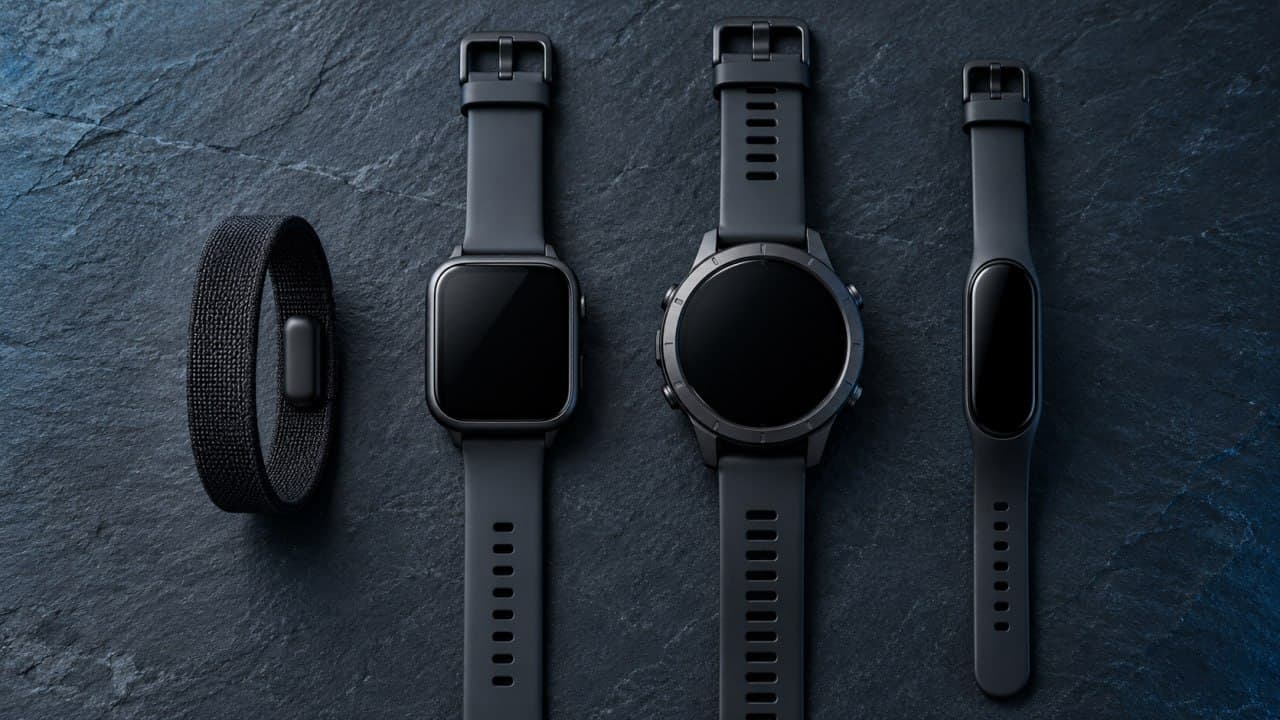
In this comparison we line up five typical representatives: the Apple Watch as the smartwatch benchmark, Garmin sports watches as a tool for endurance athletes, Whoop as a recovery band with membership, the Fitbit Charge as a classic fitness tracker with a display – and the LEEK Pulse Pro, which does without a display, GPS, cloud and subscription.
Transparency first: the LEEK Pulse Pro is our own product. That is precisely why this comparison follows a clear rule: we only compare objectively verifiable features, cite our sources with dates and say openly where the other devices are better. The detailed product presentation is in LEEK Pulse Pro in detail. The article belongs to the Wearables & Tracking topic.
The concepts at a glance
| Concept | Typical representative | Strength | Compromise |
|---|---|---|---|
| Smartwatch | Apple Watch | all-rounder, apps, communication | short battery life |
| GPS sports watch | Garmin Forerunner | training, GPS, analysis | bigger, more expensive |
| Recovery band with membership | Whoop | mature recovery platform | ongoing costs, useless without membership |
| Tracker with display | Fitbit Charge | affordable, compact, display | some analyses cost extra |
| Recovery band without subscription | LEEK Pulse Pro | battery, privacy, no follow-up costs | no GPS, no display |
The criteria we compare
Before we get into the details: these six criteria decide whether a tracker really helps in everyday life – or ends up in a drawer after three months.
1. Measurement focus. What should the device mainly capture? For runners, GPS, pace and distance are central. For strength athletes and stressed professionals, resting heart rate, heart rate variability and sleep are the more valuable data – strength training itself is best measured by a training log anyway.
2. Battery life. Underestimated but crucial. Every night a device spends on its charging cable is missing from the sleep and recovery analysis. Devices with long battery life deliver more complete data.
3. Ongoing costs. The purchase price is only half the story. Mandatory subscriptions quickly triple the cost over the period of use; optional subscriptions are fair as long as the basic functions stay free.
4. Privacy. Where does your health data end up, who has access to it, and what happens to it if the provider changes its business model? The range runs from purely local storage to full cloud.
5. Comfort. A device you take off at night does not measure your sleep. Big watches bother some people in bed; slim bands are barely noticeable.
6. Software and analysis. The best sensors are of little use if the app does not present the data clearly. Good software condenses raw data into clear decision aids without hiding the raw data.
A detailed guide to these criteria is in our fitness tracker buying guide.
The direct comparison: the facts
The following table summarises the most important specifications. Battery figures are manufacturer values or values from reviews; actual battery life depends heavily on use. Prices are guide values as of the date stated and may change – you will find the sources at the end of the article.
| Feature | LEEK Pulse Pro | Apple Watch Series 11 | Garmin Forerunner 570 | Whoop 5.0 / MG | Fitbit Charge 6 |
|---|---|---|---|---|---|
| Form factor | band without display | smartwatch | GPS sports watch | band without display | tracker with display |
| Display | no | yes | yes (AMOLED) | no | yes (OLED) |
| Built-in GPS | no | yes | yes | no | yes |
| Smartphone | Android (iOS not currently) | iPhone only | Android and iPhone | Android and iPhone | Android and iPhone |
| Battery (manufacturer/review) | up to 30 days | approx. 24 h (up to 38 h in low power mode) | 10–11 days (smartwatch mode), 18 h GPS | up to 14 days | up to 7 days |
| Purchase price | 179,90 € | from €449 (42 mm, RRP) | US$549.99 (US launch price) | included in membership | approx. €140–150 (retail) |
| Subscription | none | optional (Fitness+) | optional (Connect+ €8.99/month) | mandatory: €199–399/year (DE) | optional (Premium) |
| Data storage | on the smartphone, no cloud | Apple ecosystem, cloud sync optional | Garmin account and cloud | Whoop account and cloud | Google account and cloud |
| Focus | recovery, sleep, strain | everyday life, health, training | running, endurance, training analysis | recovery, sleep, strain | everyday life, fitness, sleep |
Battery life compared
Maximum values according to manufacturers or tests from the table above, in normal everyday mode without continuous GPS. For ranges, the midpoint is shown.
- LEEK Pulse Proup to 30 days
- Whoop 5.0 / MGup to 14 days
- Garmin Forerunner 57010–11 days
- Fitbit Charge 6up to 7 days
- Apple Watch Series 11approx. 24 h
Allikas: Manufacturer information and tests, as of the table above
Näita andmeid tabelina
| Kategooria | Battery life |
|---|---|
| LEEK Pulse Pro | up to 30 days |
| Whoop 5.0 / MG | up to 14 days |
| Garmin Forerunner 570 | 10–11 days |
| Fitbit Charge 6 | up to 7 days |
| Apple Watch Series 11 | approx. 24 h |
Apple Watch: the smartwatch benchmark
For iPhone users, the Apple Watch is the obvious choice, and for good reason. It combines an excellent display, a huge choice of apps, payments, communication and a strong collection of health and training features. According to Apple, the Series 11 offers around 24 hours of battery life and a sleep score; reviews show considerably more is possible with economical use.
Strengths: the best smartwatch experience, very good iPhone integration, extensive health features, precise GPS, no mandatory subscription.
Weaknesses: short battery life – if you want to track sleep, you have to fit charging cleverly into your day. Requires an iPhone. For many strength athletes, the feature set is more than they need.
Suits: anyone who already uses an iPhone, wants a real smartwatch and does not mind charging daily. What the Apple Watch can do specifically for training is examined in Apple Watch for training: strengths and weaknesses.
Garmin: the tool for endurance athletes
Garmin has been the first port of call for runners, cyclists and triathletes for years. The Forerunner series offers precise GPS, bright displays, very in-depth training analysis and long battery life for a watch: according to a review, the Forerunner 570 lasts 10 to 11 days in smartwatch mode and 18 hours with GPS, the older Forerunner 265 13 days and 20 hours respectively.
With Garmin Connect+, Garmin introduced an optional subscription in 2025 for €8.99 a month or €89.99 a year. According to Garmin, all existing features remain free; the subscription mainly adds AI-assisted analyses and extra features.
Strengths: GPS, training analysis, running metrics, long battery life for a watch with a display, no mandatory subscription.
Weaknesses: expensive and functionally oversized for pure recovery tracking. Bigger and more conspicuous than a band, not everyone's cup of tea in bed.
Suits: runners and endurance athletes who train by pace, distance and heart rate zones. An overview of the model range is in Garmin watches at a glance.
Whoop: recovery pioneer with membership
Whoop popularised the concept of the display-free recovery band. The system is mature: sleep, recovery and strain scores, coaching features and an active community. The current Whoop 5.0 and MG generation lasts up to 14 days according to the manufacturer.
The decisive difference is the business model. Whoop is not bought but subscribed to as a membership – the hardware is included. According to a current buying guide, the tiers in Germany cost €199 (One), €264 (Peak) and €399 (Life) per year. Without an active membership, the device does not work.
Strengths: mature recovery platform, coaching, no display, good sleep tracking.
Weaknesses: ongoing costs, unusable without membership, data in the Whoop account, no built-in GPS.
Suits: anyone who wants a mature recovery system with coaching and is prepared to pay for it permanently. If you are looking for exactly this concept without a membership, you will find the side-by-side comparison in LEEK Pulse Pro vs. Whoop.
Fitbit Charge: a lot of tracker for the money
The Fitbit Charge 6 is a classic fitness tracker with a small OLED display, built-in GPS and an attractive retail price of about €140 to €150. According to the manufacturer it lasts up to seven days; with the always-on display and continuous tracking, reviews show considerably shorter battery life. Some analyses, such as the daily readiness score, require the paid Premium subscription.
Strengths: affordable, display, built-in GPS, compact, good everyday features.
Weaknesses: some features only with a subscription, shorter battery life than pure bands, data in the Google account.
Suits: beginners and occasional athletes looking for an affordable device with a display. More on this category in Fitness trackers for seniors and beginners.
LEEK Pulse Pro: focus without follow-up costs
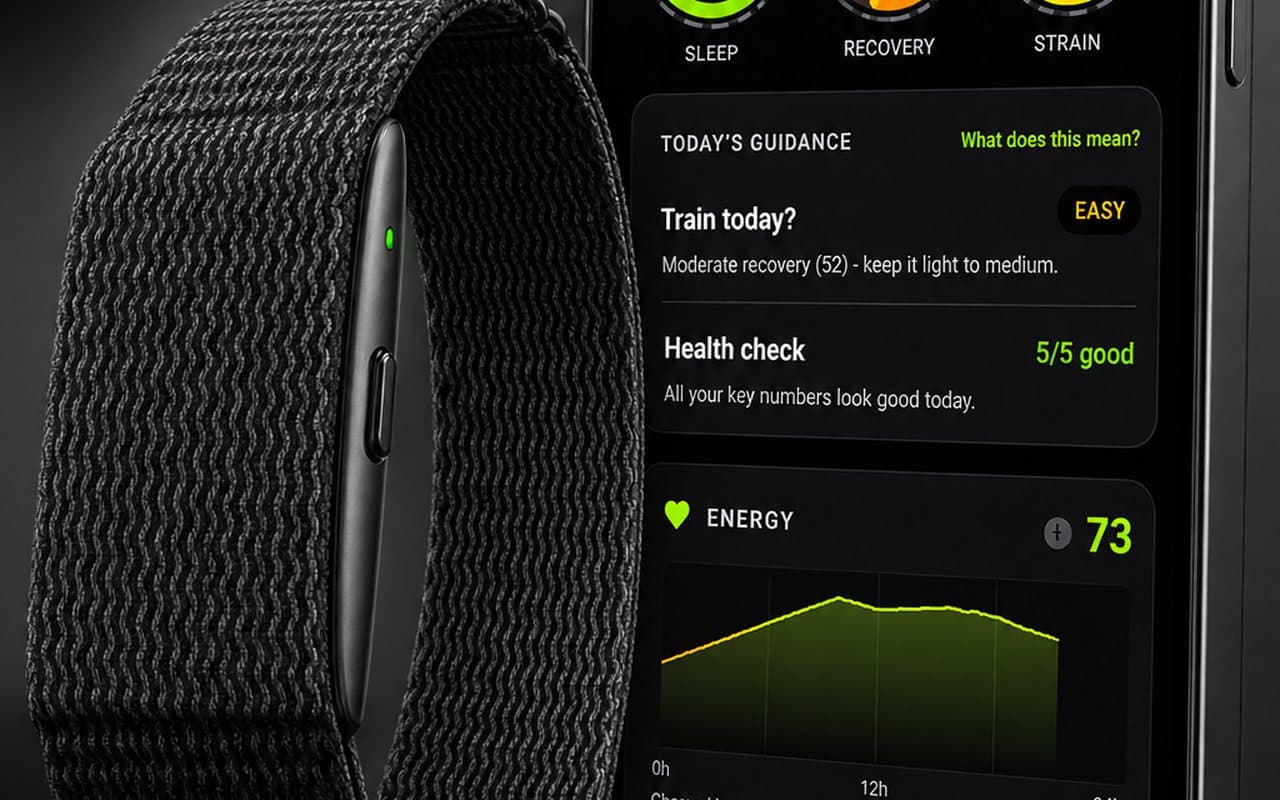
Conceptually, the LEEK Pulse Pro sits alongside Whoop: a band without a display that concentrates on sleep, recovery and strain. It measures heart rate, heart rate variability, blood oxygen saturation, stress, sleep stages and activity, and over 236 sport modes are available for training. The housing is rated IP68, so showering and swimming are no problem.
Three things set it apart from all the other devices in this comparison: battery life of up to 30 days, the no-cloud privacy concept – your data stays on your smartphone – and the absence of any subscription: every feature of the app is included in the purchase price.
Strengths: longest battery life in the comparison, no cloud, no follow-up costs, focus on recovery, unobtrusive during sleep.
Weaknesses: no GPS, no display, no smartwatch features, no web dashboard; the app is currently Android only; series launch only at the end of 2026. Like all optical wrist sensors, heart rate measurement in strength training is of limited value.
Suits: Android users among strength athletes, hybrid athletes and stressed professionals who want to manage recovery and strain without ongoing costs and without putting their health data in a cloud.
Cost comparison over three years
A wearable typically accompanies you for two to three years. Over that period the picture looks different from the purchase price alone. The following calculation uses the guide values above and only takes mandatory costs into account, or the cheapest model without optional subscriptions.
| Device | Purchase | Mandatory subscription over 3 years | Total (without optional subscriptions) |
|---|---|---|---|
| LEEK Pulse Pro | 179,90 € | €0 | 179,90 € |
| Fitbit Charge 6 | approx. €145 | €0 (Premium optional) | approx. €145 |
| Apple Watch Series 11 (42 mm) | €449 | €0 (Fitness+ optional) | €449 |
| Garmin Forerunner 570 | approx. US$550 launch price | €0 (Connect+ optional) | approx. US$550 |
| Whoop One | in membership | 3 × €199 | €597 |
| Whoop Peak | in membership | 3 × €264 | €792 |
If you use Fitbit Premium, Garmin Connect+ or Apple Fitness+, add the respective subscription costs. More on this in Fitness trackers without a subscription: what you really pay.
Privacy: where does your health data end up?
Health data is among the most sensitive data there is. The manufacturers compared handle it very differently. Apple places strong emphasis on privacy and stores health data primarily on the device; cloud synchronisation is optional. Garmin, Whoop and Fitbit rely on an account with cloud storage to make data available across devices and on the web.
The LEEK Pulse Pro does without a cloud entirely: the data does not leave your smartphone. For the privacy-conscious that is a strong argument – with the compromise that there is no web dashboard and the data is tied to the smartphone. A detailed look at what can happen to fitness data and what to watch out for is in Privacy and fitness trackers.
Sleep and recovery tracking compared
For many buyers, sleep and recovery analysis is now more important than any training feature. All five devices record sleep and derive recovery values from it – but with different weight in the overall concept.
For Whoop and the LEEK Pulse Pro, recovery is the heart of the matter: both condense resting heart rate, heart rate variability and sleep into a daily recovery score and set it against the day's strain. Both do without a display so the band does not disturb you at night. The difference lies mainly in the business model and data storage.
Garmin also offers well-founded recovery analysis with features such as HRV status and training readiness, embedded in a comprehensive training system. Apple and Fitbit reliably capture sleep stages and health values but put more emphasis on general health and everyday life; with Fitbit, some recovery analyses are tied to the Premium subscription.
One factor is often overlooked: data continuity. A recovery score is based on your personal normal range, and that becomes more accurate the more complete the data is. A device you take off to charge every other night can only build its normal range with gaps. How recovery scores are generated and how to interpret them is explained in Understanding HRV and Understanding recovery scores.
Measurement accuracy: what they all have in common
Regardless of brand, the following applies to all devices with an optical wrist sensor: under steady load and at rest – during sleep, for example – values are usually good enough to identify trends reliably. With rapid changes in intensity, intervals and strength training with strong wrist flexion, they become less accurate. Calorie figures are estimates on all devices.
If you need precise heart rate values in training, combine your watch or band with a chest strap, if the device supports it. What optical sensors can do is explained in How accurately do fitness trackers measure heart rate? and Chest strap or wrist?.
Four profiles, four decisions
Tables are helpful, but the decision is made in everyday life. Four typical profiles show how differently the right choice can turn out.
The ambitious runner. Stefan runs four times a week, is preparing for a half marathon and trains by pace and heart rate zones. For him a GPS sports watch is indispensable: he needs live pace on his wrist, the route and his lap times. Garmin is the obvious choice here. A recovery band is a sensible addition to his set-up if he does not want to wear the watch at night. How he approaches his half marathon is in Half marathon training plan.
The digital power user. Daniel uses an iPhone, likes answering messages on his wrist, pays contactlessly and trains twice a week in the gym. He wants one device for everything. The Apple Watch is the best choice for him – he accepts the short battery life and charges it in the morning while showering.
The strength athlete who values privacy. Alexander lifts four times a week, wants to manage his recovery and has no desire to hand his health data to a corporation or pay for a membership every year. He does not need GPS or a display – he wears his automatic watch on his other wrist, and his smartphone runs Android. The LEEK Pulse Pro matches his profile exactly. How he builds the data into his training plan is shown in Training plan with recovery-based adjustments.
The price-conscious beginner. Thomas wants to move more, count his steps and improve his sleep. A display with the time and step count motivates him. The Fitbit Charge offers him the best package at the lowest price – he does not need the Premium features at the start.
Common mistakes when buying a tracker
Buying by feature list. A hundred features sound good, but after three months most people use three of them. What matters is whether the core features match your goal.
Overlooking follow-up costs. A low entry price with a mandatory subscription is often more expensive over three years than a pricier device without ongoing costs.
Underestimating battery life. If you have to charge every evening, you lose sleep or daytime data – and eventually your motivation.
Overrating calorie values. No device measures energy expenditure exactly. If you plan your diet around it, you are often well off. Background in Measuring calorie burn.
Collecting data instead of using it. A tracker is only as good as the decisions you derive from its data. How to do that is explained in Analysing training data.
Decision guide: which tracker suits you?
| If you … | then … |
|---|---|
| use an iPhone and want a real smartwatch | Apple Watch |
| run or ride by pace and distance | Garmin Forerunner |
| want a mature recovery system with coaching and are fine with a subscription | Whoop |
| want to spend little and still have a display | Fitbit Charge |
| want to manage recovery – without a subscription, without a cloud, with long battery life, and use an Android smartphone | LEEK Pulse Pro |
| want both: GPS for running and recovery data without a subscription | GPS watch for training plus LEEK Pulse Pro for 24/7 recovery |
The last line is not a marketing trick but a combination many ambitious athletes use: the sports watch only goes on the wrist for training, while the band stays on around the clock and provides complete sleep and recovery data.
LEEK Pulse Pro – ahead on
- Battery life: up to 30 days
- No ongoing costs, no subscription
- Privacy: no cloud
- Focus on recovery, sleep and strain
- Unobtrusive in everyday life and during sleep
The others – ahead on
- GPS and route recording (Apple, Garmin, Fitbit)
- Display and live values on the wrist (Apple, Garmin, Fitbit)
- Smartwatch features and apps (Apple)
- In-depth running and training analysis (Garmin)
- Mature coaching platform (Whoop)
- iPhone support (LEEK app currently Android only)
- Immediate availability (LEEK: series launch end of 2026)
Our conclusion
There is no winner for everyone – but there is a clear favourite for almost everyone. If you want a smartwatch, take the Apple Watch. If you run, take Garmin. If you want a mature recovery system with coaching and accept the subscription, take Whoop. If you want an affordable way in, take Fitbit.
And if you want to answer the core question of every recovery tracker – how well recovered am I, and how much can my body handle today? – without paying every year and without putting your health data in a cloud, the LEEK Pulse Pro is the most consistent solution in this comparison. How to get the most out of the data is shown in Training with data: how to get more out of every workout with the LEEK Pulse Pro.
Sources
Information on the LEEK Pulse Pro from Syrax, as of October 2026. Information on the comparison devices according to the following sources; prices and features may have changed since:
- Apple Watch Series 11 – price and battery life: Macwelt review, 24.09.2025
- Garmin Forerunner 265/570 – battery life and launch price: Tom's Guide, 16.05.2025
- Garmin Connect+ – price and free basic features: WinFuture, 27.03.2025
- Whoop – membership prices in Germany, battery life, mandatory membership: nextpit buying guide
- Fitbit Charge 6 – price, battery life, GPS, Premium features: nextpit review
Korduma kippuvad küsimused
Which fitness tracker is the best?
There is no single best tracker – it depends on the purpose. For runners focused on pace and distance, GPS sports watches such as Garmin are ideal; for iPhone users who want a smartwatch, the Apple Watch; for display-free recovery tracking, Whoop or the LEEK Pulse Pro. If you do not want a subscription, you should rule out Whoop.
Is there a Whoop alternative without a subscription?
Yes. The LEEK Pulse Pro follows a similar concept as a display-free band focused on sleep, recovery and strain, but it is bought once – without a membership. Its app currently runs on Android. Whoop, by contrast, requires an active membership, which in Germany costs €199 to €399 per year depending on the tier.
Do I need GPS in my fitness tracker?
Only if you want to record route, pace and distance directly from your wrist when running, cycling or hiking. For strength training, recovery tracking, sleep analysis and general activity, GPS is not necessary.
Which tracker has the longest battery life?
Among the devices compared, the LEEK Pulse Pro states the longest battery life at up to 30 days. Whoop quotes up to 14 days, Garmin sports watches around 10 to 13 days in smartwatch mode depending on the model, the Fitbit Charge 6 up to 7 days and the Apple Watch Series 11 around 24 hours.
Does the Apple Watch work without a subscription?
Yes. The basic functions including training, sleep and health features can be used without a subscription. Apple offers Fitness+ as an optional paid training service. The Apple Watch does, however, require an iPhone.
Sildid
- Fitness tracker comparison
- LEEK Pulse Pro
- Apple Watch
- Garmin
- Whoop
- Fitbit
- Syrax
Autorist
Michael Lohrberg· Syraxi asutaja
Michael Lohrberg asutas Syraxi 2026. aastal. Ajateenistus ja välismissioon, tööstuses alates 2010. aastast, vahetustega töö ja kaks tööd korraga – LEEK Pulse Pro sündis küsimusest, kui palju taastumist igapäevaelus tegelikult alles jääb. Ajakirjas kirjutab ta treeningust, unest ja taastumisest – praktiliselt ja uuringutele toetudes.
Rohkem MichaelistSee artikkel on üldine teave ega asenda arsti nõuannet. Kui sul on haigusi, valusid või kahtlusi, räägi enne treeningu või toitumise muutmist oma arstiga.