ניידות ומניעהמדריך גדול
Mobility Routine: 10 Minutes a Day for Mobile Joints
Stiff hips, a tense neck, a rounded back from the desk? This 10-minute routine mobilises the joints that suffer most in everyday life – for deeper squats, pain-free pressing and a body that still feels good at 50.
 מאתMichael Lohrberg
13 דק׳ קריאה
כתבה זו עדיין אינה זמינה בעברית. היא מוצגת ב: English.
בקצרה
An effective mobility routine actively moves the joints through their full range of motion instead of just stretching passively. For most people four areas matter most: hips, thoracic spine, shoulders and ankles. Ten minutes a day with eight exercises – such as cat-cow, thoracic rotation, 90/90 hip rotation, the world's greatest stretch, wall slides and knee-to-wall – noticeably improve mobility, posture and movement quality in training within a few weeks.
תוכן העניינים
You bend down to tie your shoes and feel your lower back. You want to sink deep into a squat, but your heels lift. The front of your shoulder twinges during overhead presses. After eight hours at the desk your neck feels like concrete. Welcome to the reality of many people between 30 and 50.
The good news: a large share of these complaints has a common cause – too little movement in the joints we hardly ever take through their full range of motion in everyday life. Hips that are flexed all day while sitting. A thoracic spine hunched over the keyboard. Shoulders that never work overhead. And ankles that are barely challenged in stiff shoes.
This guide gives you a 10-minute routine that targets exactly these areas. It works as a daily habit, as a warm-up before training or as a break when working from home. It is the pillar article of our Mobility & Prevention topic.
Mobility, flexibility, stretching – what's what?
The terms are often mixed up, yet they describe different things:
| Term | Meaning | Example |
|---|---|---|
| Flexibility | passive range of motion – how far a joint can be moved with assistance | a partner pushes your leg into the stretch |
| Mobility | active, controlled range of motion – how far you can move and stabilise a joint yourself | lifting your leg high under your own power |
| Static stretching | holding a position for 30–60 seconds | seated hamstring stretch |
| Dynamic stretching | controlled, swinging movements through the range of motion | leg swings, arm circles |
For sport and everyday life, mobility is the decisive concept. It does you little good if your partner can push your hip far into a stretch but you cannot control that position under load in a squat. Good mobility work therefore combines stretching with active control.
How mobility actually improves
Many people imagine that stretching pulls muscles "longer" like a rubber band. Reality is more interesting. In the first weeks of regular mobility work, it is mainly your stretch tolerance that improves: your nervous system learns that the new position is safe and allows more range of motion before it brakes with protective tension. That is why a stretch often feels easier after just a few days.
Over months, structural adaptations follow: muscles and connective tissue adapt to the lengths you use regularly, and active training in end positions builds strength exactly where you previously had none. Only this combination of habituation, tissue adaptation and strength makes new mobility lasting and resilient.
Two rules follow for practice: consistency beats intensity, because the nervous system learns through repetition. And active control beats passive hanging, because only controlled mobility is usable in training and everyday life.
Who benefits most
On average, men are less flexible than women – partly for biological reasons, partly because stretching and mobility are rarely trained in typical male-dominated sports. Lifestyle adds to this for everyone: long hours sitting at the office and in the car, little varied movement, and strength training that often takes place in a limited range of motion.
The consequences creep in gradually:
- Hips: Shortened hip flexors and limited hip rotation restrict squat depth and can strain the lower back.
- Thoracic spine: A stiff, forward-curved thoracic spine pulls the shoulders forward and makes overhead movements harder.
- Shoulders: Limited external rotation and overhead mobility increase the risk of shoulder problems when pressing.
- Ankles: Limited ankle dorsiflexion makes the heels lift in the squat and can overload the knees and hips.
The 10-minute routine
The routine consists of eight exercises that together cover the four most important problem areas. All you need is a mat and a wall. Work slowly, with control and calm breathing. It should pull, but not hurt.
The 10-minute mobility routine
- 1
שלב 1
Cat-cow (1 minute)
On all fours, alternately round your back slowly and let it sink into an arch. Move vertebra by vertebra, in rhythm with your breathing. 8–10 repetitions.
- 2
שלב 2
Quadruped thoracic rotation (1 minute)
Place one hand behind your head, bring the elbow towards the opposite wrist, then rotate it wide upwards. Your gaze follows the elbow. 6–8 repetitions per side.
- 3
שלב 3
90/90 hip rotation (1.5 minutes)
Sit with both knees bent at 90 degrees, one leg in front, one to the side. Slowly tip the knees to the other side without using your hands. 8–10 switches.
- 4
שלב 4
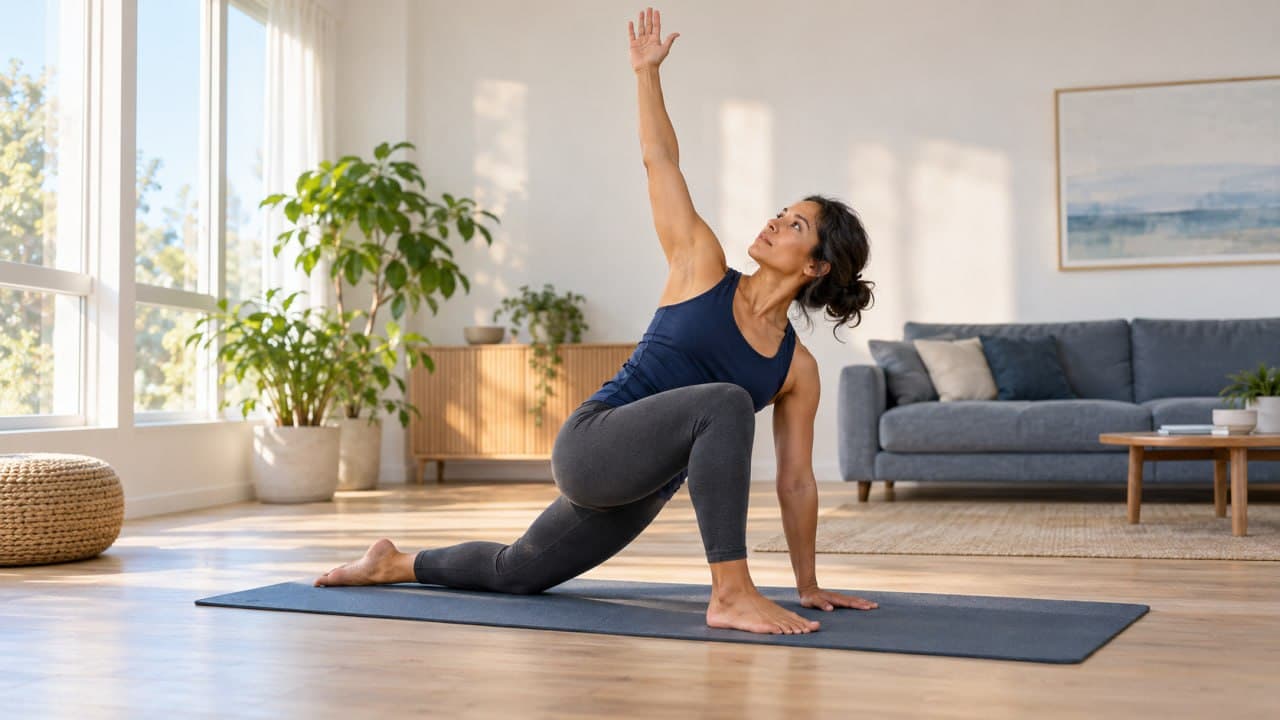
World's greatest stretch (1.5 minutes)
From a deep lunge, place your hand next to the front foot, let the elbow sink towards the floor, then rotate the arm up towards the ceiling. 4–5 repetitions per side.
- 5
שלב 5
Half-kneeling hip flexor stretch (1 minute)
In a half-kneeling position, squeeze your glutes firmly and tilt the pelvis slightly upwards until you feel a stretch at the front of the hip of the back leg. 30 seconds per side.
- 6
שלב 6
Knee-to-wall (1 minute)
Stand in a split stance in front of a wall and push the front knee over the toes towards the wall, keeping the heel on the floor. 10 repetitions per side.
- 7
שלב 7
Wall slides (1 minute)
With your back, glutes and the back of your head against the wall, place your arms on the wall in a W and slowly slide them up into a Y. 10 repetitions.
- 8
שלב 8
Deep squat with rotation (1 minute)
Sink into the deepest squat you can, heels on the floor, elbows pressing the knees slightly apart. Alternately rotate one arm up towards the ceiling. Hold and breathe.
The exercises in detail
1. Cat-cow. The gentlest start for the entire spine. As you inhale, your belly sinks towards the floor, chest and gaze go forward. As you exhale, your back rounds like a cat's, chin to chest. The movement should reach every section of the spine, not just the lower back.
2. Quadruped thoracic rotation. Perhaps the most important exercise for desk workers. The rotation must come from the thoracic spine, not the lower back. Tip: shift your hips slightly back towards your heels – this locks the lumbar spine. More variations in Mobilising the thoracic spine.
3. 90/90 hip rotation. Trains internal and external rotation of both hips at the same time – two movements that hardly occur in everyday life. Beginners support themselves with their hands behind the body; advanced athletes do the exercise hands-free with an upright torso. More exercises in Improving hip mobility.
4. World's greatest stretch. The name says it all: it mobilises the hip flexors, groin, hamstrings and thoracic spine in one movement. Also ideal as your only exercise if you only have a minute.
5. Half-kneeling hip flexor stretch. Long periods of sitting shorten the hip flexors. The trick: squeeze the glute of the back leg firmly and tilt the pelvis slightly upwards instead of falling forward into an arched back. Then even a small movement forward produces a clear stretch.
6. Knee-to-wall. The simplest test and at the same time the best exercise for ankle mobility. If you cannot get your knee to the wall with about a hand's width between toes and wall without your heel lifting, there is potential here. More in Ankle mobility.
7. Wall slides. Strengthen the muscles between the shoulder blades and improve overhead mobility. Important: the lower back stays against the wall and the arch does not increase. If your arms do not touch the wall, start with a smaller range of motion. More on the shoulder in Shoulder mobility.
8. Deep squat with rotation. The squat is a natural resting position that many adults have forgotten. If your heels lift, a rolled-up mat under the heels or holding on to a door frame helps at first.
When to do the routine
As a daily habit
The routine is most effective as a fixed daily habit – in the morning after getting up, at lunchtime or in the evening in front of the TV. Link it to something you already do every day, for example straight after your morning coffee. How that works is explained in Stick with it instead of starting over.
As a warm-up before training
Before strength training, the routine replaces aimless pedalling on the cross trainer. Combine it with three to five minutes of easy movement and then start with light warm-up sets of the first exercise. Before squats, exercises 3, 4, 6 and 8 are particularly worthwhile; before the bench press, exercises 2 and 7. How the routine fits into a complete warm-up is covered in Warming up before strength training.
As a break when working from home
After an hour of sitting, five minutes of mobility – cat-cow, thoracic rotation, hip flexor stretch and wall slides – work wonders for the neck, shoulders and back. More office tips in Back pain at the office and Chair workout: training when working from home.
Two variations: 5 minutes for the office, 20 minutes for rest days
Not every day is the same. Besides the 10-minute routine, two variations help you fit mobility into any situation.
The 5-minute office break
Ideal after an hour of screen work or before a long meeting. Everything standing or on your office chair, no mat:
| Exercise | Duration | Effect |
|---|---|---|
| Backward shoulder circles | 30 s | loosens tense shoulders |
| Door frame chest opener | 2 × 30 s | stretches the chest, shoulders back |
| Seated thoracic rotation | 1 min | mobilises the upper back |
| Lunge hip flexor stretch | 2 × 30 s | counterbalance to sitting |
| Chin tucks (make a double chin) | 10 reps | relieves the neck |
The 20-minute rest-day session
On days without training, a longer session is worthwhile. Start with the 10-minute routine and add:
- Static hamstring stretch lying down with a band, 2 × 45 seconds per side.
- Pigeon pose for the outer hip, 2 × 45 seconds per side.
- Child's pose with a side reach for the lats, 2 × 30 seconds per side.
- Slow hip circles on all fours, 8 per direction and side.
- Five minutes of calm belly breathing lying on your back to finish – it reduces tension and helps many people switch off. Background in Breathing exercises for athletes.
Breathing: the underestimated lever
Many people unconsciously hold their breath during stretches and tense against them. The nervous system interprets this as danger and does not let the muscles release. A slow, deep exhalation, on the other hand, signals safety – often you can then noticeably deepen the position. In every mobility exercise, breathe in calmly through your nose and out slowly through your mouth, and use the exhalation to go a little deeper into the movement.
The most common mobility mistakes
Too fast, too much momentum. Mobility thrives on control. If you swing through movements, you skip exactly the range where adaptation takes place.
Only moving the mobile areas. In the thoracic rotation the lower back often rotates too; in the hip flexor stretch the pelvis falls into an arch. The stiff area is spared – and stays stiff.
Stretching into pain. More pain does not mean more progress. Strong stretching pain triggers protective tension that tends to slow the effect.
Inconsistency. An hour of stretching after a back-pain weekend followed by three weeks of nothing achieves little. Tissue adapts to regular stimuli.
Mobility without strength. If you do not secure newly gained mobility with strength, you quickly lose it again – and cannot use it under load.
Stretching before training: what the research says
For a long time, static stretching before sport was considered mandatory for injury prevention. Today we know: longer static stretching of more than about 60 seconds per muscle directly before strength- or sprint-focused sessions can slightly reduce performance in the short term. There is no clear protective effect against injury from static stretching before training.
Dynamic mobility exercises, by contrast, prepare the joints without reducing performance. Static stretching is best done after training or in separate sessions and improves mobility in the long term. The details are explained in Stretching before or after training?.
| Timing | Recommendation |
|---|---|
| Before strength training | dynamic mobility, 5–10 min, then warm-up sets |
| After training | static stretching 30–60 s per muscle, if desired |
| On rest days | longer mobility or yoga session, 20–30 min |
| At the office | 3–5 min of mobility per hour of sitting |
Strength training is mobility training too
An often overlooked point: strength training through the full range of motion improves mobility – in some cases about as well as stretching. Deep squats, Romanian deadlifts with straight legs, dumbbell bench press with a deep stretch, pull-ups from a full hang: all of these exercises train strength in end-range positions. That is even more valuable than pure stretching, because you simultaneously learn to control your new mobility.
In practice this means: the best mobility strategy combines a short daily routine with strength training through the full range of motion. What that looks like for the most important basic exercise is shown in How to squat correctly.
Specific problem areas
Lower back
Non-specific back pain is among the most common complaints of all. For most forms, movement is more helpful than rest. Mobile hips and thoracic spine take load off the lower back; a strong core stabilises it. Exercises 1 to 5 of the routine are ideal for this. More in Back pain and strength training: what really helps?.
Neck and shoulders
"Text neck" is a phenomenon of screen work. Besides the routine, regular breaks, an ergonomic workstation and strengthening the upper back muscles with exercises such as face pulls and rows help. More in Improving posture: exercises against a rounded back.
Knees
Knee problems often originate above or below the knee: in a restricted hip or a stiff ankle. Exercises 3, 4 and 6 are therefore valuable for people with knee trouble too. If you have problems in training, see Knee pain when squatting.
Mobility by sport: where the focus lies
The 10-minute routine covers the most important areas for most people. Depending on your sport, it pays to emphasise individual exercises.
Strength athletes benefit above all from hip and ankle mobility for deep squats, and from thoracic rotation and wall slides for pain-free pressing overhead and on the bench. Before leg days, exercises 3, 4, 6 and 8 belong in every warm-up.
Runners need mobile hip flexors and ankles as well as strong, mobile calves. The half-kneeling hip flexor stretch and knee-to-wall are a must for them. A routine tailored specifically to runners is in Mobility for runners.
Combat and team sport athletes need mobility in all directions, especially in hip rotation and the adductors. The 90/90 hip rotation and deep lateral lunges are particularly valuable here; to prevent groin problems, see Groin strain and adductors.
Desk workers who do little sport should do the routine daily and also build in the 5-minute office break several times a day. For them, mobility is often the easiest way into more movement in general.
Mobility after 40: now more than ever
With age, connective tissue and muscles lose elasticity without countermeasures, and the joints become stiffer. That is not an unstoppable fate but largely the result of no longer performing certain movements. What you don't use, you lose – and what you use regularly is preserved.
For people over 40, the daily routine is therefore particularly valuable. Allow a little more time for warming up, approach end positions more carefully in the first weeks and combine mobility with strength training. More tips in Mobility after 40: how to stay supple.
Tools: foam roller, bands, yoga
Foam roller: Rolling can improve mobility in the short term and feels pleasant for many. The effects are usually temporary but work well as preparation. More in Using a foam roller properly.
Resistance bands: They help with shoulder exercises such as external rotations and pull-aparts and as support during stretches.
A stick or broomstick: Underrated, but ideal for shoulder exercises such as shoulder dislocates with a wide grip and for checking posture in hip-hinge exercises.
Yoga: One longer yoga session a week is an excellent addition – for mobility, body awareness and relaxation. Why yoga makes sense for strength athletes too is explained in Yoga for strength athletes.
What to expect in the first four weeks
Week 1: The exercises feel unfamiliar, some positions are barely reachable. Focus on clean execution and calm breathing, not depth.
Week 2: Most people feel a first relief in everyday life – less stiffness in the morning, a freer neck after work. That is mainly the improved stretch tolerance.
Weeks 3–4: The tests at the end of this article show measurable progress, and in training the squat gets deeper and overhead pressing more comfortable. Now it is decided whether mobility becomes a habit – stick with it.
Measuring progress: four simple tests
Mobility progress is hard to see but easy to measure. Test every four weeks:
| Test | How to do it | Target |
|---|---|---|
| Knee-to-wall | distance between toes and wall at which the knee touches the wall, heel on the floor | about 10 cm or more |
| Deep squat | hold for 30 s, heels on the floor, back neutral | possible without holding on |
| Overhead wall test | back against the wall, bring straight arms overhead to the wall | thumbs touch the wall without arching |
| Seated forward bend | sitting with straight legs, reach towards your toes | fingertips reach the toes |
Write down the results, and after a few weeks you will see in black and white what has changed. Take a photo or video of your deep squat from the side – the comparison after two months is often surprisingly clear.
Conclusion: ten minutes for a more mobile life
Mobility is not a question of talent but of habit. Ten minutes a day are enough to keep your hips, thoracic spine, shoulders and ankles mobile – for deeper squats, pain-free pressing, better posture and a body that still feels good at 50 and 60.
Start today: roll out the mat, go through the eight exercises of the routine, done. If you want to use the routine specifically for training, combine it with our technique guides to the squat and the bench press.
שאלות נפוצות
What is the difference between mobility and stretching?
Stretching usually means holding a position passively to lengthen the muscles. Mobility trains active control over a joint's entire range of motion. Good mobility routines combine both but focus on active, controlled movement.
How often should you do mobility exercises?
Short, frequent sessions work best. Ten minutes a day achieves more than an hour once a week. Most people notice the first improvements after two to four weeks.
Should I stretch before or after training?
Before training, dynamic mobility exercises that take the joints through their range of motion are ideal. Long static stretching directly before very strength-focused sessions can slightly reduce performance in the short term. Static stretching is best done after training or in separate sessions.
Does mobility help with back pain?
With non-specific back pain, regular movement, mobilisation and strengthening help many people. A mobile thoracic spine and hips take load off the lower back. With severe, radiating or persistent pain, it is important to see a doctor.
Is mobility especially important after 40?
Yes. With increasing age, mobility and tissue elasticity decline without countermeasures. Regular mobility work combined with strength training preserves range of motion and the resilience of the joints.
תגיות
- Mobility
- Flexibility
- Stretching
- Warm-up
- Hips
- Shoulders
- Back pain
על הכותב
Michael Lohrberg· מייסד Syrax
Michael Lohrberg ייסד את Syrax בשנת 2026. שירות צבאי עם משימה בחו״ל, בתעשייה מאז 2010, עבודה במשמרות ושתי עבודות במקביל – LEEK Pulse Pro נולד מהשאלה כמה התאוששות באמת נשארת בשגרה. במגזין הוא כותב על אימון, שינה והתחדשות – באופן מעשי ומבוסס מחקר.
עוד על Michaelכתבה זו נועדה למידע כללי ואינה מחליפה ייעוץ רפואי. אם יש לכם מחלות רקע, כאבים או ספקות, התייעצו עם רופא לפני שינוי האימון או התזונה.
מגזין Syrax