
Progressive Overload: The Most Important Principle for Strength and Muscle
No progression, no progress – but progression does not just mean "more weight". The seven ways to apply progressive overload, the best progression models for beginners and intermediates, and what to do when nothing moves any more.
 Szerző:Michael Lohrberg
13 perc olvasás
Ez a cikk még nem érhető el magyarul. A következő nyelven jelenik meg: English.
Röviden
Progressive overload means gradually increasing the demand on your muscles over time – through more weight, more reps, more sets, better technique, a larger range of motion, shorter rests or higher density. For most people, double progression works best: first increase reps to the top of a range, then add 2.5–5 % weight. Without a training log, systematic progression is practically impossible.
Tartalom
If you had to reduce all knowledge about strength training to a single sentence, it would read roughly like this: make it harder over time. This principle is called progressive overload, and it is the reason some people look completely transformed after two years of training – while others look exactly the same after ten years as on day one.
The body is an adaptation machine. It responds to loads that go beyond what it is used to by getting stronger and building muscle. As soon as it can handle the load, it has no reason to adapt further. If you train with the same weights for the same reps for years, you maintain your condition. Nothing more.
In this article you will learn what progressive overload means in concrete terms, the seven ways you can apply it, which progression models suit your training level, how to keep a training log and what to do when, despite everything, nothing moves forward. It belongs to our Muscle Building & Strength topic and builds on the muscle-building guide.
The principle: why progression is indispensable
Sports science often describes adaptation with the supercompensation model: training disturbs the body's equilibrium, it recovers and builds up a small reserve in the process – it becomes slightly stronger than before. If the next stimulus comes at the right time and is slightly bigger than the last, the cycle repeats at a higher level. If the stimulus stays the same, the body levels off at that level.
The model is simplified, but the core principle is right: the stimulus has to grow over time. A bench press of 60 kilograms for ten reps is a strong growth stimulus for a beginner. For someone who has been pressing 100 kilograms for years, it is little more than a warm-up set.
It is also important to know what progressive overload does not mean. It does not mean every session has to be heavier than the last. It does not mean you have to torture yourself to exhaustion every week. And it does not mean weight is the only lever. It means that the load shows a clear upward trend over weeks, months and years.
The 7 ways to apply progressive overload
Most people only think of the weight on the bar when it comes to progression. That is the most obvious way – but not the only one, and not always the best.
1. More weight
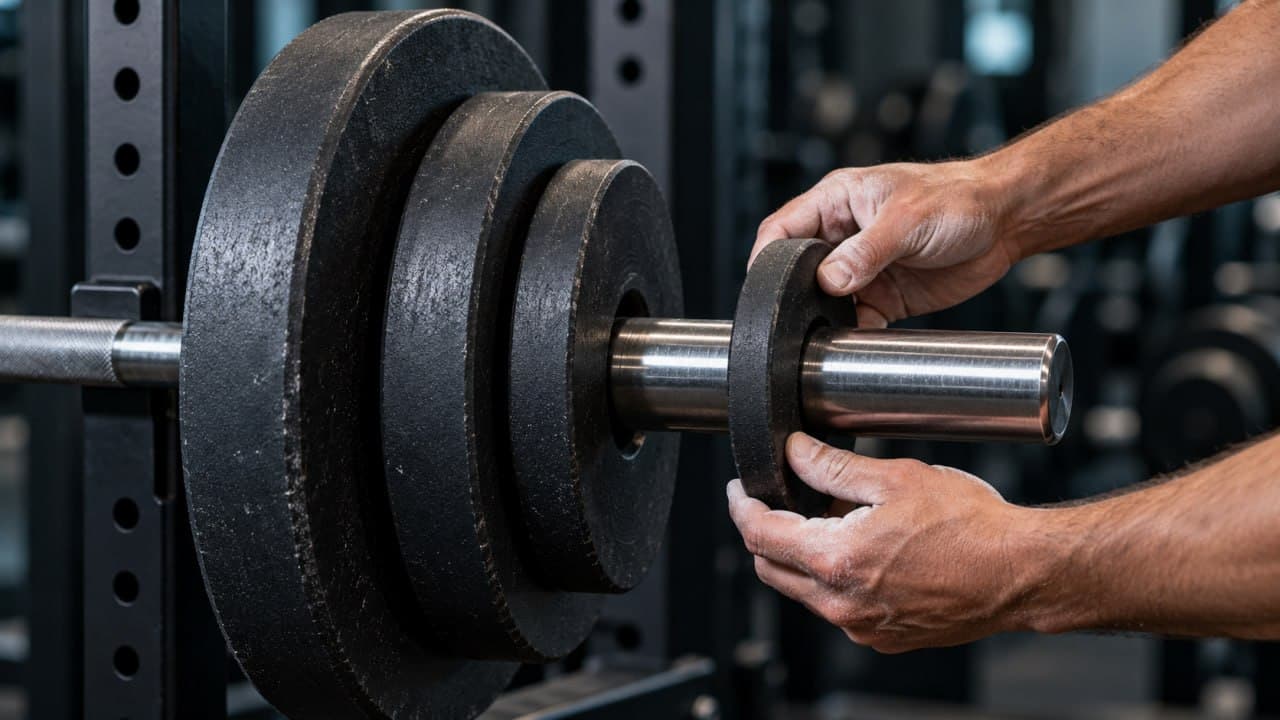
The classic: you move more load at the same rep count. For the big compound lifts, this is the central measure of progress. Squats, deadlifts, bench press and rows can be progressed in small steps for years.
2. More reps
At the same weight you manage more reps. This is particularly important for dumbbell and isolation exercises, where the next weight jump is often too big. Going from 12 to 14 kilograms in lateral raises is almost 17 per cent more – hardly any muscle progresses that fast.
3. More sets
More volume is a strong growth stimulus as long as you can recover from it. Instead of three sets you do four. This route is more for intermediates who are struggling to add weight. How much volume makes sense is explained in Training volume: how many sets per muscle per week?.
4. Better technique and control
If today you move 80 kilograms more cleanly and with more control than a month ago – at full depth, without momentum, with a controlled lowering phase – that is progress too. The tension reaches the target muscle better.
5. Larger range of motion
A squat that was barely parallel two months ago and goes noticeably deeper today is a bigger stimulus – especially in the stretched position, which is particularly effective for muscle growth. Details in Range of motion: do deeper reps build more muscle?.
6. Shorter rests at the same performance
If you manage the same performance with 90 instead of 150 seconds of rest, your work capacity has increased. Caution: for muscle growth, longer rests are usually better for compound lifts. This route is better suited to conditioning and home workouts.
7. Higher frequency
Instead of training a muscle once a week, you train it twice. That distributes volume better and increases the number of growth stimuli per week.
| Route | Best for | Note |
|---|---|---|
| Weight | Compound lifts | main route for strength |
| Reps | Isolation exercises, dumbbells, bodyweight | reps first, then weight |
| Sets | Intermediates | watch your recovery |
| Technique / control | everyone, especially beginners | not measurable, but real |
| Range of motion | squats, lunges, curls | depth first, then load |
| Rest | conditioning, home training | secondary for muscle growth |
| Frequency | beginners on a once-a-week split | switch to twice a week first |
Progression models: which one suits you?
A progression model is a set of rules that determines when and how you progress. Without a rule, your gut decides – and your gut is too cautious on bad days and too reckless on good ones.
Linear progression (beginners)
The simplest model: a little more weight every session or every week with the same sets and reps. Classic programmes such as 5×5 work like this. It is excellent for beginners because they adapt very quickly in the first months. At some point – usually after three to six months – the pace can no longer be maintained. A typical example is in 5x5 training plan.
| Week | Squat (3 × 5) |
|---|---|
| 1 | 60 kg |
| 2 | 62.5 kg |
| 3 | 65 kg |
| 4 | 67.5 kg |
| 5 | 70 kg |
Double progression (for almost everyone)
The most versatile model and our standard recommendation. You work within a rep range instead of a fixed number. First you increase the reps, then the weight.
Double progression in 4 steps
- 1
Lépés 1
Set a rep range
Choose a range for each exercise, for example 6–10 reps for compound lifts and 10–15 for isolation exercises.
- 2
Lépés 2
Determine your starting weight
Pick a weight with which you reach roughly the bottom of the range in the first set with 2–3 reps in reserve.
- 3
Lépés 3
Increase the reps
In every session, try to do one more rep in at least one set at the same weight – with clean technique and 1–3 reps in reserve.
- 4
Lépés 4
Increase the weight
Once you reach the top of the range in all working sets, increase the weight by 2.5–5 % next session and start again at the bottom of the range.
An example for the bench press with a range of 6–10 reps over three sets:
| Session | Weight | Set 1 | Set 2 | Set 3 | Decision |
|---|---|---|---|---|---|
| 1 | 70 kg | 8 | 7 | 6 | continue |
| 2 | 70 kg | 9 | 8 | 7 | continue |
| 3 | 70 kg | 10 | 9 | 8 | continue |
| 4 | 70 kg | 10 | 10 | 10 | increase weight |
| 5 | 72.5 kg | 8 | 7 | 7 | continue |
The big advantage: you always have a clear, achievable goal for the next session – one more rep. It works from beginner to intermediate and for barbell, dumbbell and machine exercises alike. The 3-day full-body plan for beginners relies on exactly this model.
Progression by RIR (for intermediates)
Instead of fixed reps, you orient yourself by proximity to failure. You set a target – say three sets of 8 reps at RIR 2 – and adjust the weight so that this target is met. When the same load feels easier over the weeks (RIR 3–4 instead of 2), you increase it.
The model automatically takes your daily form into account: on bad days you use a little less, on good days a little more. But it requires experience in estimating your own reserve. How it works is explained in RIR and RPE explained.
Undulating and block periodisation (experienced lifters)
If you have been training for years, you no longer progress from week to week. Models that plan load over several weeks help here – such as alternating heavy and lighter days or blocks with different emphases. That is a topic of its own, covered in Periodisation explained simply.
The training log: no data, no progression
This is where most people fail. They train by feel, vaguely remember last week's weights and spontaneously choose whatever feels "right". The result is stagnation – not because they are lazy, but because they do not even know whether they have progressed.
A training log is your most important tool. Notebook, spreadsheet or app – it does not matter. For each exercise, record:
- Weight
- Reps per set
- Estimated reserve (RIR) in the last set
- Notes: poor sleep, pain, technique changes
Before every session, look at what you managed last time and set yourself a concrete goal. How to set up a useful log is covered in Keeping a training log. Recovery data from a wearable – sleep, resting heart rate and HRV – can additionally explain why a session went worse. How to read it is explained in Understanding HRV.
How fast can you progress?
The rate of progression depends heavily on your training level. These values are rough guides for people who train cleanly and eat well:
| Training level | Realistic progression | Squat example |
|---|---|---|
| Beginner (0–6 months) | every session or week | +2.5 kg per week |
| Advanced beginner (6–18 months) | every 1–2 weeks | +2.5 kg every 1–2 weeks |
| Intermediate (1.5–4 years) | per month | +2.5–5 kg per month |
| Experienced (4+ years) | per training block / quarter | +5–10 kg per year |
These numbers refer to working weight at the same rep count, not to your maximum. And they vary with age, genetics, body weight and life circumstances. If you are losing weight at the same time, expect considerably slower progress – in a calorie deficit, maintaining strength is often already a success, as we explain in Lose fat, keep muscle.
Plateaus: what to do when nothing works
Sooner or later everyone reaches the point where an exercise stalls. That is normal. Two to three weeks without progress are no reason to panic. If the stagnation lasts longer, work through this checklist – in this order:
1. Check the basics
Before tinkering with your training: are you sleeping enough? Are you eating enough calories and protein? Is your stress level unusually high right now? An astonishing number of plateaus disappear as soon as nights get longer again or the calorie deficit ends. The fundamentals are in Sleep as a performance booster and How much protein do you really need?.
2. Clear fatigue
After many weeks of hard training, fatigue has often accumulated that masks your true performance. A deload week with roughly half the volume and slightly reduced intensity lets this fatigue fade. Many people set new personal bests afterwards. More in Deload week: when and how to use it.
3. Change the rep range
If you have been training in the 6–8 range for months, switching to 10–12 can provide new stimuli – and vice versa. After a few weeks you often return to the old range stronger.
4. Vary the exercise
Instead of the barbell bench press, do the dumbbell or incline bench press for a block; instead of the back squat, the front squat. The variation trains the same muscle from a slightly different angle and can address weak points.
5. Adjust the volume
For intermediates, too little volume is a common reason for stagnation. One or two additional sets per week for the stalled muscle can make the difference. With very high volume, on the other hand, less can be more.
6. Smaller increments
If the jump from 100 to 102.5 kilograms does not work, micro plates of 0.5 or 1 kilogram help. Especially for the bench press and overhead press, 2.5 kilograms is often too big a step. More strategies are in Breaking through a strength plateau.
A year of progression: what it looks like in practice
Numbers on paper are abstract. Here is what a typical first year of training can look like for someone who trains three times a week on a full-body plan, eats well and keeps a log:
| Point in time | Squat (working sets) | Bench press | Row | What's happening |
|---|---|---|---|---|
| Month 1 | 50 kg × 8 | 45 kg × 8 | 40 kg × 10 | learning technique, rapid progress from neural adaptation |
| Month 3 | 75 kg × 8 | 60 kg × 8 | 55 kg × 10 | linear progression still works almost every week |
| Month 6 | 95 kg × 8 | 72.5 kg × 8 | 67.5 kg × 10 | first tough weeks, switch to double progression |
| Month 9 | 105 kg × 8 | 80 kg × 8 | 72.5 kg × 10 | progress every two to three weeks, first deload week |
| Month 12 | 115 kg × 8 | 85 kg × 8 | 77.5 kg × 10 | increments get smaller but steady |
Working weights in the first year of training (example)
Values from the table above. The steepest rise comes in the first months – after that the curves flatten but keep climbing.
- Squat
- Bench press
- Row
Adatok táblázatban
| Month | Squat | Bench press | Row |
|---|---|---|---|
| 1 | 50 kg | 45 kg | 40 kg |
| 3 | 75 kg | 60 kg | 55 kg |
| 6 | 95 kg | 72,5 kg | 67,5 kg |
| 9 | 105 kg | 80 kg | 72,5 kg |
| 12 | 115 kg | 85 kg | 77,5 kg |
The values are an example, not a benchmark – body weight, age, leverages and previous experience shift them considerably. But the pattern is typical: a steep rise at the start, then a gradual flattening. If you know that, you will not interpret the tough weeks from month six onwards as failure, but as the normal transition from beginner to intermediate.
Progression in different life situations
Over 40: the basic rules stay the same, but increments should be slightly smaller and warm-ups longer. Tendons and joints need more time to get used to higher loads. Moderate rep ranges of 8 to 15 are often more joint-friendly than heavy triples. More in Building muscle after 40.
During stress and little sleep: in phases of high work or personal pressure, it is perfectly legitimate to switch progression to maintenance for a while. The same weights and reps with clean technique are a success in such weeks. As soon as things calm down, you continue.
After a break: if you have paused for a few weeks or months, restart at about 70 to 80 per cent of your previous working weights. Thanks to muscle memory, your old performance usually returns much faster than it was originally built. How that works is explained in Muscle memory, and a structured return is shown in Training plan after a break.
The mental side: why small wins matter
Progressive overload is not only physiology but also psychology. One more rep than last week, a new weight on the bar, an entry in the log that beats the previous one – these are small wins that motivate. They make progress visible long before the mirror shows it.
Many people do not stop training because it is too hard but because they no longer see any progress. A well-kept log with a clear progression model is therefore also one of the best tools for sticking with it. How to turn training into a fixed habit is covered in Stick with it instead of starting over.
The most common progression mistakes
Progressing too fast. If you add five kilograms every week although your technique is already wobbling, you will pay for it sooner or later with stagnation or injury. Tendons and ligaments adapt more slowly than muscles.
Sacrificing technique. One more kilogram at half depth is not progress but a step backwards with more weight. Progression only counts with the same or better execution.
Trying to progress too many exercises at once. For intermediates, it is normal that not every exercise improves every week. Focus on the most important exercises.
Constantly switching programmes. If you start a new plan every three weeks, you never get the chance to progress. Stick with a programme for at least eight to twelve weeks.
Not planning recovery. Progression without deloads eventually leads to accumulated fatigue that blocks any further progress.
Progression and muscle growth: strength isn't everything
A common misunderstanding: if you only look at the numbers on the bar, you confuse strength with muscle mass. The two are closely related but not the same. Especially in the first months, a large part of strength gains comes from better coordination – the nervous system learns to activate more muscle fibres at once. Later, the link between more load and more muscle becomes tighter.
For muscle growth, then: progression in moderate rep ranges of 6 to 15 is more valuable than chasing a new one-rep max. If you want to build muscle specifically, measure your progress by your working sets, not by max testing.
Progression in home training
Without weight plates, progression seems difficult. In fact, home training offers more options than many people think: more reps, slower lowering phases, pauses in the hardest position, single-leg or single-arm variations, elevated feet for push-ups and eventually harder exercise progressions all the way to pistol squats and muscle-ups. How this works systematically is shown in Bodyweight progressions and in our home workout without equipment.
Conclusion: small steps, big effect
Progressive overload is not a complicated concept, but it is one that requires discipline. The sum of many small increments is what makes the difference over a year. One more rep here, 2.5 kilograms more there – unremarkable in a single session, impressive over twelve months.
Choose a progression model that suits your training level, keep a log and be patient. If you are looking for a proven plan, start with the 3-day full-body plan or, if you have been training longer, with the upper/lower split. And if you want to take your technique on the compound lifts to a new level, our guides to the squat and the bench press will help.
Gyakori kérdések
What does progressive overload mean?
Progressive overload means gradually increasing the training demand over weeks and months so that the body keeps adapting. That can happen through more weight, more reps, more sets or better execution.
How often should you increase the weight?
Beginners can often add a little every week or even every session for the first few months. Intermediates tend to progress every two to four weeks, and experienced lifters sometimes only over months. What matters is that progression happens over a longer period, not in every session.
What should you do when you stop getting stronger?
First check sleep, nutrition and calorie intake. After that, a deload week, a different rep range, an exercise variation, more volume or a different progression model can help. A plateau of two to three weeks is normal; six weeks is a signal to act.
Do you always have to add more weight?
No. More reps at the same weight, more sets, a larger range of motion or more controlled execution are progression too. Especially for isolation exercises and home training, increasing reps is often more sensible than increasing weight.
How small should weight increases be?
For big lifts such as the squat and deadlift, 2.5 to 5 kg is common; for the bench press and overhead press, more like 1 to 2.5 kg. With dumbbells and isolation exercises the jumps are often too large; there, you increase reps first.
Címkék
- Progressive overload
- Progression
- Strength training
- Muscle building
- Programming
- Plateau
A szerzőről
Michael Lohrberg· A Syrax alapítója
Michael Lohrberg 2026-ban alapította a Syraxot. Katonai szolgálat külföldi misszióval, 2010 óta az iparban, váltott műszak és két munkahely párhuzamosan – a LEEK Pulse Pro abból a kérdésből született, mennyi regeneráció marad valójában a hétköznapokban. A magazinban edzésről, alvásról és regenerációról ír – gyakorlatiasan és kutatásokra alapozva.
Többet MichaelrőlEz a cikk általános tájékoztatásul szolgál, és nem helyettesíti az orvosi tanácsot. Betegség, fájdalom vagy kétség esetén beszélj orvosoddal, mielőtt edzésen vagy étrenden változtatsz.
Syrax Magazin