Bench Press: Technique, Mistakes and Variations for a Stronger Chest
The most popular exercise in the gym – and one of the most often performed incorrectly. Grip width, shoulder blades, arch, bar path, breathing and leg drive: how to press more weight, build more chest and protect your shoulders.
 NgaMichael Lohrberg
13 min lexim
Ky artikull nuk është ende i disponueshëm në shqip. Shfaqet në: English.
Shkurt
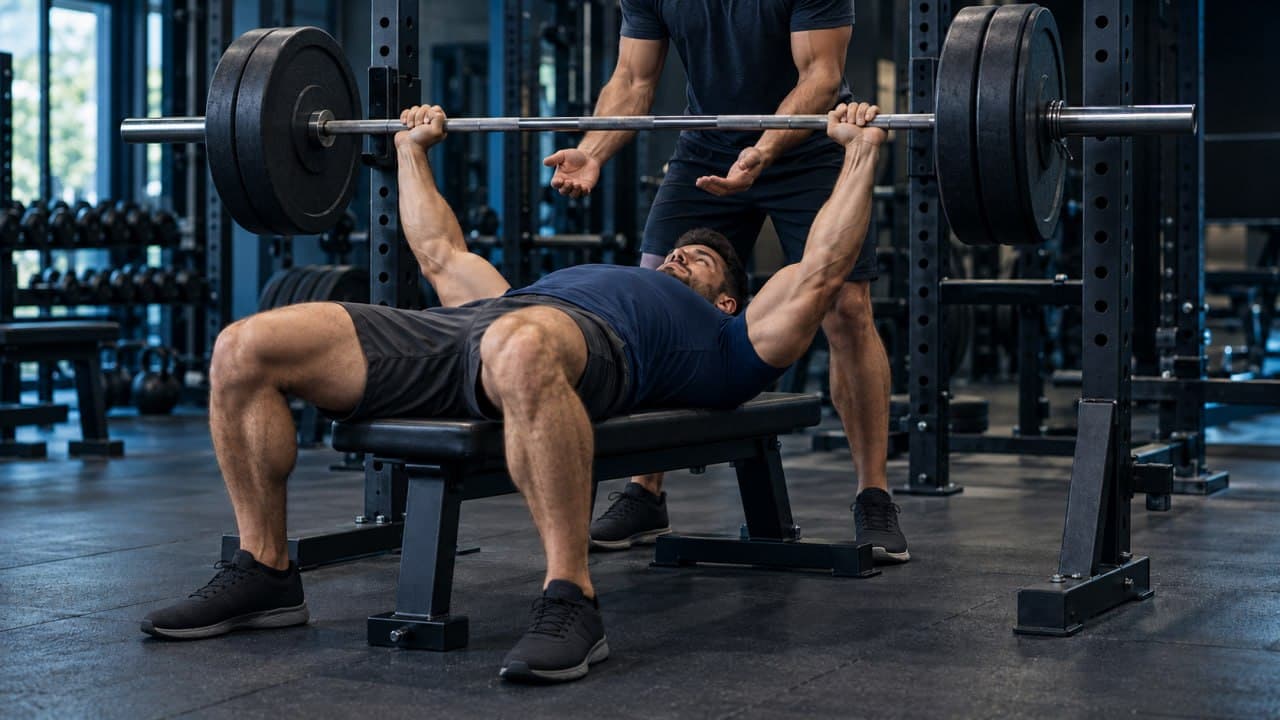
For a clean bench press, lie with your eyes under the bar, pull your shoulder blades together and down, create a slight arch and plant your feet firmly on the floor. Grip so that your forearms are roughly vertical at the bottom – usually a little wider than shoulder-width. Lower the bar under control to your lower chest, elbows about 45–70 degrees from your body, and press it back up slightly diagonally towards your shoulders. For muscle growth, 3–4 sets of 6–12 reps work well.
Përmbajtja
Monday is international chest day. Hardly any exercise has such a firm place in fitness culture as the bench press. "How much do you bench?" is the question strength athletes have measured themselves by for decades. And rightly so: the bench press is one of the most effective exercises for building the chest, front delts and triceps, it is easy to progress and it makes your upper body stronger overall.
At the same time, the bench press is one of the exercises most often associated with shoulder pain. The reason is almost always the execution: elbows flared too wide, loose shoulder blades, a wrong bar path and an ego that grows faster than the technique. This guide explains step by step how to press safely and effectively – and which variations help you keep making progress. It belongs to our Exercises & Muscle Groups topic.
Which muscles does the bench press work?
The bench press is a multi-joint exercise for the upper body. The shoulder and elbow joints work together to press the load away from the chest. The main muscles involved:
- Pectoralis major: the main player, especially in the lower part of the movement when the bar is close to the chest.
- Front deltoid: assists the press, especially with a narrower grip and a steeper bench.
- Triceps: extends the elbow and takes over a large part of the work in the upper part of the movement.
- Stabilisers: the rotator cuff, back muscles, lats and even the legs provide stability and transfer force.
Important for your training plan: the bench press trains the upper chest relatively little. For a balanced chest, add the incline press or similar exercises. A complete chest programme is shown in Chest training: the best exercises.
The set-up: 80 per cent of success
Experienced lifters like to say that a set is decided before the bar leaves the rack. That is especially true of the bench press. A good set-up protects your shoulders, shortens the bar path and gives you a stable base.
Position on the bench
Lie down so that your eyes are roughly under the bar. If you are too far up, the bar hits the hooks when you unrack it. If you are too far down, you have to lift the bar a long way forward – which costs strength and stability before your first rep has even begun.
Shoulder blades: the most important point
Pull your shoulder blades together and down, as if you wanted to tuck them into your back pockets. This creates a stable platform in your upper back from which you press. The shoulder moves into a safe, centred position, the chest is pushed up and the bar path gets shorter.
Hold this tension throughout the whole set. Many people lose it in the last reps – the shoulders roll forward, and that is exactly when the risk of injury increases.
Grip width
The ideal grip width depends on your arm length and your shoulders. A good starting point: your forearms are vertical at the bottom – viewed from the front and from the side. For most people that is a grip slightly wider than shoulder-width.
| Grip | Effect | Who it suits |
|---|---|---|
| Narrow (shoulder-width) | more triceps, less shoulder stress | triceps focus, sensitive shoulders |
| Medium (forearms vertical) | balanced, best force transfer | standard for most people |
| Wide | more chest, shorter path, more shoulder load | experienced lifters with healthy shoulders |
Wrap your thumbs around the bar. The so-called "suicide grip" without thumbs is dangerous because the bar can roll out of your hands without warning.
Wrists
The bar does not sit in your fingers but in the lower part of your palm, as directly over your forearm as possible. Bent-back wrists cost strength and hurt in the long run. Think "knuckles towards the ceiling".
Feet and arch
Your legs are not passive in the bench press. Plant your feet firmly on the floor, roughly under or slightly behind your knees, and actively drive them into the floor during the upward phase. This "leg drive" transfers tension through your whole body.
A slight arch is desirable. It stabilises the shoulders and pushes the chest up. Important: your glutes and upper back stay on the bench. The extreme arches of some powerlifters are a competition tool that shortens the range of motion as much as possible – for muscle growth, a moderate arch makes more sense.
The movement step by step
The bench press in 7 steps
- 1
Hapi 1
Find your position on the bench
Lie on the bench so that your eyes are roughly directly under the bar. Your head, upper back and glutes are in contact with the bench.
- 2
Hapi 2
Set your shoulder blades
Pull your shoulder blades together and down, as if you wanted to tuck them into your back pockets. Hold this position throughout the whole set.
- 3
Hapi 3
Choose your grip width
Grip the bar so that your forearms are roughly vertical at the bottom of the movement – usually a little wider than shoulder-width. Wrap your thumbs around the bar.
- 4
Hapi 4
Feet and arch
Plant your feet firmly on the floor, roughly under or slightly behind your knees. Create a slight arch so that your chest comes up.
- 5
Hapi 5
Unrack the bar
Take a deep breath, brace your trunk and lift the bar out of the rack with straight arms until it is over your shoulders. Alternatively, a partner can help with the lift-off.
- 6
Hapi 6
Lower under control
Lower the bar to your lower chest over about two seconds. Your elbows point about 45 to 70 degrees away from your torso, not 90 degrees out to the side.
- 7
Hapi 7
Press powerfully
Press the bar up explosively and slightly back towards your shoulders, driving your feet into the floor. Exhale at the top, or hold your breath across several reps in heavy sets.
The bar path
The bar does not move straight up and down in the bench press but along a slightly diagonal path. At the top it is over your shoulders; at the bottom it touches the lower part of your chest, roughly at nipple height or just below. So as you press up, it moves slightly back towards your head.
This J-shaped path is no coincidence: it keeps the load over the shoulder joint as much as possible and lets the chest and triceps each work where they are strongest.
Elbow angle: neither 90 nor 0 degrees
Perhaps the most important technique point for healthy shoulders. If the elbows are flared 90 degrees to the side – upper arms perpendicular to the body – the load on the front of the shoulder increases significantly. If they are kept tight against the body, the movement becomes inefficient and the chest barely works.
The sweet spot is about 45 to 70 degrees between upper arm and torso. Viewed from above, that gives roughly an arrow shape rather than a T.
Lowering and touching
Lower the bar under control over about two seconds. Do not let it drop onto your chest and do not use your chest as a trampoline. The bar touches your chest lightly – with full-body tension. If you bounce the bar off your rib cage, you take the work away from the muscle in exactly the position that is most valuable for growth.
Breathing
Take a deep breath at the top, hold it during the descent and the hardest part of the ascent, and exhale at the top. In heavy sets with few reps, many athletes hold their breath over two or three reps. Breath-holding stabilises but briefly raises blood pressure – if you have high blood pressure or cardiovascular disease, check the technique with your doctor first.
Safety: spotters, safety pins and unracking
The bench press is the exercise where a failed attempt is most dangerous – the bar then rests on your chest or neck. So:
- Train with a spotter when you go close to failure. The partner stands behind the bench, helps with the lift-off and only steps in if the bar stalls.
- Use the safety pins in the rack when you train alone. Set them just below chest height.
- No collars without a partner? Many experienced lifters skip collars when training alone so that they can tip the plates off to the side in an emergency. With safety pins, that is not necessary.
- Do not train to failure alone. End sets one or two reps short.
The 10 most common mistakes
1. Elbows at 90 degrees
Shoulder killer number one. Keep your elbows about 45 to 70 degrees from your body.
2. Loose shoulder blades
Without set shoulder blades, the stable base is missing; the shoulders roll forward and take over too much work.
3. Bar to the neck or upper chest
A touch point that is too high forces the elbows out and loads the shoulders.
4. Bouncing off the chest
Saves strength, costs muscle stimulus and can injure your ribs in the worst case.
5. Glutes lift off the bench
Seemingly increases the load, but changes the exercise and strains the lower back. Your glutes stay on the bench.
6. Bent-back wrists
The bar belongs in the heel of your hand, not in your fingers.
7. Feet in the air or unstable
Without firm floor contact, the base is missing. Exception: deliberate variations with your feet on the bench.
8. Half reps
If you only press the top half, you mainly train your triceps and leave the chest's biggest growth potential untapped.
9. Asymmetrical pressing
One side presses faster than the other and the bar tilts. Often a sign of strength differences that you can address with dumbbells. More in Recognising and correcting muscle imbalances.
10. Progressing too fast
The chest can be progressed quickly; the tendons in the shoulder cannot. Small increments of 1 to 2.5 kilograms and patience pay off. How to progress properly is explained in Progressive overload.
Variations: the right exercise for your goal
| Variation | Emphasis | When it makes sense |
|---|---|---|
| Barbell flat bench | chest, triceps, strength | main exercise |
| Dumbbell bench press | chest, greater range of motion | muscle building, evening out left-right differences |
| Incline press (30°) | upper chest, front delts | complement for a complete chest |
| Close-grip bench press | triceps | building triceps, weak lockout |
| Pause bench press | strength from the bottom position | technique, control, competition prep |
| Floor press | upper part of the movement, shoulder-friendly | home gym, sensitive shoulders |
| Machine chest press | stable, safe to failure | volume, beginners, training alone |
| Dips | lower chest, triceps | bodyweight complement |
For muscle growth, a combination works well: barbell or dumbbell bench press as the main exercise, complemented by an incline variation and an isolation exercise such as cable flyes. Details on the accessory exercises are in Incline press, Dips and Cable exercises.
Dumbbells or barbell?
Both have advantages. The barbell can be loaded heavier and progressed in finer steps – ideal for strength. Dumbbells allow a greater range of motion and a more natural path for the shoulders, and they reveal left-right differences. Many people with shoulder issues tolerate dumbbells better. The downside: beyond a certain weight, simply getting the dumbbells into position becomes difficult.
The bench press in your training plan
Volume and frequency
For muscle growth, 3 to 4 working sets of 6 to 12 reps, once or twice a week, work well. Together with another pressing exercise, that brings you to about 10 to 16 sets per week for the chest – a good range for most lifters. How to distribute volume across the week is explained in the muscle-building guide.
Warming up
Shoulders need preparation. A proven scheme for a working set at 80 kilograms:
| Set | Weight | Reps |
|---|---|---|
| 1 | 20 kg (empty bar) | 12 |
| 2 | 40 kg | 8 |
| 3 | 55 kg | 5 |
| 4 | 65 kg | 3 |
| 5 | 72.5 kg | 1–2 |
Before that, a few sets of band pull-aparts, external rotations with a band and easy arm circles help. A compact routine for the shoulders and thoracic spine is in our 10-minute mobility routine.
Balance with your back
If you press a lot, you have to pull a lot too. An imbalance between chest and back training encourages rounded shoulders and posture problems. As a rule of thumb: at least as many sets of pulling as pressing. Rows, pull-ups and face pulls are the ideal partners. More in Back training and Face pulls: the exercise for healthy shoulders.
Body proportions and the bench press
As with the squat, proportions determine what the bench press looks like and how hard it is. Two factors are particularly important:
Arm length. People with long arms have to move the bar a longer distance. That makes the bench press harder and shifts more of the load to the chest in the stretched position. They often benefit from a slightly wider grip and a moderate arch that shortens the path. People with short arms and a big rib cage, on the other hand, have a mechanical advantage – which explains why some relatively light athletes press astonishing weights.
Shoulder mobility. If you cannot pull your shoulder blades together well or have a stiff thoracic spine, you will struggle to get into a stable starting position. Regular thoracic mobility work helps more here than any extra kilo on the bar. Exercises are in Mobilising the thoracic spine.
The conclusion is the same as for any compound lift: do not blindly copy other people's technique; find the position in which your shoulders work stably and pain-free and you move the bar along a consistent path.
Two sample days for a better bench press
If you want to work specifically on your bench press, you can train it twice a week with different emphases. A proven pattern:
| Day | Exercise | Sets × reps | Goal |
|---|---|---|---|
| Day A (heavy) | Barbell bench press | 4 × 5–6 | strength, technique under load |
| Day A | Incline dumbbell press | 3 × 8–10 | upper chest |
| Day B (volume) | Pause bench press (1 s pause on the chest) | 3 × 8 | control in the bottom position |
| Day B | Dips or cable flyes | 3 × 10–15 | volume, stretch |
| Both days | Rows or pull-ups | 3–4 sets | balance, shoulder health |
Both days follow double progression: first you increase the reps within the range, then the weight. After six to eight weeks, a lighter week helps clear accumulated fatigue.
Bench pressing at home: no bench, no rack
Not everyone has a rack with safety pins at home. Safe pressing is still possible. The floor press – pressing while lying on the floor – naturally limits the range of motion: your upper arms stop on the floor before the bar reaches your chest. That spares your shoulders and makes failing less dangerous, because you can set the load down at elbow height.
You can also train effectively with dumbbells on a flat bench or even on a stable exercise ball. And if you have to manage completely without weights, turn to push-ups and their harder variations. How to progress them systematically is shown in Perfecting the push-up; how to equip a home gym sensibly is explained in Setting up a home gym.
Shoulder pain when benching
If the bench press hurts, it is rarely the exercise itself and almost always the dosage or execution. Check in this order: elbow angle, shoulder blade tension, touch point, grip width, rate of progression. A temporary switch to dumbbells, the floor press or a slightly narrower grip with a neutral hand position often helps.
If the pain persists for more than two to three weeks despite adjustments, your shoulder belongs in the hands of a doctor or physiotherapist. We discuss the most common causes and solutions in Avoiding shoulder pain when bench pressing.
Bench pressing after 40
As we age, the shoulders usually become the limiting structure in the bench press. Tendons recover more slowly and small overloads add up faster. That does not mean you should stop – on the contrary, strength training is valuable for shoulder health. But a few adjustments are worthwhile: a longer warm-up with band exercises for the rotator cuff, more moderate rep ranges of 8 to 12 instead of heavy singles, more frequent use of dumbbells with the hands turned slightly inwards and progressing in even smaller steps. Train like that and you can press strong well into old age. General tips for joint-friendly training are in Protecting your joints in training.
How strong are you? Reference values
Bench press numbers love to be compared – comparing with yourself three months ago makes more sense. Still, rough reference values help with orientation. Based on one rep and your own body weight:
| Level | Bench press (1 rep) |
|---|---|
| Beginner | approx. 0.5–0.75 × body weight |
| Intermediate | approx. 1.0 × body weight |
| Strong | approx. 1.25–1.5 × body weight |
| Very strong | from approx. 1.5 × body weight |
Bench press performance relative to body weight
Guide values for the one-rep max as a multiple of body weight. The transitions are fluid.
- Beginner · 0,5–0,75 × BWapprox. 0.5–0.75 × body weight
- Intermediate · 0,75–1,25 × BWaround 1.0 × body weight
- Strong · 1,25–1,5 × BWapprox. 1.25–1.5 × body weight
- Very strong · 1,5–2 × BWfrom approx. 1.5 × body weight
Long arms, a big rib cage, age and years of training affect these values considerably. More in Strength standards: how strong are you really?, and how to estimate your maximum safely without testing it is covered in Calculating your 1RM.
Equipment: what really helps
You do not need much for the bench press. Firm shoes ensure stable leg drive, and chalk keeps the bar from slipping in sweaty hands. Wrist wraps can stabilise the wrists in heavy sets, but for most lifters they only make sense at loads close to their maximum. Special bench shirts, as used in equipped powerlifting, have no place in normal training.
Conclusion: technique first, then weight
The bench press is a fantastic exercise – if you do it right. A clean set-up with locked-in shoulder blades, a sensible elbow angle, a controlled lowering phase and patient progression make the difference between a strong chest and wrecked shoulders. Invest the first weeks in technique, film your sets, train with a spotter or safety pins and balance every press with a pull.
As a complement, we recommend our guide to the second big compound lift, the squat. And if you are looking for a plan that combines the bench press and squat sensibly: the 3-day full-body plan for beginners brings both together.
Pyetje të shpeshta
How wide should you grip the bar for the bench press?
For most people, a grip slightly wider than shoulder-width, where the forearms are vertical at the bottom, is ideal. A wider grip emphasises the chest more but puts more load on the shoulders. A narrow grip shifts the work towards the triceps.
Where should you lower the bar when benching?
The bar touches the lower part of the chest, roughly at nipple height or just below. Lowering it to the neck or upper chest puts unnecessary strain on the shoulders.
Is arching harmful in the bench press?
A moderate arch is not harmful for healthy people. It stabilises the shoulders, slightly shortens the range of motion and protects the shoulder joint. Your glutes and upper back stay on the bench.
How many sets of bench press for muscle growth?
For muscle growth, 3 to 4 sets of 6 to 12 reps, once or twice a week, work well. Add a second pressing exercise such as the incline press or dips to reach a sensible weekly chest volume.
Why do my shoulders hurt when I bench?
Common causes are elbows flared too wide, a lack of tension in the shoulder blades, too wide a grip and adding weight too quickly. If the pain persists, reduce the weight and have it checked by a doctor or physiotherapist.
What is a good bench press number?
As a rough guide, your own body weight for one rep is a solid goal for trained lifters, and 1.25 to 1.5 times body weight is advanced. The values depend heavily on height, arm length, age and training experience.
Etiketa
- Bench press
- Chest training
- Technique
- Compound lifts
- Shoulders
Rreth autorit
Michael Lohrberg· Themeluesi i Syrax
Michael Lohrberg themeloi Syrax në vitin 2026. Shërbim ushtarak me mision jashtë vendit, në industri që nga viti 2010, punë me turne dhe dy punë njëkohësisht – LEEK Pulse Pro lindi nga pyetja se sa rikuperim mbetet vërtet në jetën e përditshme. Në revistë shkruan për stërvitjen, gjumin dhe rigjenerimin – në mënyrë praktike dhe të bazuar në kërkime.
Më shumë për MichaelKy artikull ka karakter të përgjithshëm informues dhe nuk zëvendëson këshillën mjekësore. Nëse ke sëmundje, dhimbje ose dyshime, fol me mjekun përpara se të ndryshosh stërvitjen ose ushqyerjen.
Syrax Revista