
Whey Protein: What It Is, What It Does and How Much You Really Need
Eduard Boehm's complete whey guide: what whey protein is, the difference between protein and whey, nutrition and calories, effects, the right amount, water or milk, side effects and whether too much whey is harmful – with label values, cost per 25 g of protein and clear decision aids.
 AvEduard Boehm
14 min läsning

Den här artikeln finns ännu inte på svenska. Den visas på: English.
Kort sagt
Whey protein is milk whey protein: the protein left in the liquid whey after cheese-making, filtered and dried into a powder. 'Protein' is the general term for the nutrient, 'whey' a specific protein source – so whey is protein, but not all protein is whey. It contains all essential amino acids, plenty of leucine and is digested quickly. A 30 g serving of powder provides 22 to 25 g of protein and around 105 to 120 kcal depending on the product; Syrax Premium Whey provides 23.4 g of protein, 119 kcal and about 2 g of leucine. Whey is a food, not a must: what matters for muscle building is your protein intake across the day, about 1.2 to 2.0 g per kilogram of body weight for people who train. A shake is worthwhile if you struggle to reach that amount with meals. One or two servings a day are unproblematic for healthy adults; people with kidney disease or a milk protein allergy should avoid it or seek medical advice.
Innehåll
No supplement is bought as often and understood as rarely as whey protein. Some consider it a muscle drug, others overpriced milk powder. Neither is true. Whey is a food: high-quality, concentrated protein from milk, conveniently packaged.
In this guide I explain what is in the powder, how it differs from "protein", how much of it you need and where the limits are. I give figures with sources – from the label of our own whey, from position papers of professional societies and from studies. Where industry advertising promises more than the research supports, I say so.
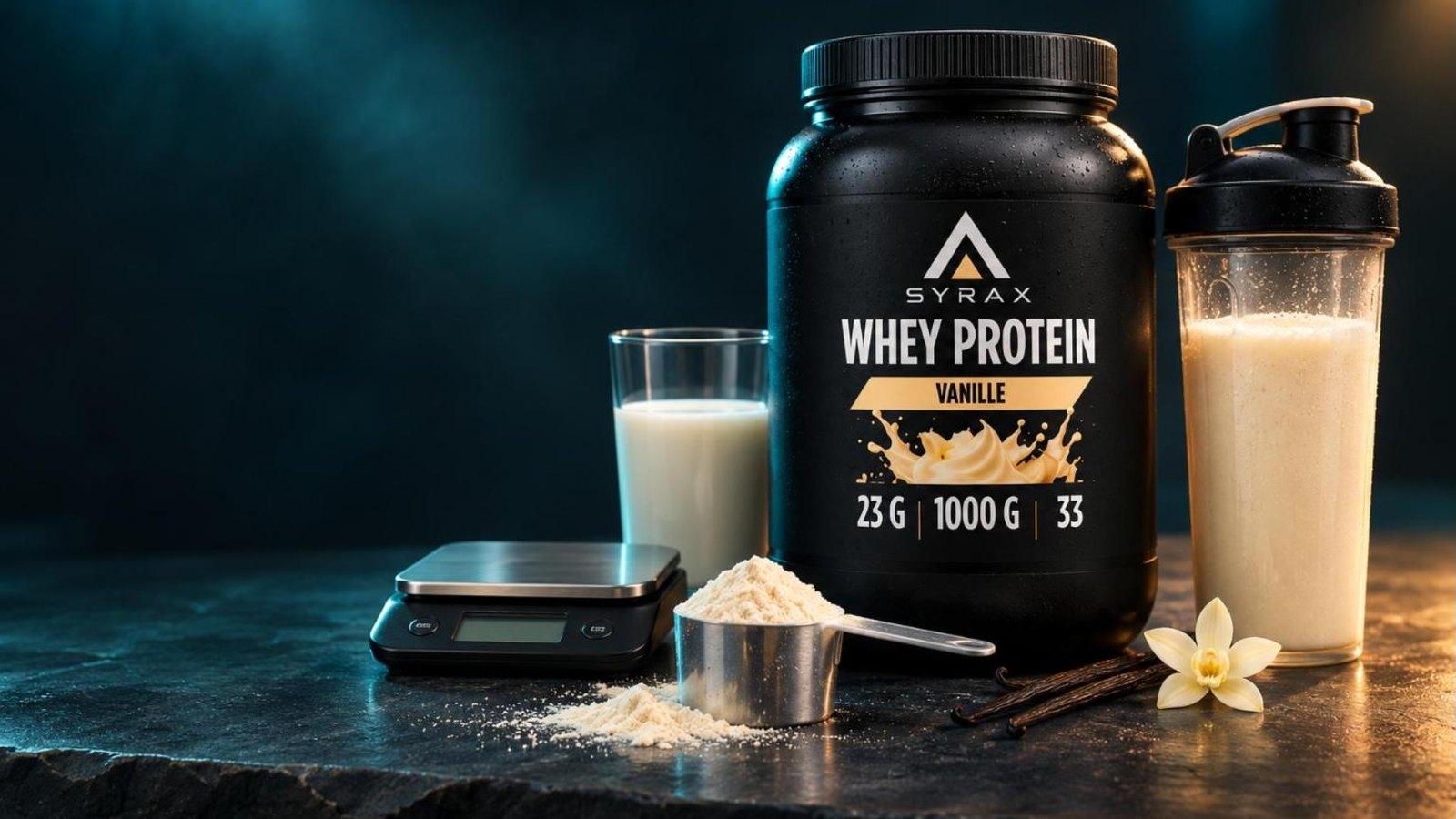
Whey protein in 30 seconds
- What: milk whey protein from cow's milk, a by-product of cheese-making, filtered and dried.
- What's in it: usually 22 to 25 g of protein per 30 g serving, little fat and carbohydrate, around 105 to 120 kcal.
- What it can do: supply protein – with all essential amino acids and plenty of leucine. Protein contributes to a growth in and the maintenance of muscle mass.
- What it can't do: replace training, burn fat or build more muscle than the same amount of protein from quark, meat or eggs.
- For whom: anyone who struggles to reach their protein amount with meals.
Protein or whey: what's the difference?
This is the most common question of all, and it has a simple answer: protein is the umbrella term, whey is a source.
"Protein" is the technical term for one of the three macronutrients alongside carbohydrates and fat. Protein is found in meat, fish, milk, eggs, pulses and grains. "Whey" is the liquid left after cheese-making. Whey protein is therefore protein from whey.
| Term | What it means | Examples |
|---|---|---|
| Protein | nutrient made of amino acids | in almost all foods |
| Protein powder | concentrated protein as a powder | whey, casein, egg, soy, pea, rice, blends |
| Whey protein | protein powder made from whey protein | concentrate, isolate, hydrolysate, clear whey |
| Casein | the other milk protein, digested slowly | quark, casein powder |
When someone asks "protein or whey?", they usually mean: should I take a whey protein or another protein powder? I cover that further down. In short: whey is not automatically better than other protein sources – but it is one of the highest-quality and best-researched.
How whey is made
Cow's milk contains about 3.4 percent protein. Of this, around 80 percent is casein and 20 percent whey protein. During cheese-making the casein curdles and becomes cheese; the whey protein stays behind in the liquid whey.
Depending on the degree of filtration, three forms result: concentrate (usually 70 to 80 percent protein, some lactose and fat), isolate (usually over 90 percent protein in the raw material, hardly any lactose) and hydrolysate (enzymatically pre-split, expensive, slightly bitter). I compare which form suits you in detail in Whey or isolate?.
Whey protein nutrition and calories
Nutritional values differ by product, form and flavour. As an example, here are the label values of our own whey – so you can put any other product next to it.
| Syrax Premium Whey (vanilla) | per 30 g serving | per 100 g |
|---|---|---|
| Energy | 119 kcal | approx. 397 kcal |
| Protein | 23.4 g | 78.1 g |
| Carbohydrates | 1.3 g | approx. 4.3 g |
| of which sugars (lactose) | 1.3 g | approx. 4.3 g |
| Fat | 2.5 g | approx. 8.3 g |
| Salt | 0.13 g | approx. 0.43 g |
| Leucine (8.6 g per 100 g protein according to specification) | approx. 2.0 g | approx. 6.7 g |
Two things stand out. First: a good 80 percent of the calories come from protein – that is what makes whey so efficient. Second: the protein content per 100 g is below 80 percent, even though the raw material is concentrate with about 80 percent protein. The reason is flavouring, emulsifier and sweetener. This applies to all flavoured powders and is not a flaw. A value well below 70 percent would be a warning sign.
How efficient is whey compared with foods?
A useful metric is protein per 100 kcal. It shows how much protein you get for your calorie budget.
Protein per 100 kcal
Whey according to the label (Syrax Premium Whey, with water). Foods: typical nutritional values per 100 g; individual products vary.
- Chicken breast (raw)approx. 22 g
- Whey protein (with water)19.7 g
- Low-fat quarkapprox. 18 g
- Skyrapprox. 17 g
- Eggsapprox. 9 g
- Milk 1.5%approx. 7 g
Visa data som tabell
| Kategori | Protein per 100 kcal |
|---|---|
| Chicken breast (raw) | approx. 22 g |
| Whey protein (with water) | 19.7 g |
| Low-fat quark | approx. 18 g |
| Skyr | approx. 17 g |
| Eggs | approx. 9 g |
| Milk 1.5% | approx. 7 g |
Whey plays in the same league as chicken breast and low-fat quark. The advantage is not quality but convenience: 30 seconds with a shaker instead of cooking, long shelf life, portable.
What whey does in the body
Whey is protein, and protein acts in the body like protein. The only health claim approved by the EU therefore concerns protein in general: protein contributes to a growth in and the maintenance of muscle mass. There is no separate, whey-specific claim – EFSA did not confirm the corresponding applications.
What still makes whey special are three properties:
- Complete amino acid profile. Whey contains all nine essential amino acids that the body cannot make itself.
- Plenty of leucine. Leucine acts as a start signal for building muscle protein. One serving of Syrax Premium Whey provides about 2 g. The position paper of the International Society of Sports Nutrition (ISSN) cites 700 to 3,000 mg of leucine per meal as a guide.
- Fast digestion. The amino acids reach the blood quickly. After training, muscle protein synthesis in young men rose more after whey than after the same amount of casein or soy in one study (Tang et al., 2009).
The context matters: these differences show up in measurements over hours. Over weeks and months, what counts above all is how much protein you eat in total and whether you train. A large meta-analysis of 49 studies found that protein supplements improve gains in muscle mass and strength with resistance training – but mainly when they increase total protein intake; at around 1.6 g per kilogram of body weight the effect was largely exhausted (Morton et al., 2018).
Do you need whey at all?
Honest answer: maybe not. The German Nutrition Society (DGE) sees no physiological need for protein supplements in athletes, and Stiftung Warentest also concluded in its test of 21 protein powders (2020) that recreational athletes mostly do not need them. Both are right: if you eat enough protein, a shake adds nothing.
But eating enough protein is not always easy in everyday life. This is how to find out whether whey makes sense for you:
| Your situation | Whey useful? | Why |
|---|---|---|
| You reach your protein amount with meals | not necessary | a shake changes nothing |
| Breakfast and lunch are low in protein (rolls, pasta) | yes | simplest way to close a gap |
| Diet with a tight calorie budget | yes | lots of protein for few calories, protects muscle mass |
| Often on the road, shift work, little time | yes | long shelf life, ready in 30 seconds |
| Over 50, little appetite | yes | 25 to 40 g of protein per meal are hard to eat |
| Vegan diet | no | plant-based protein powder instead of whey |
| Milk protein allergy | no | whey is milk protein |
| Kidney disease | only after medical advice | protein intake must be agreed |
How to calculate your personal requirement is explained in How much protein do you really need?.
How much whey per day?
The right amount does not come from the tub but from your gap. Here is how to proceed:
- Calculate your daily requirement. For people who exercise more than five hours a week, the DGE cites about 1.2 to 2.0 g of protein per kg of body weight. At 80 kg that is 96 to 160 g.
- Count your meals. How much protein do breakfast, lunch, dinner and snacks already provide? A rough weekly average is enough.
- Close the gap with whey. If 20 to 30 g are missing, a shake is the simplest solution. If 60 g are missing, look at your meals first.
In practice, that means one to two servings of 25 to 30 g of powder for most people. Per meal, 20 to 40 g of protein is considered sensible, roughly 0.3 to 0.4 g per kilogram of body weight. One serving of whey falls exactly in this range.
How many grams is a scoop?
Scoops are not standardised; depending on the manufacturer they hold 25 to 35 g, and "heaped" or "level" quickly makes a 5 g difference. For Syrax Premium Whey, 30 g is about one heaped scoop. My advice: weigh it once, then you know what your scoop looks like.
Can you take too much whey?
Yes – not in the sense of poisoning, but of a permanently very high protein intake. Three points matter:
- Kidneys: The DGE considers an intake of more than 2 g of protein per kg of body weight over the long term to be potentially unfavourable for kidney health, especially with pre-existing damage, for example from diabetes. For healthy people there is no evidence of harm at usual amounts. If you have kidney disease, agree your protein intake with your doctor.
- No additional benefit: Above your requirement, extra protein does not build more muscle; it supplies calories.
- Displacement: Three or four shakes a day displace foods with fibre, vitamins and minerals. Powder should supplement, not replace.
When should you drink whey?
For a long time the rule was: shake within 30 minutes of training, otherwise the "anabolic window" closes. That is outdated. A meta-analysis found that the timing of protein intake plays hardly any role for strength and muscle growth if the daily amount is right (Schoenfeld et al., 2013). The DGE also considers optimal timing unresolved.
In practice, this means:
- After training, if your next meal is still a few hours away – the classic, because it fits the routine well. More in Protein shake after training.
- At breakfast, if there are otherwise only rolls or muesli.
- As a snack in the afternoon, instead of bars or pastries.
- Before bed, slowly digested protein such as casein or low-fat quark is somewhat better suited. You can find the comparison in Casein or whey?.
Spread your protein across three to four meals – both the DGE and the ISSN recommend this.
Whey with water or milk?
A question of taste and calories. With milk the shake becomes creamier and more filling, but it also adds lactose and fat.
One shake, two versions
30 g Syrax Premium Whey vanilla with 300 ml of water or with 250 ml of low-fat milk (1.5% fat, typical nutritional values).
- with water
- with 250 ml milk 1.5%
- Energy (kcal)with water: 119 kcalwith 250 ml milk 1.5%: approx. 237 kcal
- Protein (g)with water: 23.4 gwith 250 ml milk 1.5%: approx. 31.9 g
- Carbohydrates (g)with water: 1.3 gwith 250 ml milk 1.5%: approx. 13.3 g
- Fat (g)with water: 2.5 gwith 250 ml milk 1.5%: approx. 6.3 g
Visa data som tabell
| Kategori | with water | with 250 ml milk 1.5% |
|---|---|---|
| Energy (kcal) | 119 kcal | approx. 237 kcal |
| Protein (g) | 23.4 g | approx. 31.9 g |
| Carbohydrates (g) | 1.3 g | approx. 13.3 g |
| Fat (g) | 2.5 g | approx. 6.3 g |
| Goal | Better with | Why |
|---|---|---|
| Losing weight, saving calories | water | half the calories |
| Building muscle, gaining weight | milk | more protein and energy |
| After endurance training | milk, or water plus a banana | carbohydrates refill the stores |
| Lactose-sensitive | water or lactose-free milk | less milk sugar |
| On the go | water | no fridge needed |
Cold helps. With very cold water or ice cubes every shake tastes rounder, because the sweetness feels less intrusive.
Side effects: is whey bad for you?
For healthy adults whey is a well-tolerated food. Still, some people get problems – usually for one of these reasons:
| Complaint | Common cause | What helps |
|---|---|---|
| Bloating, rumbling stomach | lactose in concentrate, sugar alcohols, drinking too fast | isolate or clear whey, drink more slowly, shake with a meal |
| Feeling of fullness | large shake with milk | with water, smaller serving |
| Skin blemishes | dairy products in some people | case reports and observational data, no clear proof – try a plant-based powder if affected |
| Allergic reaction | milk protein allergy | avoid whey, seek medical advice |
| Headache, restlessness | usually not the whey but caffeine in "pre-workout proteins" | read the ingredients list |
Lactose: a concentrate contains little lactose per serving – Syrax Premium Whey has 1.3 g of sugar, mostly milk sugar. For comparison: a glass of milk (250 ml) contains about 12 g. Many people with lactose intolerance tolerate small amounts well, but sensitivity is individual. If you are very sensitive, choose isolate or clear whey.
Watch the allergens: whey contains milk. Many products – including our Premium Whey – also contain soy lecithin as an emulsifier. Our clear whey contains barley malt extract and therefore gluten.
Whey for weight loss
Whey does not make you slim, but it can help you keep muscle in a calorie deficit – and that decides whether a diet leaves you with a defined body or just a smaller one. Three reasons:
- Protein is more filling than carbohydrates and fat.
- Lots of protein, few calories: 23 g of protein for 119 kcal.
- Muscle protection: in a deficit, protein requirements tend to rise. More in Lose fat, keep muscle.
Beware of "diet shakes" and "fat burner proteins": additives such as L-carnitine, green tea or chromium have no meaningful benefit for fat loss in healthy people. Plain whey is enough.
Whey, isolate, clear whey, casein or plant-based?
Whey is not the only protein powder. Here is the overview – with links to the detailed comparisons:
| Powder | Strength | Weakness | In detail |
|---|---|---|---|
| Whey concentrate | inexpensive, creamy, versatile | some lactose | this article |
| Whey isolate | hardly any lactose and fat, more protein per gram | more expensive | Whey or isolate? |
| Clear whey | refreshing like iced tea, almost lactose-free | more expensive, not with milk | Whey or clear whey? |
| Casein | slowly digested, keeps you full for long | thick, less leucine | Casein or whey? |
| Plant-based (pea, soy, rice) | vegan, lactose-free | often less leucine, taste | Vegan protein powder |
How to recognise good whey
The four most important checks before you buy:
- Protein per 100 g: at least around 70 percent for flavoured concentrate, clearly more for isolate.
- Ingredients list: whey protein first, no added single amino acids such as glycine or taurine that can artificially raise the protein value ("amino spiking").
- Price per 25 g of protein instead of price per tub.
- Lab report: heavy metals and microbiology tested? One study found deviations in protein content and conspicuous mineral levels in individual protein powders (González-Weller et al., 2023).
Werner has compiled the full checklist with all the label tricks in How to recognise good whey protein. I explain how to read a lab report in Evaluating supplements.
What does protein from whey cost?
Whey is convenient, but not the cheapest protein source. An honest comparison, calculated per 25 g of protein:
What 25 g of protein costs
Syrax products: regular shop price, as of November 2026. Low-fat quark: 500 g with 60 g of protein for about €0.90 to €1.20 at German discount supermarkets (autumn 2026, varies with offers).
- Low-fat quarkapprox. €0.40–0.50
- Syrax Premium Wheyapprox. €1.47
- Syrax Clear Wheyapprox. €1.76
Visa data som tabell
| Kategori | Price per 25 g of protein |
|---|---|
| Low-fat quark | approx. €0.40–0.50 |
| Syrax Premium Whey | approx. €1.47 |
| Syrax Clear Whey | approx. €1.76 |
Quark clearly wins on price. Whey wins on shelf life, portability and time. For many, the best solution is a mix: quark and skyr at home, a shake where quark won't fit – in the sports bag, at the office, after evening training.

Six myths about whey
"Whey is a doping agent." No. Whey is milk protein and legally a food. A risk only exists with contaminated products of dubious origin. Competitive athletes therefore look for lists such as the Cologne List (Kölner Liste).
"Without a shake right after training, the workout is wasted." No. The daily amount counts; the window is several hours wide.
"More whey, more muscle." Only up to your requirement. After that, extra protein supplies calories, not muscle.
"Whey makes you fat." No more than any other food with the same calories. One serving with water has about 120 kcal.
"Hydrolysate is better for recreational athletes." No measurable advantage in everyday life, but considerably more expensive and more bitter.
"Women need special protein." The requirement per kilogram of body weight is similar. Special products usually differ in packaging and price.
Three recipes beyond the shake
- Protein porridge: cook 50 g of oats with 200 ml of milk, take off the heat, stir in 30 g of whey (don't cook it, or it will clump), top with berries. About 37 g of protein.
- Skyr bowl: 250 g of skyr, 15 g of vanilla whey, an apple, cinnamon. About 39 g of protein.
- Pancakes: blend 1 banana, 2 eggs, 30 g of whey and 30 g of oats and fry in a pan. About 41 g of protein.
More ideas: Protein shake recipes and High-protein breakfast.
Conclusion: a good tool, not a magic potion
Whey protein is one of the highest-quality and best-researched foods for athletes – and still only a tool. It closes the gap between the protein you need and the protein you eat. If you don't have that gap, you don't need powder. If you do, there is hardly a simpler way to close it.
If you use whey, do it deliberately: calculate the amount, read the label, compare the price per gram of protein. And if you are looking for a second supplement with proven effects alongside protein, read Creatine and protein: take them together? – the two complement each other well.
Sources: DGE Sports Nutrition Working Group: Protein intake in sport (summary, PTAheute 2020) · Verbraucherzentrale: Whey protein – what you should know about milk whey protein (2026) · Stiftung Warentest: Protein powder test (2020) · González-Weller et al.: Proteins and Minerals in Whey Protein Supplements (2023) · Morton et al.: Meta-analysis of protein supplementation and resistance training (2018) · Jäger et al.: ISSN Position Stand – Protein and Exercise (2017) · Tang et al.: Whey, casein and soy after resistance exercise (2009) · Schoenfeld et al.: Protein timing – meta-analysis (2013) · EU Register of nutrition and health claims · Label and specification of Syrax Premium Whey (as of November 2026)
Vanliga frågor
What is whey protein?
Whey protein is milk whey protein from cow's milk. It is produced during cheese-making: the liquid whey is filtered until the protein is concentrated and then dried into a powder. Whey contains all essential amino acids, especially a lot of leucine, and is digested quickly.
What is the difference between protein and whey protein?
Protein is the technical term for the nutrient, regardless of the source. Whey is a specific protein source, namely milk whey protein. Protein powder can be made from whey, but also from casein, egg, soy, pea or rice. So whey is always protein, but protein is not always whey.
How much whey protein per day makes sense?
For most people, one or two servings of 25 to 30 g of powder a day are enough as a supplement to normal meals. What matters is total protein: for people who exercise more than five hours a week, the German Nutrition Society (DGE) cites about 1.2 to 2.0 g of protein per kilogram of body weight.
Can you take too much whey protein?
Yes, if your total protein intake is very high over a long period. The DGE considers more than 2 g of protein per kilogram of body weight over the long term to be potentially unfavourable for the kidneys, especially with pre-existing conditions. It does not build extra muscle anyway. If you have kidney problems, agree your protein intake with your doctor.
Whey with water or milk?
Both work. With water, a shake made from 30 g of Syrax Premium Whey has 119 kcal and 23.4 g of protein. With 250 ml of low-fat milk (1.5%), it has around 237 kcal and almost 32 g of protein, is creamier and keeps you full for longer. Use water when dieting and milk when bulking.
How many grams is a scoop of whey?
That depends on the manufacturer; it is usually 25 to 35 g. For Syrax Premium Whey, a 30 g serving is about one heaped scoop. The most accurate way is to weigh your scoop once on a kitchen scale.
Is whey protein bad for your health?
Not for healthy adults, as long as it supplements your diet rather than replacing meals. Possible problems are bloating from lactose or sweeteners, skin blemishes in some people and allergies to milk protein. Medical advice is needed with kidney disease.
When should you drink whey protein?
Whenever you would otherwise fall short on protein – often after training, at breakfast or as a snack. The so-called anabolic window is several hours wide. More important than the minute is reaching your protein amount over the day and spreading it across three to four meals.
Taggar
- Whey protein
- Protein powder
- Protein shake
- Milk protein
- Muscle building
- Supplements
Om skribenten
Eduard Boehm· Skribent om kost, näringsämnen och kosttillskott
Eduard Boehm har i årtionden ägnat sig intensivt åt kost, kosttillskott och deras påverkan på kroppen. I Syrax Magazin förenar han sin långa erfarenhet med aktuell kunskap om kosttillskott, näringsämnen och medveten kost – med fokus på etikett, dos och forskning.
Mer om EduardArtikeln är allmän information och ersätter inte medicinsk rådgivning. Har du sjukdomar, smärta eller är osäker – prata med din läkare innan du ändrar träning eller kost.
Syrax Magasin
Läs vidare

Kosttillskott
Whey or Isolate? Concentrate and Isolate in an Honest Comparison
Whey protein or whey isolate – what's the difference, and which is worth it? Eduard Boehm compares protein content, lactose, fat, calories, tolerance, muscle building and price per 25 g of protein, explains hydrolysate and clear whey and shows how to tell from the label what's really inside.
8 min läsningEnglish
Kost & kroppssammansättning
How Much Protein Do You Really Need?
Protein needs for muscle building, dieting, endurance and after 50: what research recommends, how to spread the amount across meals, which foods provide the most and whether too much protein is harmful.
6 min läsningEnglish

Kosttillskott
Protein Shake After Training: When It's Worth It – Including After Cardio and Running
Do you need a protein shake straight after training? Werner Ludmann explains what's left of the anabolic window, when a shake after strength training, running, cardio and endurance sport really makes sense, how much protein and carbohydrate belong in it and which situations don't need a shake – with a decision table and three recipes.
8 min läsningEnglish