
Deload with Data: Reading LEEK Pulse Pro Recovery Scores
When does a deload make sense – and how do sleep, resting heart rate, HRV and recovery scores help you decide? A practical guide to reading recovery data, spotting typical fatigue patterns and planning a deload week, using the LEEK Pulse Pro as an example.
 Yazar:Michael Lohrberg
6 dk okuma

Bu yazı henüz Türkçe olarak mevcut değil. Şu dilde gösteriliyor: English.
Tam şeffaflık: bu yazı, bu derginin yayıncısı Syrax'ın bir ürünü olan LEEK Pulse Pro hakkındadır.
Kısaca
A deload is a planned week of reduced training load in which accumulated fatigue dissipates. Classically, it is scheduled every four to eight weeks. Recovery data can help you time it better: if HRV drops below your normal range for several days, resting heart rate rises and your recovery score stays low despite enough sleep – and your performance stalls at the same time – a deload often makes sense. What matters are trends over several days, not single values, and always the combination of data, performance and how you feel.
İçindekiler
Training progress doesn't happen during training but in the recovery afterwards. If you add volume and weight week after week, you also accumulate fatigue – until performance stalls, joints ache and motivation drops. A deload clears this fatigue deliberately.
The big question is: when? Strictly every six weeks – or when your body needs it? This is exactly where recovery data can help. This article shows you which values are meaningful and how to read them, using our LEEK Pulse Pro fitness band as an example. It belongs to the Muscle Building topic.
What a deload is – and isn't
A deload is a planned phase of reduced load, usually one week. Typical features:
- fewer sets – about 40 to 50 percent less volume,
- more reserve – about 3 to 5 reps short of failure,
- the same exercises – so movement patterns and technique are maintained.
A deload is not a training stop and nothing to feel guilty about. It's part of a good plan – just like the rest between sets. The basics of training planning are in the muscle building guide.
Fixed schedule or as needed?
| Approach | Advantage | Disadvantage |
|---|---|---|
| Fixed rhythm (e.g. every 6 weeks) | simple, plannable | sometimes too early, sometimes too late |
| By feel | flexible | fatigue is often recognised late |
| By data + performance | individual, more objective | requires regular wearing and logging |
For many people, a combination works best: a rough rhythm as a framework, shifted a week or two earlier or later depending on data and performance.
The values that matter
Heart rate variability (HRV)
HRV describes the variation in intervals between heartbeats. A value below your normal range for several days can indicate strain, stress, poor sleep or an oncoming illness. What matters is the comparison with your own values, not with other people. The background is explained in Understanding HRV.
Resting heart rate
If your overnight resting heart rate rises a few beats above your usual value for several days, that's a classic sign of increased strain – from training, stress, alcohol or infections.
Sleep
Duration and regularity of sleep strongly influence recovery. A persistently low recovery score combined with short sleep points more to a sleep problem than to too much training.
Recovery score
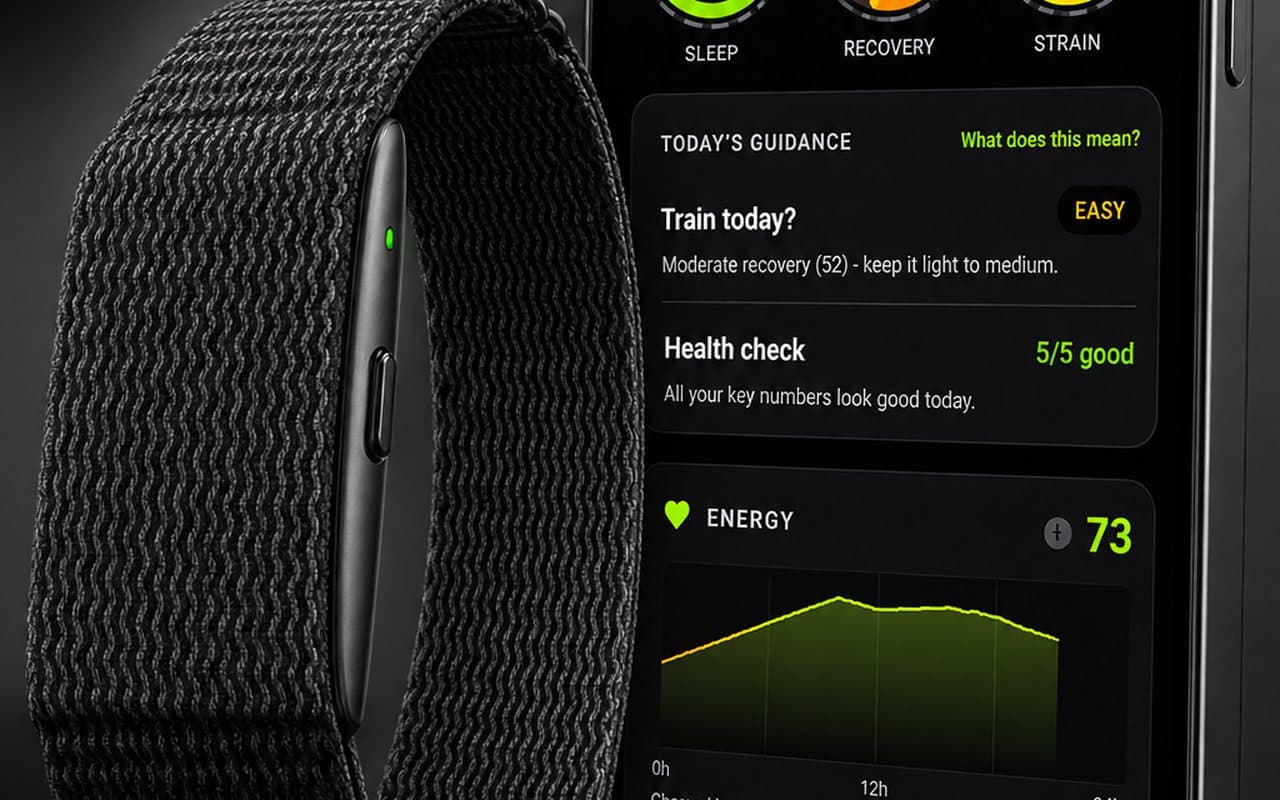
The LEEK Pulse Pro combines HRV, resting heart rate and sleep into a recovery score in the app, complemented by a strain score for daily load. The recovery score is convenient for a daily glance – but for the deload decision it's worth looking at the individual values behind it too.
The traffic-light system for the deload decision
| Signal | Green | Amber | Red |
|---|---|---|---|
| HRV (7-day trend) | in normal range | slightly below | clearly below for several days |
| Resting heart rate | normal | 2–3 beats higher | clearly higher for several days |
| Sleep | sufficient, regular | occasional short nights | too short or restless for days |
| Performance | rising | stalling | falling over several sessions |
| How you feel | motivated, fresh | tired, heavy legs | unmotivated, aching joints |
How to read the lights:
- Mostly green: keep training as planned.
- Several amber signals: slightly reduce volume in the next sessions, sleep more, keep watching.
- Red data signals plus stalling or falling performance: schedule a deload.
Important: red data without a drop in performance can also point to stress, alcohol or an oncoming infection. A deload then helps only to a limited extent – sleep, stress reduction and, with signs of illness, a break are more important.
How to plan the deload week
Plan a deload week in 5 steps
- 1
Adım 1
Check the signals
Compare the 7-day trends of HRV, resting heart rate, sleep and recovery score with your normal range and with your performance in your training log.
- 2
Adım 2
Halve the volume
Reduce the number of sets per exercise by about 40 to 50 percent, for example from four to two sets.
- 3
Adım 3
Lower the intensity
Train with about 3 to 5 reps in reserve and keep the weights the same or reduce them slightly.
- 4
Adım 4
Prioritise recovery
Plan more sleep, eat enough protein and calories and replace hard cardio sessions with walks.
- 5
Adım 5
Check your return
If your values are back in the normal range at the end of the week and you feel fresh, start the next training block.
Example: normal week vs. deload week
| Exercise | Normal week | Deload week |
|---|---|---|
| Squat | 4 × 6 @ RIR 2 | 2 × 6 @ RIR 4 |
| Bench press | 4 × 8 @ RIR 2 | 2 × 8 @ RIR 4 |
| Row | 4 × 10 @ RIR 1–2 | 2 × 10 @ RIR 3–4 |
| Hamstring curl | 3 × 12 @ RIR 1 | 2 × 12 @ RIR 3 |
| Cardio | 2 × intervals | easy walks |
Working sets: normal week vs. deload week
Example from the table above. Sets are roughly halved and the exercises stay the same – in addition, the distance from failure (RIR) increases.
- Normal week
- Deload week
- SquatNormal week: 4Deload week: 2
- Bench pressNormal week: 4Deload week: 2
- RowNormal week: 4Deload week: 2
- Leg curlNormal week: 3Deload week: 2
Verileri tablo olarak göster
| Kategori | Normal week | Deload week |
|---|---|---|
| Squat | 4 | 2 |
| Bench press | 4 | 2 |
| Row | 4 | 2 |
| Leg curl | 3 | 2 |
What the abbreviation RIR means and how to estimate your reserve is explained in RIR and RPE explained. How many sets per week make sense normally is described in Training volume: how many sets per week?.
A practical example
Jonas has been training for five weeks in a block with increasing volume. In week five he notices three things:
- His HRV has been clearly below his normal range for four days.
- His resting heart rate is four beats higher than usual, although he sleeps enough.
- On the bench press, he manages one rep fewer in two sessions in a row.
Three signals point in the same direction – Jonas brings his deload week forward by a week. After six days, HRV and resting heart rate are back in the normal range, and in the first session of the new block he presses one more rep than before. Whether a new plan makes sense afterwards is covered in Changing your training plan.
Deloading while dieting
In a calorie deficit you recover more slowly, and recovery scores often drop slightly. That's normal. Many people schedule deload weeks during longer diets – sometimes combined with a few days at maintenance calories. More in Losing fat, keeping muscle.
The limits of data
Recovery scores are indications, not diagnoses. They are influenced by many factors: alcohol, late meals, heat, the menstrual cycle, stress, travel. A single bad value after a birthday party says nothing about your training state. So pay attention to:
- trends over three to seven days, not daily values,
- several signals at once,
- your performance in your training log as the most important cross-check.
With signs of illness such as fever, a sore throat or persistent exhaustion, take a training break – not a deload week. With unclear symptoms, talk to a doctor.
Where the LEEK Pulse Pro fits – and where it doesn't
A good fit if you:
- want to track your recovery over weeks and months,
- want to wear your band at night without constantly charging it,
- don't want a cloud or subscription for your health data,
- use an Android smartphone.
Less of a fit if you:
- want to see live values on your wrist – the band deliberately has no display,
- want to record GPS routes,
- use an iPhone – the app is currently available for Android.
All features at a glance are in LEEK Pulse Pro in detail; how to track strength training overall is covered in Tracking strength training.
Conclusion: timing makes the difference
A deload is one of the simplest tools for long-term progress – provided it comes at the right time. Recovery data such as HRV, resting heart rate and recovery score make visible what you would otherwise only notice in stalling weights. Combined with your training log, a clear picture emerges: carry on, reduce slightly or deload. How training with data works overall is covered in Training with data.
Sık sorulan sorular
What is a deload?
A deload is a planned phase, usually one week, in which you significantly reduce training volume and often intensity. The aim is to clear accumulated fatigue so that fitness adaptations can fully show.
How often should you deload?
Many programmes schedule a deload week every four to eight weeks. Advanced lifters with high volume often need one more frequently, beginners less often. Recovery data and performance can help adjust the timing.
Which data show that I need a deload?
Signs include HRV that has dropped for several days, an elevated resting heart rate, poorer sleep and a persistently low recovery score – especially when performance stalls or drops and motivation fades at the same time.
Will I lose muscle or strength during a deload?
No. One week of reduced load isn't enough to measurably lose muscle. Many lifters are even stronger after a deload because the fatigue has cleared.
Can a fitness tracker alone decide when I should deload?
No. Recovery data are a helpful signal, not a verdict. What matters is the combination of data trend, training performance, how you feel and life circumstances such as stress or illness.
Etiketler
- Deload
- Recovery
- HRV
- Resting heart rate
- LEEK Pulse Pro
- Training management
Yazar hakkında
Michael Lohrberg· Syrax'ın kurucusu
Michael Lohrberg, Syrax'ı 2026'da kurdu. Yurt dışı görevli askerlik, 2010'dan beri sanayide, vardiyalı çalışma ve aynı anda iki iş – LEEK Pulse Pro, günlük hayatta gerçekte ne kadar toparlanma kaldığı sorusundan doğdu. Dergide antrenman, uyku ve rejenerasyon üzerine pratik ve bilimsel temelli yazıyor.
Michael hakkında daha fazlasıBu yazı genel bilgilendirme amaçlıdır ve tıbbi tavsiyenin yerini tutmaz. Rahatsızlığın, ağrın veya şüphen varsa antrenmanını ya da beslenmeni değiştirmeden önce doktoruna danış.
Syrax Dergi
Okumaya devam et
Giyilebilirler ve takipSyrax
LEEK Pulse Pro in Detail: The Fitness Tracker Without a Display or Subscription
No screen, no cloud, no subscription, up to 30 days of battery: the LEEK Pulse Pro deliberately takes a different path from smartwatches. What the band measures, how the analysis works, where its limits are – and who it is worth it for.
13 dk okumaEnglish

Kas gelişimi ve güçSyrax
Tracking Strength Training: What a Fitness Tracker Can – and Can't – Do
Which data really matter in strength training, why wrist heart rate is inaccurate when lifting, what belongs in your training log and how sleep, HRV and recovery data improve your training decisions – using the LEEK Pulse Pro as an example.
5 dk okumaEnglish

Kas gelişimi ve güç
Training Volume: How Many Sets per Muscle per Week?
How many sets per muscle group per week you need to build muscle: what research says, how to count sets correctly, when more stops being better and how to adjust your volume step by step.
5 dk okumaEnglish