LisäravinteetSuuri opas
How to Assess Supplements: Reading the Label, Dose, Upper Limits and Lab Report
How good is a dietary supplement really? Eduard Boehm shows step by step how to read labels, check the dose against reference values and BfR maximum levels, understand lab reports, assess additives and calculate the price per effective serving – explained using real labels and analyses of Syrax products.
 KirjoittajaEduard Boehm
14 min lukuaika
Tätä artikkelia ei ole vielä saatavilla suomeksi. Se näytetään kielellä: English.
Lyhyesti
Dietary supplements are legally foods and are not tested for efficacy or content before they go on sale – so you can only judge quality yourself. Five checks are enough: 1. Do you need the nutrient at all? 2. How much active ingredient is in each daily dose – as the pure substance, not the compound? 3. How does the dose compare with the reference value (NRV) and the maximum levels proposed by Germany's Federal Institute for Risk Assessment (BfR)? 4. What does the lab report prove – and for which batch? 5. What does the effective daily dose cost? By the way, a lab report stating 'lead < 3.0 mg/kg' means: below the EU maximum level for food supplements – not 'lead-free'. Active ingredient analyses are the most meaningful, such as the 3,909 mg of creatine measured per daily serving of our creatine tablets.
Sisältö
I have been studying nutrition and dietary supplements for decades. What has changed most in that time isn't the science – the fundamentals of creatine, vitamin D or magnesium have been well established for years. What has changed is the shelf: more forms, more combinations, more promises. And with every new product the most important question becomes harder to answer: is this any good – and do I even need it?
This article is the guide to our topic area Supplements. It shows how to check any dietary supplement yourself in five steps. Because theory alone doesn't help much, I explain each step using real labels and lab reports of our own Syrax products – including where the result isn't entirely flattering.
Why you have to check supplements yourself
Dietary supplements are legally foods, not medicines. In Germany they must be notified to the Federal Office of Consumer Protection and Food Safety before they are first sold. They may only contain approved vitamins, minerals and other substances and may only carry health claims authorised by the EU. What doesn't exist: an official check of whether the dose works, whether the content is correct or whether the product is clean before it reaches the shelf. That responsibility lies with the manufacturer; authorities carry out random checks.
German consumer advice centres have therefore pointed out two problems for years: products whose content deviates significantly from the label, and products dosed so high that high consumers exceed sensible amounts. With a little practice, both can be spotted on the label and in the lab report.
Step 1: Do you need the nutrient at all?
The most honest question comes first. A supplement is only as good as the need it covers. I distinguish three situations:
| Situation | Example | What it means for supplements |
|---|---|---|
| Well-documented benefit regardless of deficiency | Creatine for strength and power training, protein when protein intake is low | A supplement can make sense even without a lab value |
| Benefit only if there is a gap or deficiency | Vitamin D in winter, iron, iodine, omega-3 if you eat little fish | Check diet and situation first; for iron and vitamin D ideally a blood test |
| Benefit unclear or poorly documented | Many plant extracts, "boosters", detox products | Examine critically, don't rely on advertising claims |
What is well documented and what isn't is sorted out in our supplement pyramid. For iron and vitamin D in particular: no high-dose long-term intake without a blood test. Which lab values make sense for athletes is covered in Blood tests for athletes.
Step 2: Reading the label – active ingredient per daily dose
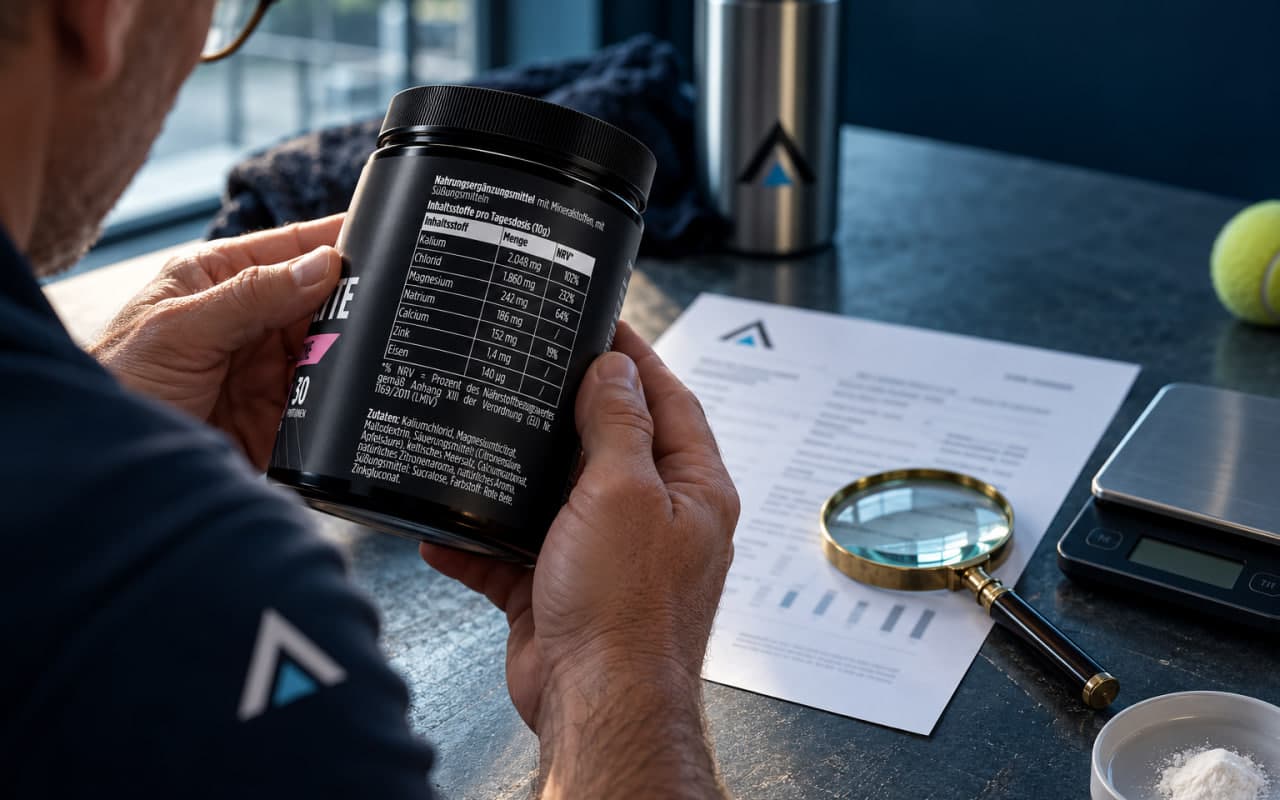
Every dietary supplement must state the amount of active substances per recommended daily dose, and for vitamins and minerals also as a percentage of the nutrient reference value (NRV). Three statements are also mandatory: that the recommended daily dose must not be exceeded, that the product is not a substitute for a balanced diet, and that it must be stored out of the reach of children.
The real work begins with the question of what exactly is stated.
Compound or pure active ingredient?
Minerals and many active substances are present in the product as a compound. What matters is the share of the pure substance.
Example magnesium: our Magnesium 4-fold Complex states "magnesium 200 mg (53.4% NRV)" on the label and breaks down how much comes from which compound – 160 mg from bisglycinate, 22.5 mg from citrate, 11.5 mg from malate, 6 mg from taurate. That's how it should be. If the label only says "500 mg magnesium bisglycinate", that is just around 70 mg of magnesium.
Example creatine: our creatine tablets declare "4,500 mg creatine monohydrate, of which creatine 3,960 mg". Monohydrate contains around 88 percent creatine. If you only read the monohydrate value, you overestimate the dose by a good ten percent. Werner has written up the full comparison of forms in Creatine: powder, tablets or gummies?.
Extract, standardisation, "equivalent to"
With botanicals it gets trickier. Two statements can mean very different amounts of active ingredient:
| Statement on the label | What it means | Example from our range |
|---|---|---|
| "300 mg extract, of which 30 mg withanolides" | Standardised extract, marker substance quantified | Ashwagandha capsules (10% withanolides) |
| "30 mg extract, equivalent to 300 mg root" | Extract with a 10:1 drug-extract ratio, no marker substance stated | Ashwagandha gummies |
| "600 mg turmeric powder, of which 33 mg curcumin" | Root powder, marker substance content stated | Turmeric + piperine |
| "315.8 mg extract, of which 300 mg curcuminoids" | Highly standardised extract | Turmeric 95% + piperine |
All four statements are correct – but the gummies deliver less than a tenth of the extract amount of the capsules, and the turmeric powder around a tenth of the curcuminoids in the extract. "Equivalent to X mg of plant" sounds big but says nothing about the active ingredient. With botanical products, always look for a standardised marker substance with a stated amount.
Proprietary blends
"Performance blend 2,000 mg" without individual amounts is a warning sign: you can't check whether the effective ingredients are present in relevant quantities. Reputable combination products list every component individually – our pre-workout booster, too, lists beta-alanine, creatine, arginine, tyrosine and caffeine individually per serving.
Step 3: Putting the dose into context – NRV, BfR and EFSA
Three references help to assess a dose. They are often confused:
- NRV (nutrient reference value): an EU labelling figure, roughly the daily requirement of an adult. "100% NRV" doesn't mean "optimal" but "as much as the reference amount".
- BfR maximum level proposal: Germany's Federal Institute for Risk Assessment proposes how much a food supplement should contain per daily dose at most, so that even people who get a lot from their diet and combine several products stay safe. The current version comes from statement 006/2024. These values are recommendations, not laws – there are no binding EU-wide maximum levels yet.
- EFSA upper limit (UL): the tolerable total intake per day from all sources, above which side effects become more likely.
Honestly assessed: our products and the BfR values
Because we expect transparency from others, here is the comparison for some nutrients for which we offer several products. The BfR values are taken from the overview by the German consumer advice centre.
| Nutrient | NRV | BfR proposal per day | Syrax products (per daily dose according to label) |
|---|---|---|---|
| Magnesium | 375 mg | 250 mg, split into at least 2 servings | 4-fold Complex 200 mg · 5x Complex 250 mg · Shots 400 mg |
| Vitamin D | 5 µg | 20 µg | D3+K2 drops 25 µg · 3,000 IU every 3 days and 4,000 IU every 4 days, each ⌀ 25 µg |
| Zinc | 10 mg | 6.5 mg | Magnesium-zinc gummies 10 mg · zinc bisglycinate 25 mg |
| Iron | 14 mg | 6 mg | Iron + vitamin C 14 mg · iron bisglycinate 25 mg |
| Iodine | 150 µg | 100 µg | Iodine tablets 150 µg |
| Potassium | 2,000 mg | 500 mg | Electrolyte tablets 300 mg · electrolyte powder 2,048 mg |
| Vitamin B6 | 1.4 mg | 0.9 mg | Magnesium 5x Complex 1.4 mg |
What follows from this? For me, three things:
First: many products – including some of ours – are above the BfR proposals. That is legal and can make sense where there is an established need, such as iron for a proven deficiency or zinc on medical advice. For long-term intake without a specific reason, the lower-dosed variants are the better choice. That's why our high-dose zinc and iron tablets carry the advice not to take any other zinc- or iron-containing products.
Second: the total counts. If you combine magnesium shots, an electrolyte drink and a multivitamin, you can quickly exceed sensible amounts. Add up all products before adding a new one.
Third: with vitamin D, the intervals are part of the dose. One capsule of 4,000 IU every four days averages 1,000 IU (25 µg) a day – not 4,000. How to dose vitamin D correctly is explained in my article on vitamin D.
Step 4: Understanding the lab report
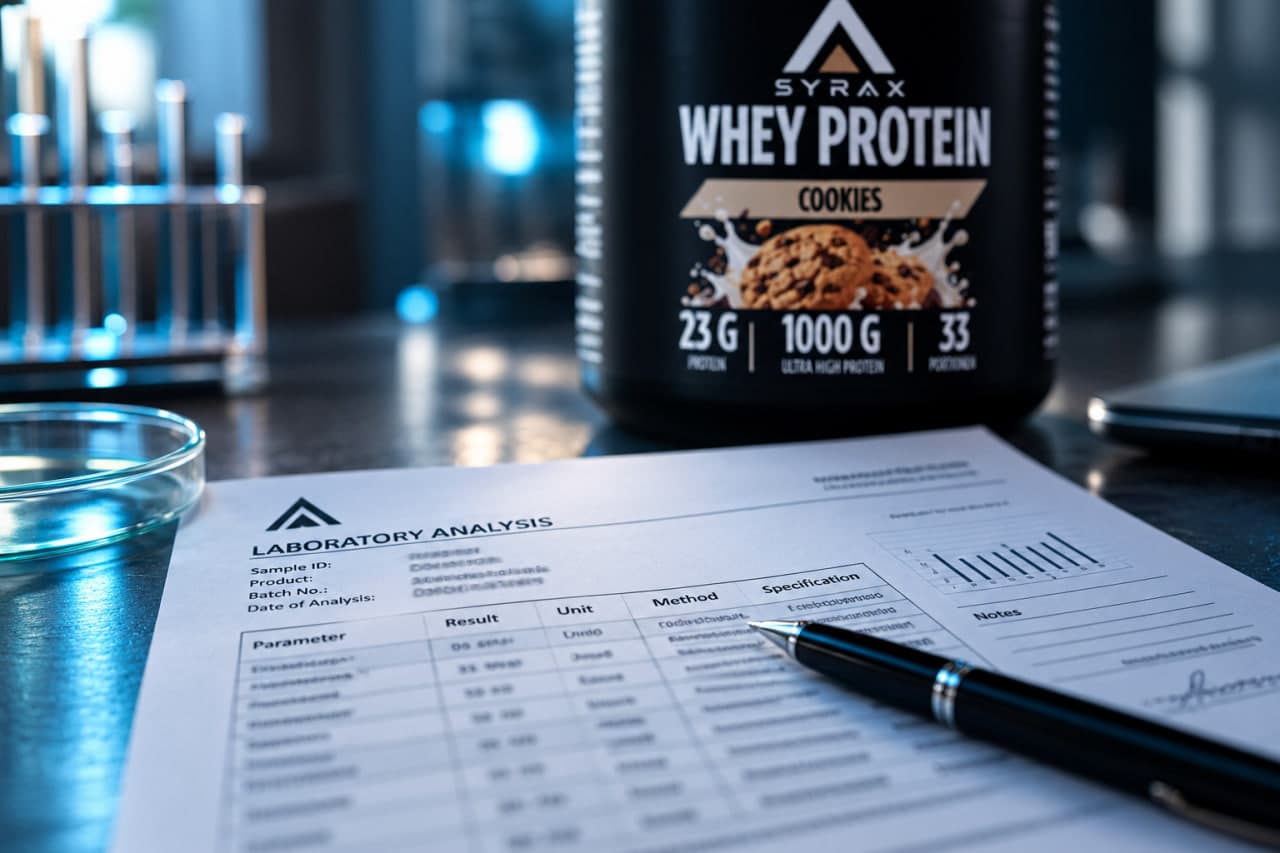
A lab report is the best quality feature a manufacturer can provide voluntarily – if you can read it. For many Syrax products you will find the reports directly on the product page, and we are adding the rest continuously. Most come from a testing laboratory in North Rhine-Westphalia and follow the same structure.
The header: who, when, which batch?
First check four details: testing laboratory, date, sample description and batch with best-before date. A report applies only to the batch tested. If the test date is long ago or the best-before date of the tested batch has long passed, it says little about the goods on the shelf. To be honest: we still have a few older reports too, such as an analysis from 2024 for the pre-workout booster. We are updating them.
Heavy metals: "less than" means "below the limit"
The typical line reads: lead < 3.0 mg/kg, arsenic < 1.0 mg/kg, cadmium < 0.5 mg/kg, mercury < 0.1 mg/kg. The "<" sign means "less than". The values are based on the EU contaminants regulation 2023/915, which sets maximum levels for food supplements – 3.0 mg/kg lead, 1.0 mg/kg cadmium and 0.10 mg/kg mercury.
What the statement means: the content is below these limits, for cadmium even below half the maximum level. What it doesn't mean: "free of heavy metals" or "0". A report with exact measured values would be even more informative – that's a lever the whole industry can still work on.
Microbiology: microbes in colony-forming units
| Line in the report | What is measured | How to read it |
|---|---|---|
| Aerobic mesophilic colony count | Total microbial count in CFU per gram | Low values such as "< 1,000 CFU/g" or "1,090 CFU/g" indicate hygienic production |
| Yeasts and moulds | Fungal load | "< 100 CFU/g" is unremarkable |
| Enterobacteriaceae | Gut bacteria as a hygiene indicator | "< 100 CFU/g" is unremarkable |
| Salmonella, E. coli | Pathogens | must be "negative" |
In all the Syrax reports I looked at for this article, the finding was "no objections".
Pesticides: important for botanical products
With botanical raw materials, pesticides are an additional risk. Our ashwagandha capsules, turmeric products and chaste tree were also tested for pesticide residues – the result in each case: no residues detectable. For plant extracts I wouldn't do without this line.
Active ingredient and purity: the gold standard
Most reports test purity and hygiene – not content. Only an active ingredient analysis shows whether the capsule contains what the label says. Such analyses are available for some Syrax products:
| Product | Declared | Measured | Ratio |
|---|---|---|---|
| Creatine tablets (6) | 3,960 mg creatine | 3,909 mg creatine | 98.7% |
| Creatine gummies apple (3) | 3 g creatine | 3.07 g creatine | 102% |
| Creatine monohydrate powder | 100% monohydrate | Purity 99.18% | – |
| Lion's mane gummies (2) | 200 mg mushroom extract | 56.4 mg polysaccharides, 8.0 mg beta-glucans | Content of marker substances |
Deviations of a few percent are normal and covered by tolerances. I would prefer exactly this kind of analysis for any product whose content is hard to control – gummies, capsules with plant extracts and anything with very small amounts of active ingredient.
Step 5: Price per effective daily dose
The tub price is the most misleading number on the shelf. Products only become comparable when you divide by the number of effective daily doses. Three examples from our range, shop prices as of October 2026:
| Product | Effective reference amount | Price |
|---|---|---|
| Creatine powder 1,000 g | per 3 g creatine | approx. €0.17 |
| Creatine tablets 180 | per 3 g creatine | approx. €0.50 |
| Magnesium 4-fold Complex | per 100 mg magnesium | approx. €0.14 |
| Magnesium gummies | per 100 mg magnesium | approx. €0.33 |
| Omega-3 18/12 | per 1 g EPA + DHA | approx. €0.75 |
| Omega-3 Max 35/25 | per 1 g EPA + DHA | approx. €0.39 |
The last example shows how misleading it can be: the two omega-3 products cost almost the same, but Max delivers twice as much EPA and DHA per daily dose. Per gram of fatty acid it is therefore only half as expensive. The details are in my article on omega-3.
Additives: what they reveal
Additives are approved and safe at the permitted levels. Still, it's worth looking at the ingredients list because it says a lot about the product and how well it is tolerated.
Fillers and anti-caking agents such as microcrystalline cellulose, dicalcium phosphate or magnesium stearate are technically necessary in tablets. A powder doesn't need them – our creatine doypack, collagen powder and MSM powder consist of 100 percent active ingredient.
Sugar alcohols such as maltitol, sorbitol and erythritol are found in almost all sugar-free gummies. They provide fewer calories than sugar but can have a laxative effect in larger amounts. The label must point this out.
Sweeteners such as sucralose, acesulfame-K or steviol glycosides are found in protein powders, shots and boosters. They are approved and save sugar; if you want to avoid them, choose unflavoured products.
Azo dyes such as E 124 (Ponceau 4R) and E 122 (azorubine) require the EU warning "may have an adverse effect on activity and attention in children". In our range this applies, for example, to the strawberry whey protein and some booster flavours. Unproblematic for adults, and such products aren't intended for children anyway – if you want to avoid colourings, choose vanilla, chocolate or the apple variant of the booster.
Preservatives such as potassium sorbate and sodium benzoate are common in liquid shots because water spoils. Capsules and powders don't need them.
Animal ingredients and allergens: softgels are often made of gelatine (in our case bovine gelatine, halal-compliant), glucosamine comes from crustaceans, collagen from cattle or fish, whey contains milk and, via the lecithin, soy. Vegan alternatives are labelled in the shop.
Advertising promises and permitted claims
For vitamins and minerals, the EU has published a list of authorised health claims, such as "magnesium contributes to normal muscle function" or "vitamin D contributes to the normal function of the immune system". For most botanicals there are no authorised claims – phrases such as "strengthens the immune system", "reduces stress" or "detoxifies the liver" have no place there.
So be sceptical of:
- "clinically tested", when the study refers to a single ingredient at a different dose,
- "high dose" as a promise of quality – higher isn't better, just higher,
- before-and-after pictures and discount codes as proof of effect,
- products that promise rapid muscle gains or hormone-like effects.
Seals, lists and doping safety
Quality seals complement lab reports but don't replace them:
| Seal / list | What is tested | What it doesn't mean |
|---|---|---|
| Cologne List | Analysis of selected batches for certain doping substances | No statement on efficacy or dosage |
| Informed Sport / Informed Choice | Regular doping analyses of batches | No efficacy testing |
| GMP, HACCP, ISO 22000 | Hygiene and manufacturing standards at the manufacturer | No testing of the individual product |
| Independent lab analysis | Purity, microbes, possibly content of a batch | Applies only to that batch |
Anyone subject to doping controls – including at official amateur competitions – should only use products whose specific batch is on such a list and should check this directly in the database before buying. For recreational athletes a listed product isn't a must, but it's a plus.
Storage: quality doesn't end at the checkout
Even a flawless product deteriorates if it is stored incorrectly. Fish oil oxidises with heat and light, vitamins degrade over time, powders absorb moisture. Store supplements in a cool, dry and dark place, close bags and tubs properly, and for shots note the instruction "use within two months of opening". If fish oil smells clearly rancid, throw it away.
The checklist for buying
Checking a dietary supplement in five steps
- 1
Vaihe 1
Clarify your need
Check whether you need the nutrient at all – based on your diet, your situation or a blood test. Without a need, any supplement is superfluous.
- 2
Vaihe 2
Read the active ingredient per daily dose
Find the table 'ingredients per daily dose' and note the amount of the pure active substance, e.g. elemental magnesium rather than magnesium citrate, or creatine rather than creatine monohydrate.
- 3
Vaihe 3
Put the dose into context
Compare the amount with the nutrient reference value (NRV) and the BfR's proposed maximum levels. Add up all the products you take.
- 4
Vaihe 4
Check the lab report
Look at the laboratory, date, batch and scope of testing. Heavy metal and microbiology results show purity; only an active ingredient analysis proves the content.
- 5
Vaihe 5
Calculate the price per effective dose
Divide the pack price by the number of effective daily doses – not by the number of capsules or servings.
What comes next: the Syrax Supplement Compass
This guide is the starting point of our supplement series. Every Monday Werner Ludmann writes from a club athlete's perspective, and every Wednesday I examine one nutrient in detail – always with label, lab report and price per effective dose:
- Creatine: powder, tablets or gummies? and the big creatine guide
- Whey or clear whey? and Whey protein
- Dosing magnesium correctly
- Electrolytes in sport
- Omega-3: EPA and DHA per capsule
- Creatine for endurance and racket sports
- Dosing vitamin D correctly
Conclusion: fewer tubs, more clarity
You don't recognise good supplements by their packaging but by three things: a clear statement of the active ingredient per daily dose, a dose that matches your needs, and a lab report that matches the batch. If you check these three points and then calculate the price per effective dose, you no longer need advertising promises – and you usually end up buying less, but better.
Sources: Verbraucherzentrale: Micronutrients – when is it too much? (BfR maximum level proposals, statement 006/2024, German) · Regulation (EU) 2023/915 on maximum levels for contaminants · EU Register of nutrition and health claims · Verbraucherzentrale: Magnesium – what to consider (German) · Labels, product specifications and lab reports of the Syrax products (as of October 2026)
Usein kysytyt kysymykset
Are dietary supplements tested before they are sold?
Not like medicines. They are classed as foods, must be notified to the authorities (in Germany, the Federal Office of Consumer Protection and Food Safety) and may only contain approved substances and authorised health claims. There is no official check of efficacy, content or purity before sale; the manufacturer is responsible.
What does '< 3.0 mg/kg lead' mean in a lab report?
The lead content was below 3.0 mg per kilogram. That is the EU maximum level for food supplements. The statement confirms that the limit was met – it does not mean there is no lead at all.
What is the difference between the NRV and a maximum level?
The NRV (nutrient reference value) is a reference amount for labelling, e.g. 375 mg of magnesium. The BfR's proposed maximum levels state how much a food supplement should deliver per day at most so that even high consumers stay safe – 250 mg for magnesium. The BfR values are recommendations, not legal limits.
How can I tell whether a product really contains what the label says?
Only from an active ingredient analysis by an accredited or recognised laboratory for the specific batch. Standard lab reports on heavy metals and microbes say nothing about the content of the active ingredient.
Are sweeteners and colourings in supplements a concern?
Approved additives are considered safe at the permitted levels. Some require warnings, however, such as the azo dyes E 124 and E 122 ('may have an adverse effect on activity and attention in children'), and sugar alcohols like maltitol have a laxative effect in larger amounts. If you are sensitive, choose neutral variants.
What is the price per effective serving?
The pack price divided by the number of daily doses that deliver the effective amount. This makes products comparable: for creatine, 3 g of creatine costs around €0.17 as Syrax powder, around €0.50 as tablets and around €1.00 as gummies.
Do recreational athletes need products from the Cologne List?
Recreational athletes who aren't drug-tested don't strictly need them, but a listing is an additional sign of quality. Anyone subject to testing should only use products whose specific batch has been tested for doping substances and is listed.
Avainsanat
- Supplements
- Quality
- Lab report
- Reading labels
- Upper limits
- Dietary supplements
Kirjoittajasta
Eduard Boehm· Kirjoittaja: ravitsemus, ravintoaineet ja ravintolisät
Eduard Boehm on perehtynyt vuosikymmenten ajan ravitsemukseen, ravintolisiin ja niiden vaikutuksiin elimistössä. Syrax-lehdessä hän yhdistää pitkän kokemuksensa ajankohtaiseen tietoon ravintolisistä, ravintoaineista ja tietoisesta syömisestä – tarkkana pakkausmerkintöjen, annostuksen ja tutkimusten suhteen.
Lisää EduardistaArtikkeli on yleistä tietoa eikä korvaa lääkärin neuvoja. Jos sinulla on sairauksia, kipuja tai epäilyksiä, keskustele lääkärin kanssa ennen kuin muutat treeniä tai ruokavaliota.
Syrax Magazine