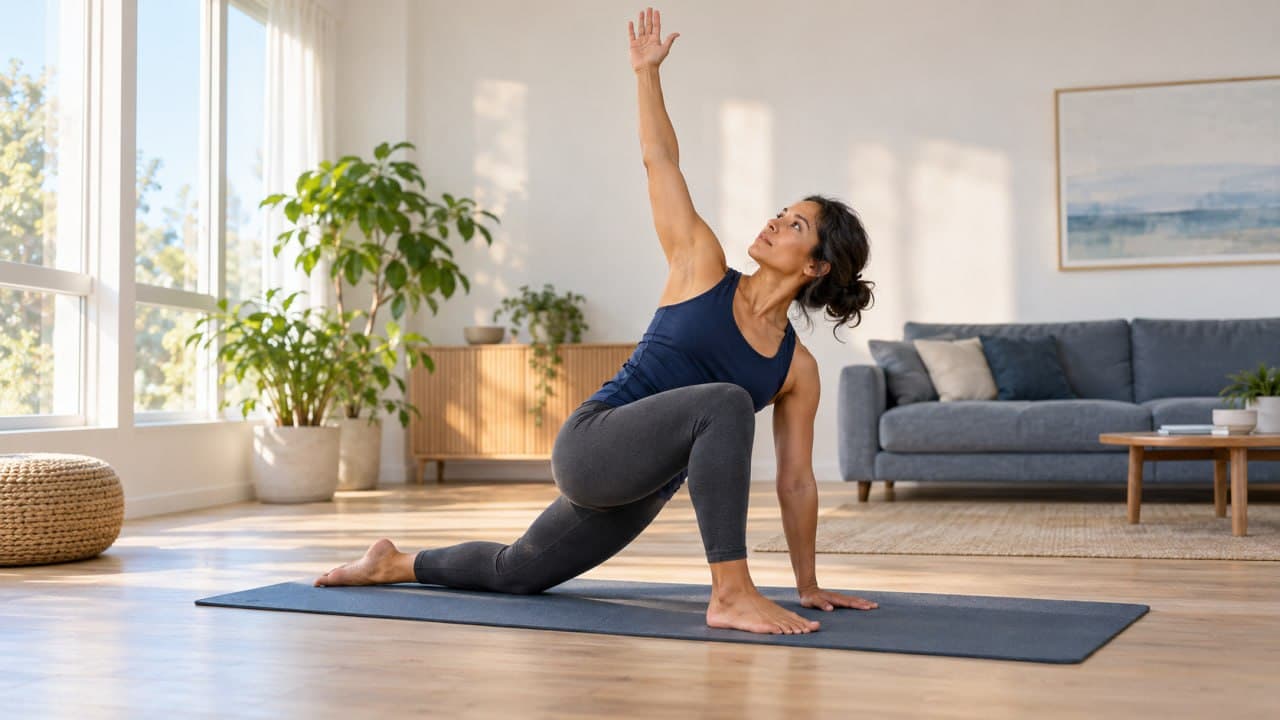
Running for Beginners: 5 Kilometres in 8 Weeks
From the sofa to five kilometres non-stop – without side stitches, knee pain or frustration. The complete beginner's plan with walk-run intervals, technique, shoes, heart rate guidance and the mistakes most beginners make.
 DiMichael Lohrberg
13 min di lettura

Questo articolo non è ancora disponibile in italiano. Viene mostrato in: English.
In breve
As a beginner runner, start with walk-run intervals on three non-consecutive days a week – for example 8 × 1 minute running and 2 minutes walking – and gradually lengthen the running phases over eight weeks until you can run 30 minutes or 5 kilometres non-stop. The pace is slow enough that you can still talk in full sentences. Increase your weekly volume by no more than about 10–15 per cent and allow at least one rest day between runs.
Indice
Running is the simplest sport in the world. Shoes on, door open, off you go. And yet countless beginners give up within the first few weeks. After five minutes their lungs burn, they get a stitch, their shins hurt, and after the third attempt their motivation is gone. The conclusion: "Running just isn't for me."
The problem is almost never the person – it is the approach. Most beginners run too fast, too much and too soon. They try to jog for 30 minutes non-stop on day one, at a pace their body simply cannot handle yet. This guide shows a better way: a structured 8-week plan that takes you step by step to five kilometres non-stop using walk-run intervals. Plus everything important about pace, technique, equipment and the most common mistakes. It belongs to our Endurance & Running topic.
Why running is worth it
Running is one of the most efficient ways to improve your endurance. Regular running strengthens the heart, lowers resting heart rate, improves blood lipids and insulin sensitivity and has been shown to lift your mood. For strength athletes it has another advantage: better endurance speeds up recovery between hard sets and increases overall work capacity.
Then there is the practical side: running needs no gym, no equipment and hardly any time. Three sessions of 30 minutes a week fit into any calendar – even on business trips.
The most important principle: run slowly
The biggest mistake beginner runners make is pace. If you come from strength training, you are used to pushing hard. In running, that is exactly wrong at the start. Your cardiovascular system adapts quickly; your tendons, ligaments and bones adapt slowly. Running too fast mainly overloads these passive structures – and that is exactly where typical beginner complaints in the shins, knees and Achilles tendon come from.
The rule of thumb: run slowly enough that you can still talk in full sentences. For many beginners that feels almost ridiculously slow – sometimes barely faster than brisk walking. That is exactly right. This easy pace roughly corresponds to what coaches call zone 2. Why it is so effective is explained in detail in the zone 2 guide.
Before you start: preparation
Health check
If you are over 40, have not done any sport for a long time, are significantly overweight or have pre-existing conditions such as high blood pressure or heart problems, get a medical check-up before you start. That is not a formality but common sense. Which examinations make sense is covered in Health check-ups.
Walking as a first step
If you have barely been active so far, you do not start with running but with walking. Can you manage 30 to 45 minutes of brisk walking without problems? Then you are ready for the plan. If not, spend two to four weeks doing three to four brisk walks a week, ideally including some uphill. That prepares your heart, muscles and joints.
The right shoes
A suitable running shoe is the only real investment. What matters is fit and feel, not brand or price. Look for a thumb's width of room in front of your longest toe, a stable heel and a ride you find comfortable. A specialist shop with a treadmill and advice is ideal. Detailed buying criteria are in Buying running shoes: what really matters.
The 8-week plan: from 0 to 5 kilometres
The plan is based on three sessions a week on non-consecutive days, for example Tuesday, Thursday and Sunday. Each session starts with five minutes of brisk walking and ends with five minutes of easy jogging or walking. The times given refer to the main part.
| Week | Main part (per session) | Total running time |
|---|---|---|
| 1 | 8 × (1 min run / 2 min walk) | 8 min |
| 2 | 6 × (2 min run / 2 min walk) | 12 min |
| 3 | 5 × (3 min run / 2 min walk) | 15 min |
| 4 | 4 × (5 min run / 2 min walk) | 20 min |
| 5 | 3 × (8 min run / 2 min walk) | 24 min |
| 6 | 2 × (12 min run / 2 min walk) | 24 min |
| 7 | 20 min run / 2 min walk / 5 min run | 25 min |
| 8 | 30 min continuous running (or 5 km) | 30 min |
Pure running time per session over 8 weeks
Running minutes excluding walk breaks, from the plan above. In weeks 5 and 6 the running time stays the same, but the blocks get longer – that's the real jump.
Mostra i dati in tabella
| Week | Running time per session |
|---|---|
| 1 | 8 min |
| 2 | 12 min |
| 3 | 15 min |
| 4 | 20 min |
| 5 | 24 min |
| 6 | 24 min |
| 7 | 25 min |
| 8 | 30 min |
At a very slow pace, 30 minutes of running does not necessarily equal five kilometres. That is not a problem: whether you run the five kilometres in 30, 35 or 40 minutes is secondary for health and fitness. What matters is that you can run them non-stop.
Your first running day
- 1
Passo 1
Walk briskly for 5 minutes
Start with five minutes of brisk walking to prepare your heart, muscles and joints for the effort.
- 2
Passo 2
Run slowly for 1 minute
Run slowly enough that you could still chat. Short steps, upright torso, relaxed shoulders.
- 3
Passo 3
Walk for 2 minutes
Switch to brisk walking and let your breathing settle. Do not stand still.
- 4
Passo 4
Repeat eight times
Repeat the cycle of one minute running and two minutes walking eight times in total.
- 5
Passo 5
Cool down for 5 minutes
Finish the session with five minutes of easy walking. Drink something and note how it felt.
The golden rule: repeating is allowed
The plan is a roadmap, not a law. If a week feels too hard, repeat it. If you slept badly or are ill on a given day, postpone the session. Someone who needs twelve weeks for the plan has won just as much as someone who does it in eight – just more sustainably.
What happens in your body over the 8 weeks
It helps to know what is changing beneath the surface – especially in the weeks when it does not feel any easier yet.
Weeks 1–2: your cardiovascular system responds fastest. Blood volume increases and the heart can pump slightly more blood per beat. The first sessions still feel hard because coordination and running economy are missing.
Weeks 3–5: your muscles build more mitochondria and capillaries and become more resistant to fatigue. Many beginners now notice that the walking breaks feel almost unnecessary. This is exactly where caution is needed: tendons, ligaments and bones still lag behind your fitness. This is the phase in which most overuse complaints arise.
Weeks 6–8: your running style becomes more economical, your heart rate at the same pace drops and recovery after sessions is faster. The passive structures have adapted enough that 30 minutes non-stop becomes possible.
These different speeds of adaptation are why the plan deliberately progresses more slowly than many beginners would think they could handle. Your heart would be ready sooner – your Achilles tendon would not.
Treadmill or outdoors?
Both work. The treadmill has some advantages for beginners: you can set speed and incline precisely, the surface is even and cushioned, and the weather does not matter. Many beginners find it easier to hold a truly slow pace on the treadmill. An incline of one to two per cent roughly compensates for the missing air resistance.
Outdoors, running is more varied, the terrain trains your foot muscles and coordination, and fresh air lifts many people's mood. Soft surfaces such as forest paths are easier on the joints than tarmac but require a little more attention to roots and stones.
Our recommendation: if the weather allows, run outside. If the treadmill helps you run regularly, it is the better choice. Regularity beats any surface.
Running when you are overweight
The same principles apply to heavier people – with a little more patience. Every running stride loads the knees, hips and ankles with a multiple of your body weight. The higher your weight, the more important it is to get used to it slowly.
A proven route: start with four to six weeks of brisk walking, ideally uphill or on a treadmill with an incline – an excellent endurance workout with low impact. Add cycling or rowing to build endurance in a joint-friendly way. Then begin the 8-week plan, but expect to repeat individual weeks. And combine running with strength training for the legs and hips, which stabilises the joints. How incline walking works is covered in Stair climbing and incline walking; how to lose weight at the same time without losing muscle is explained in Lose fat, keep muscle.
Running technique for beginners
The perfect running technique is hotly debated. For beginners, a few simple basic rules are enough:
- Short, quick steps instead of big bounds. A higher cadence reduces the load on your knees and hips. Many beginners take strides that are too long and land on their heel far in front of their body.
- Upright torso, leaning slightly forward from the ankles, not from the hips.
- Relaxed shoulders and arms. Your arms swing loosely forwards and backwards, not across your body. Your hands are relaxed, not clenched into fists.
- Look ahead, at the ground about 10 to 20 metres in front of you.
- Your foot lands under your body, not far in front of it. Whether your heel, midfoot or forefoot touches the ground first is secondary for beginners – what matters more is that you do not "brake" with a straight leg in front of your body.
If you want to go deeper, you will find exercises and drills in Improving your running technique.
Breathing and side stitches
"How should I breathe?" is one of the most common beginner questions. The best answer: naturally and deep into your belly. Breathing through your mouth and nose at the same time is perfectly fine. If you have to breathe so fast that you can no longer talk, you are going too fast.
Side stitches are common in beginners. The exact cause has not been conclusively established, but some factors clearly increase the risk: too high a pace, a large meal shortly before running, drinking a lot at once and shallow chest breathing. If you get a stitch: walk briefly, breathe out deeply and press lightly on the spot with your fingers. More solutions are in Side stitches when running: causes and solutions.
Controlling heart rate and pace
A fitness tracker or heart rate watch can help you find the right pace. As a rough guide, a heart rate of about 60 to 75 per cent of your maximum heart rate applies to easy runs. In beginners, however, heart rate rises quickly even when jogging slowly. That is normal and improves week by week. If your heart rate stays significantly higher, add more walking breaks.
More important than any number at the start is the talk test: can you say a whole sentence without gasping for air? Then the pace is right. How to calculate your individual heart rate zones is explained in Calculating and using heart rate zones. And if you run without a GPS watch, Running without a GPS watch shows ways to keep an eye on heart rate and load anyway.
| Measure | Target range for easy runs | Note |
|---|---|---|
| Talk test | full sentences possible | most important guide for beginners |
| Heart rate | approx. 60–75 % HRmax | varies greatly between individuals |
| Effort (1–10) | 3–4 | "comfortably hard" |
The most common beginner mistakes
1. Too fast
By far the most common mistake. Almost every beginner runs faster than they should. The result: side stitches, exhaustion, frustration and overuse.
2. Too much too soon
If you run every day in week one out of enthusiasm, you will be on the sofa with shin pain by week three. Tendons and bones need weeks to months to adapt. As a rule of thumb: increase your weekly volume by no more than 10 to 15 per cent.
3. No rest days
At the start there should be at least one day off between two runs. Rest days are not lost time but the phase in which your body adapts.
4. The wrong shoes
Old casual trainers or football boots are not running shoes. A suitable shoe does not cost the earth and prevents many complaints.
5. Ignoring pain
Muscle soreness is normal. Sharp, pulling or increasing pain in the joints, shins or Achilles tendons is a signal to rest. If you run through it, you turn a small irritation into a long-lasting injury. More on typical complaints in Knee pain when running.
6. Only running
Muscular endurance in the legs, hips and trunk protects against injury. Two short strength sessions a week with squats, lunges, calf raises and core exercises make you a more robust runner. We explain the squat step by step in How to squat properly.
7. Comparisons
Your colleague runs five kilometres in 25 minutes? Good for them. Your benchmark is yourself from last week.
Combining running and strength training
Many people who start running already train in the gym. The good news: the two combine very well if you follow a few rules.
- Easy running after strength training or on separate days.
- Do not run right before heavy leg exercises – it costs strength in squats and deadlifts.
- Keep an eye on your total load. When you start running, reduce your leg training slightly for the first few weeks.
A possible week for a strength athlete starting the plan:
| Day | Training |
|---|---|
| Monday | Strength training full body |
| Tuesday | Run (plan) |
| Wednesday | Strength training full body |
| Thursday | Run (plan) |
| Friday | Strength training full body |
| Saturday | Rest or a walk |
| Sunday | Run (plan) |
If you want to know more about the interactions, read Running and muscle growth: can you do both?.
Warming up and stretching: what beginners need
Five minutes of brisk walking before the first running interval is the most important warm-up for beginners. If you like, add a few dynamic exercises: leg swings forwards and backwards, easy lunges, ankle circles and a few skips. Static stretching before running is not necessary and offers no proven protection against injury. You can stretch after running if it feels good – but what really prevents injury is gradual progression and strengthening. A compact routine for the hips and ankles is in Mobility for runners.
Food and drink
For runs of up to about 45 minutes you do not need any special sports nutrition. Have your last larger meal two to three hours beforehand, drink enough throughout the day and take a small bottle of water when it is hot. Gels, bars and electrolyte drinks only become interesting for longer runs. How much you should drink over the day is covered in Hydration: how much should you drink?.
Running in any weather
Rain, cold, heat – there is always an excuse. With the right clothing, running is possible in almost any weather. In winter, layering is the rule: several thin layers rather than one thick jacket, and it is fine to feel slightly cool at the start because you will warm up after a few minutes. In great heat, run early in the morning or late in the evening, slower than usual and with water. Detailed tips in Running in winter.
After the 8 weeks: what next?
You have done it: 30 minutes or five kilometres non-stop. Congratulations – you are now a runner. For the next steps you have several options:
- Consolidate: run 30 minutes easy three times a week for four to six weeks. That makes the new ability stable.
- Increase volume: gradually extend one of your three weekly runs to 45 to 60 minutes.
- Add speed: after a few weeks, add a session with short intervals. How that works is explained in Interval training for runners.
- Set a goal: a 5K fun run or the step up to 10 kilometres. The right plan is in 10 km in under 50 minutes.
Motivation: how to stick with it
The first weeks are the hardest. A few tricks help:
- Fixed appointments in your calendar – like a business meeting.
- Lay out your running kit the evening before. Every little hurdle counts.
- Run with a partner or join a running group.
- Track your progress. Every session you tick off is a small win.
- The two-day rule: never skip two planned runs in a row.
More strategies for lasting habits are in Stick with it instead of starting over.
Conclusion: arriving slowly is faster
Learning to run is not a sprint. If you start slowly, run regularly, take your rest days and increase your volume carefully, you will reach five kilometres in eight to twelve weeks – and stay healthy along the way. If you start too fast, you usually end up back on the sofa after a few weeks.
Stick to the plan, run slower than you think and be patient with your body. In two months you will wonder why you did not start much earlier. And if you want to understand why the easy pace is so effective, read our guide to zone 2 training next.
Domande frequenti
How fast should I run as a beginner?
Slowly enough that you can still talk in full sentences while running. For most beginners that means a pace that feels almost too slow. Running too fast is the most common reason for side stitches, frustration and overuse problems.
How often per week should I run as a beginner?
Three sessions a week on non-consecutive days are ideal. That gives the body enough stimulus and at the same time enough time to get used to the new load – especially tendons, ligaments and bones.
What helps against side stitches when running?
Run more slowly, breathe deep into your belly and have your last larger meal two to three hours before running. If a stitch occurs, it helps to walk briefly, breathe out deeply and press lightly on the painful spot.
Do I need special running shoes?
Yes, a suitable running shoe is worth it. What matters is a good fit, enough room for your toes and a comfortable feel. Expensive specialist models are not necessary for beginners. Ideally get advice in a specialist shop and try several models.
Is running bad for your knees?
Not for healthy people. Studies show that recreational runners do not have an increased risk of osteoarthritis. Problems usually come from increasing volume too quickly. If you have pre-existing conditions or are significantly overweight, start with walking and joint-friendly alternatives.
Can I start running if I am overweight?
Yes, but with patience. Start with brisk walking and uphill walking until you can manage 45 minutes without problems, then begin with very short running intervals. Cycling and rowing are joint-friendly additional options. If you have pre-existing conditions, medical advice makes sense.
Tag
- Running
- Running for beginners
- 5K
- Training plan
- Endurance
- Jogging
Sull'autore
Michael Lohrberg· Fondatore di Syrax
Michael Lohrberg ha fondato Syrax nel 2026. Servizio militare con missione all'estero, nell'industria dal 2010, lavoro a turni e due lavori in parallelo – il LEEK Pulse Pro è nato dalla domanda su quanto recupero resti davvero nella vita quotidiana. Nel magazine scrive di allenamento, sonno e rigenerazione – in modo pratico e fondato sulla ricerca.
Scopri di più su MichaelQuesto articolo ha scopo informativo generale e non sostituisce il parere medico. In caso di patologie, dolori o dubbi, parla con il tuo medico prima di modificare allenamento o alimentazione.
Syrax Magazine