
Pre-Workout Boosters Label-Checked: Caffeine, Beta-Alanine, Timing – and When to Skip Them
What is in a pre-workout booster, how much of it actually works, and when does it do more harm than good? Werner Ludmann checks caffeine, beta-alanine, creatine and arginine per serving, explains timing for evening training and the new German BfR recommendation on beta-alanine, and gives an honest assessment of the Syrax booster.
 著者:Werner Ludmann
読了時間 10 分
この記事はまだ日本語に翻訳されていません。Englishで表示しています。
要約
A pre-workout booster works mainly through caffeine: studies show performance benefits from about 3 mg per kilogram of body weight, taken 30 to 60 minutes before training. Beta-alanine, by contrast, does not work acutely but only over weeks, and since August 2026 the German Federal Institute for Risk Assessment (BfR) recommends single doses below 400 mg and no more than 1.2 g per day – many boosters are well above that. According to current research, arginine and tyrosine do little for trained people. The Syrax booster provides 190 mg caffeine, 1.6 g beta-alanine and 1.5 g creatine per serving (6.5 g) for about €0.41 – useful for hard sessions in the morning or afternoon, with half a serving for beginners. If you train in the evening, stop caffeine at least six hours before bed or skip the booster.
目次
There are evenings when your head has had enough after a long day at work, but the session is in the plan. That is exactly the moment pre-workout boosters are sold for: one scoop of powder, one shaker, and 30 minutes later the weight feels lighter. But how much of that is chemistry, how much is marketing – and what does the booster cost you in sleep?
In this article I take a booster apart ingredient by ingredient, convert the amounts to your body weight, explain the new recommendation from the German Federal Institute for Risk Assessment (BfR) on beta-alanine and give an honest assessment of our own Syrax booster. For me, it comes down to one simple question: does it help me train better on a particular day without paying for it the following night?
What a pre-workout booster is
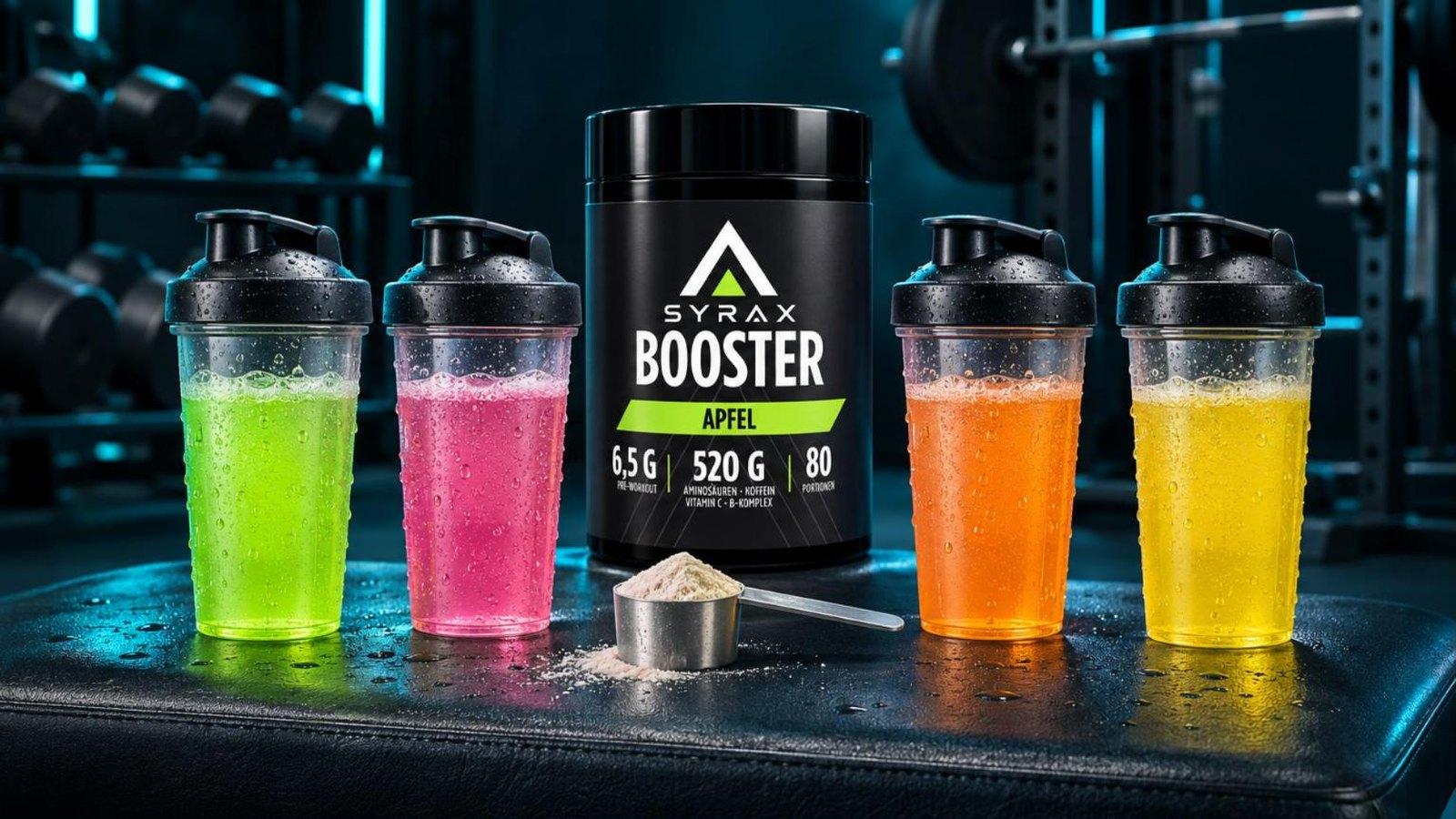
A pre-workout booster is a powder blend you drink 30 to 60 minutes before training. Almost every product is built on the same framework:
- Caffeine as the main active ingredient against tiredness and for readiness to perform
- Beta-alanine for efforts lasting one to four minutes
- Creatine for short, intense efforts
- Arginine or citrulline for the so-called pump
- Tyrosine, taurine or B vitamins as extras
- Sweeteners, flavourings and often colourings
Whether a booster works depends on two questions: how much is in each serving, and does the ingredient work acutely at all – that is, on the same day? That is exactly where many products fail.
Ingredient by ingredient: what works and in what amount
| Ingredient | Typical amount in studies | Works acutely? | Evidence |
|---|---|---|---|
| Caffeine | 3–6 mg per kg body weight | yes, after 30–60 minutes | well supported for endurance, sprints, strength endurance |
| Beta-alanine | 3.2–6.4 g per day for 4+ weeks | no, only over weeks | benefits for efforts of 1–4 minutes; safety questions |
| Creatine | 3–5 g daily | no, over days to weeks | very well supported; EU claim from 3 g daily |
| L-arginine | 6–8 g | hardly | usually no effect in trained people |
| L-citrulline | 6–8 g (citrulline malate) | partly | mixed results |
| L-tyrosine | 150 mg per kg | partly | mainly discussed for heat or sleep deprivation |
The table shows the core problem: the only ingredient that reliably works on the same day is caffeine. Everything else either only works after weeks of regular intake or is barely supported in trained people.
Caffeine: the real engine
The position stand of the International Society of Sports Nutrition (ISSN) sums up the evidence like this: 3 to 6 mg of caffeine per kilogram of body weight, about 60 minutes before exercise, improves performance in many sports – especially endurance, repeated sprints and strength endurance. Perceived exertion also drops, so the session feels easier.
Work it out for yourself:
| Body weight | 3 mg/kg (lower effective dose) | 6 mg/kg (upper study dose) |
|---|---|---|
| 60 kg | 180 mg | 360 mg |
| 75 kg | 225 mg | 450 mg |
| 90 kg | 270 mg | 540 mg |
Important: the upper study dose is above what the European Food Safety Authority (EFSA) considers safe for healthy adults – 200 mg as a single dose and 400 mg per day, all sources combined. In everyday life that means more than one serving of booster plus your morning coffee quickly adds up to too much. How caffeine works in training and how to find your personal amount is covered in detail in Caffeine in sport.
Beta-alanine: works, but not today
Over weeks, beta-alanine raises the carnosine content of your muscles, which buffers acid. According to the ISSN position stand this takes 4 to 6 g daily for at least two to four weeks; the efforts that benefit most last one to four minutes – an 800-metre run, a long block of rallies or a rowing piece. The single serving before training does nothing except tingle.
Since August 2026 there has also been a new safety assessment: the BfR (opinion 046/2026) recommends single doses below 400 mg and no more than 1.2 g of beta-alanine per day for healthy adults, and only for a few weeks. The main reason is skin tingling (paraesthesia), which becomes noticeable from about 700 mg, plus missing long-term data. Children, teenagers, pregnant and breastfeeding women and people aged 65 and over should not take beta-alanine.
Creatine in a booster: nice, but too little
Creatine is the best-researched sports supplement there is. The EU allows the claim that creatine increases physical performance in successive bursts of short-term, high-intensity exercise – but only from a daily intake of 3 g. A booster you take two or three times a week never reaches that. Creatine therefore belongs in your daily routine as a separate product; I worked out which form is cheapest in Creatine: powder, tablets or gummies?
Arginine, citrulline, tyrosine: the pump is not a performance gain
Arginine is largely broken down in the gut and liver before it reaches the blood. Studies in trained people usually show no performance benefit. Citrulline does somewhat better but needs 6 to 8 g, which hardly any booster contains. Tyrosine is discussed for exercise in the heat or with sleep deprivation; for normal strength training the benefit is unclear. The visible "pump" feels good – it does not make you measurably stronger.
Timing: when the booster works and when it hurts you
Caffeine peaks in the blood after 30 to 60 minutes. In healthy adults its half-life is roughly three to seven hours – depending on genetics, smoking, hormones and medication. So after five hours, half of it is often still in your system.
For evening athletes that is the crucial point. In a sleep study (Drake et al., 2013), 400 mg of caffeine even six hours before bedtime cut sleep by more than an hour. A booster at 7 pm before tennis practice means a large part of it is still active at 11 pm.
| Training starts | Take booster | Bedtime at the earliest | My recommendation |
|---|---|---|---|
| 7:00 am | 6:15 am | – | ideal, caffeine is gone by the evening |
| 12:00 pm | 11:15 am | – | good |
| 5:00 pm | 4:15 pm | approx. 10:30 pm | half a serving, no afternoon coffee |
| 7:00 pm | 6:15 pm | after midnight | better skip it |
| 8:30 pm | 7:45 pm | very late | skip it |
If you train in the evening, better sleep usually gains you more than a booster. How to wind down well after evening training anyway is what I explain in Sleeping after an evening match.
The Syrax Pre-Workout Booster label-checked
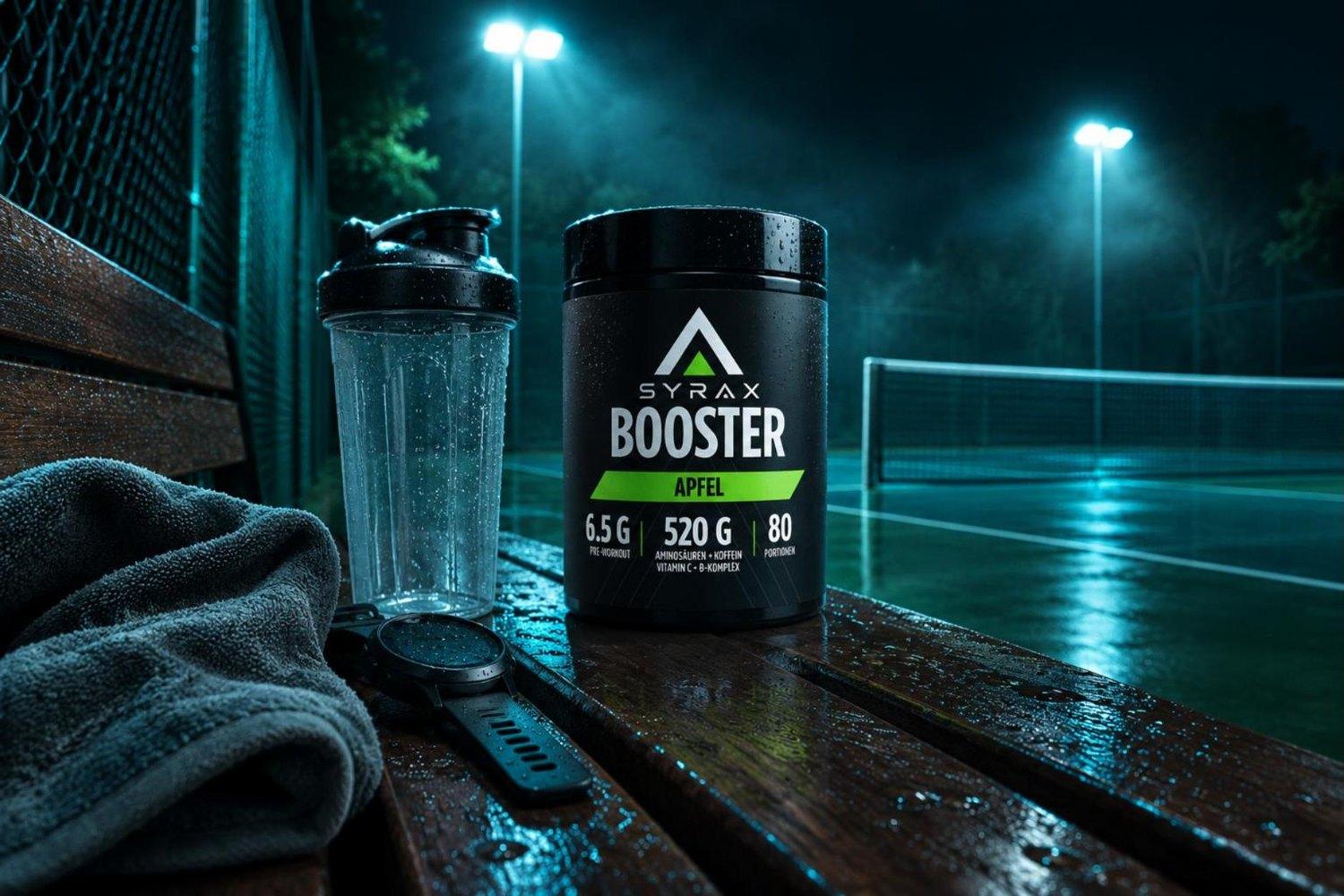
We sell one booster in four flavours with an identical formula. All values come from the label, prices from the shop (regular price, as of November 2026).
| Per serving (6.5 g) | Amount | Assessment |
|---|---|---|
| Caffeine | 190 mg | just under the EFSA single dose of 200 mg; equals 2.5 mg/kg at 75 kg |
| Beta-alanine | 1,600 mg | above the BfR recommendation (single dose below 400 mg, max. 1.2 g per day) |
| Creatine monohydrate | 1,500 mg | half the daily amount, does not replace daily creatine |
| L-arginine HCl | 1,000 mg | below study doses, little effect to be expected |
| L-tyrosine | 200 mg | small amount |
| Vitamin C | 45.5 mg | plus B vitamins |
| Servings per tub (520 g) | 80 | |
| Price per serving | approx. €0.41 (apple, raspberry, tutti frutti) · approx. €0.37 (orange) | regular price €32.90 or €29.99 |
| Colourings | apple without azo dyes; raspberry, orange, tutti frutti with E 124 and E 122 | warning: "May have an adverse effect on activity and attention in children" |
| Sugar | no added sugar | sweetened with sweeteners |
Caffeine per serving compared
Caffeine content of typical drinks according to EFSA and manufacturer information compared with one serving of Syrax booster (6.5 g). EFSA considers 200 mg as a single dose safe for healthy adults.
- Espresso (60 ml)approx. 80 mg
- Filter coffee (200 ml)approx. 90 mg
- Energy drink (250 ml)approx. 80 mg
- Syrax booster (1 serving)190 mg
- EFSA single dose200 mg
データを表で表示
| カテゴリー | Caffeine |
|---|---|
| Espresso (60 ml) | approx. 80 mg |
| Filter coffee (200 ml) | approx. 90 mg |
| Energy drink (250 ml) | approx. 80 mg |
| Syrax booster (1 serving) | 190 mg |
| EFSA single dose | 200 mg |
My honest assessment
The booster is strong on caffeine: 190 mg is a clear, effective dose that falls within the study range at 60 to 75 kg body weight and stays below the EFSA single dose. At about €0.41 per serving it costs hardly more than a coffee on the go – with the difference that you know the exact dose.
It is weak where almost all boosters are weak: at 1.6 g per serving the beta-alanine is four times the new BfR single dose, does not work on training day and mainly causes the tingling. Creatine and arginine are underdosed to do anything on their own.
My practical approach to the Syrax booster:
- Beginners and anyone under 65 kg: start with half a serving (approx. 3.3 g). That is 95 mg caffeine and 800 mg beta-alanine – much less tingling.
- No more than two to three hard sessions per week, not daily. That keeps the caffeine effect intact and the beta-alanine within limits.
- No coffee, tea or energy drinks in the same window.
- Creatine separately at 3 g daily if you want the creatine effect.
- If you want to avoid azo dyes, choose the apple flavour.
Booster or just coffee?
If all you want is the caffeine effect, coffee does the job too. Two cups of filter coffee provide roughly the same amount but vary between 60 and 150 mg per cup depending on beans and brewing. The booster has the advantage of a precise dose and fits into your water bottle. Coffee has the advantage of coming without beta-alanine and sweeteners.
| Pre-workout booster | Coffee | Nothing at all | |
|---|---|---|---|
| Caffeine precisely dosed | yes | no | – |
| Cost per session | approx. €0.40 | approx. €0.20–3.00 | €0 |
| Other actives | beta-alanine, creatine, arginine | antioxidants | – |
| For evening training | unfavourable | unfavourable | ideal |
| Best for | hard sessions during the day, competition | morning training | easy sessions, evening training |
Who should be careful
- Children, teenagers, pregnant and breastfeeding women: no booster. That applies doubly because of the new BfR recommendation on beta-alanine.
- People aged 65 and over: no beta-alanine according to the BfR; caffeine only after consulting a doctor.
- High blood pressure, heart rhythm disorders, cardiovascular disease: only after medical advice.
- Medication: some antibiotics, the contraceptive pill and certain antidepressants slow down caffeine breakdown considerably.
- Anxiety, restlessness, sleep problems: caffeine makes them worse. Less is more here.
- Doping controls: if you compete in tested sport, look for tested products. Eduard explains general quality criteria in Evaluating supplements.
Common mistakes
- A booster before every session. After two or three weeks of daily use you hardly feel anything any more – but your sleep does.
- Booster plus coffee plus energy drink. You quickly end up above 400 mg of caffeine per day.
- A double serving because the first did not work. Usually that is down to poor sleep the night before, not the dose.
- Mistaking the tingling for the effect. It is a side effect of beta-alanine, not a sign of more performance.
- Thinking the creatine in the booster is enough. 1.5 g twice a week does not replace 3 g daily.
- Booster at 7 pm, bed at 11 pm. You pay the bill the next day.
Conclusion: a tool for particular days
A pre-workout booster is not a staple of training but a tool for particular days: the heavy leg session on Saturday morning, the practice match in the afternoon, the session after a short night. The part that works is the caffeine – and it works best when you don't take it every day and don't sacrifice your sleep for it.
If you want to improve long-term performance, daily creatine, enough protein and good sleep will get you much further than any booster. How to add creatine most cheaply is in Creatine: powder, tablets or gummies?, and the fundamentals are in the creatine guide.
Sources: Guest et al.: ISSN Position Stand – Caffeine and Exercise Performance (2021) · EFSA: Scientific Opinion on the Safety of Caffeine (2015) · BfR: Beta-alanine in food supplements and fortified foods (opinion 046/2026, German) · Trexler et al.: ISSN Position Stand – Beta-Alanine (2015) · Drake et al.: Caffeine Effects on Sleep Taken 0, 3, or 6 Hours before Going to Bed (2013) · Kreider et al.: ISSN Position Stand – Creatine (2017) · Syrax product labels (as of November 2026)
よくある質問
What does a pre-workout booster really do?
The most effective ingredient is caffeine. From about 3 mg per kilogram of body weight, 30 to 60 minutes before training, studies show better endurance, slightly more strength and lower perceived exertion. Beta-alanine only works after several weeks of regular intake; according to current research, arginine and tyrosine do little for trained people.
How much caffeine in a pre-workout booster is safe?
EFSA considers single doses of up to 200 mg and up to 400 mg of caffeine per day safe for healthy adults – coffee, tea, cola and energy drinks all count. Pregnant and breastfeeding women should have no more than 200 mg per day; children and teenagers should not use boosters.
When should I take a booster before training?
About 30 to 60 minutes beforehand, when caffeine levels in the blood peak. If you train in the evening, leave at least six hours between the booster and bedtime, otherwise the time it takes to fall asleep and your deep sleep suffer.
Why does my skin tingle after a booster?
The tingling is called paraesthesia and comes from beta-alanine. It is harmless and usually disappears after 30 to 60 minutes. Since 2026 the BfR has recommended single doses below 400 mg because the tingling then hardly occurs; half a serving reduces it noticeably.
Does the creatine in a booster replace taking creatine separately?
No. The EU performance claim for creatine applies from 3 g per day, every day – including rest days. A booster with 1.5 g creatine per serving covers only half of that and is not taken daily.
Can you take a pre-workout booster every day?
Better not. Your body gets used to caffeine, the effect fades, and 1.6 g of beta-alanine every day is above the daily amount the BfR recommends for supplements. A booster makes sense for two to three hard sessions per week.
Who should not take a pre-workout booster?
Children, teenagers, pregnant and breastfeeding women, people over 65, and anyone with high blood pressure, heart rhythm disorders or other cardiovascular diseases without medical advice. If you are sensitive to caffeine or have sleep problems, you are better off without one.
タグ
- Pre-workout
- Booster
- Caffeine
- Beta-alanine
- Supplements
- Training
著者について
Werner Ludmann· トレーニング・クラブスポーツ・サプリメント実践担当ライター
ヴェルナー・ルートマンは情熱的なテニスプレーヤーで、長年クラブスポーツで活動しています。ランニングでもスポーツのバランスをとっています。Syraxマガジンでは、運動やフィットネス、アクティブなライフスタイルへの経験と情熱を、実践者の視点から伝えています――サプリメントは実際のトレーニングで何をもたらすのか?
ヴェルナーについてこの記事は一般的な情報提供を目的としており、医師の助言に代わるものではありません。持病や痛み、不安がある場合は、トレーニングや食事を変える前に医師に相談してください。
Syrax マガジン
次に読む
サプリメント
Creatine: Powder, Tablets or Gummies? An Honest Comparison with Lab Results
Creatine powder, creatine tablets or creatine gummies: Werner Ludmann compares the three forms by active ingredient per serving, cost per 3 g of creatine, additives, everyday practicality and lab results – with label evidence for every Syrax product.
読了時間 10 分English
 完全ガイド
サプリメント
How to Assess Supplements: Reading the Label, Dose, Upper Limits and Lab Report
How good is a dietary supplement really? Eduard Boehm shows step by step how to read labels, check the dose against reference values and BfR maximum levels, understand lab reports, assess additives and calculate the price per effective serving – explained using real labels and analyses of Syrax products.
読了時間 14 分English

サプリメント
Creatine for Women: Dosage, Effects and the Worry About Water Retention – What's Really True
Does creatine make sense for women? Werner Ludmann explains what studies with women show, why 3 g a day is enough, what the water and weight issue is about, how it relates to the cycle, menopause and pregnancy – and which form of creatine fits everyday life.
読了時間 6 分English