
Calisthenics for Beginners: Getting Started with Bodyweight Training
Calisthenics from zero: the basic exercises, progressions from the easiest to the hardest variation, a three-day beginner plan, the right equipment and how to get stronger without weights.
 OlehMichael Lohrberg
5 min bacaan
Artikel ini belum tersedia dalam Bahasa Melayu. Ia dipaparkan dalam: English.
Ringkasnya
Calisthenics is strength training with your own body weight. Beginners start with six basic movements – push-up, pull-up or row, dip, squat, lunge and core exercises – and choose a variation for each that allows 5 to 12 clean reps. Progress comes through progressions: once you manage 3 × 12, switch to the harder variation. Three full-body sessions a week with 2–3 sets per exercise are enough for significant strength gains in the first months.
Kandungan
Calisthenics has an image problem: when people think of the scene, they picture athletes floating horizontally from bars or doing handstand push-ups. That puts beginners off. Yet at its core, calisthenics is simply strength training with your own body weight – and with push-ups, pull-ups and squats, it is as old as training itself.
The beauty of it: you need hardly any equipment, can train anywhere and learn to control your body. This guide shows you how to start from zero. It belongs to the Home Workouts & Calisthenics topic. A complete plan with no equipment at all is the home workout without equipment.
The principle: progressions instead of weight plates
In the gym, you make an exercise harder by adding weight. In calisthenics, you change the leverage: the further your centre of gravity is from the pivot point, the harder the exercise. A push-up on your knees is easier than one on your feet, and one with your feet on a bench is harder still.
Every basic exercise has a progression ladder – a series of variations from easy to hard. Your goal is to climb it step by step.
The six basic exercises and their progressions
1. Push-up (horizontal push)
| Level | Variation |
|---|---|
| 1 | wall push-up |
| 2 | push-up on a table edge or bench |
| 3 | knee push-up |
| 4 | push-up |
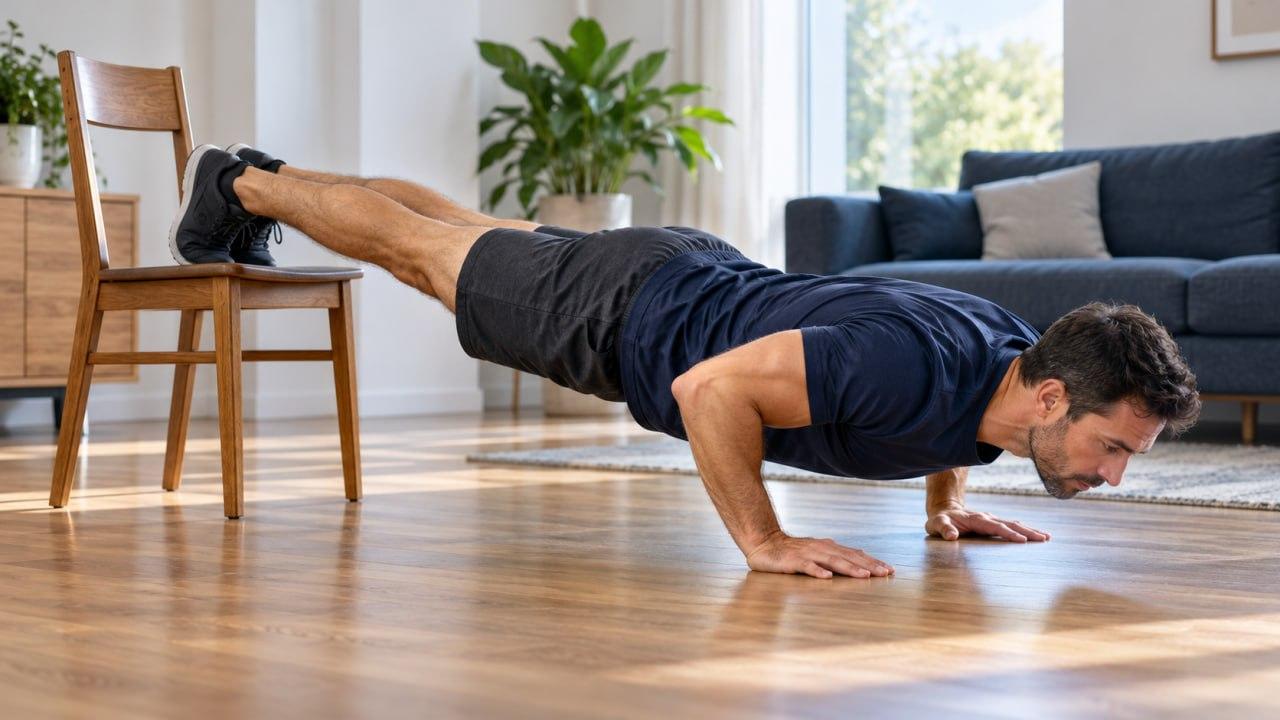
| 5 | feet-elevated push-up |
| 6 | archer push-up (weight shifted onto one arm) |
How much body weight you move in push-up variations
Measured load on the hands. This lets you control progression without weights in small steps.
- Hands elevated, approx. 60 cm41%
- Knee push-up49%
- Hands elevated, approx. 30 cm55%
- Push-up64%
- Feet elevated, approx. 30 cm70%
- Feet elevated, approx. 60 cm74%
Sumber: Ebben et al., J Strength Cond Res 2011
Papar data sebagai jadual
| Kategori | Share of body weight |
|---|---|
| Hands elevated, approx. 60 cm | 41% |
| Knee push-up | 49% |
| Hands elevated, approx. 30 cm | 55% |
| Push-up | 64% |
| Feet elevated, approx. 30 cm | 70% |
| Feet elevated, approx. 60 cm | 74% |
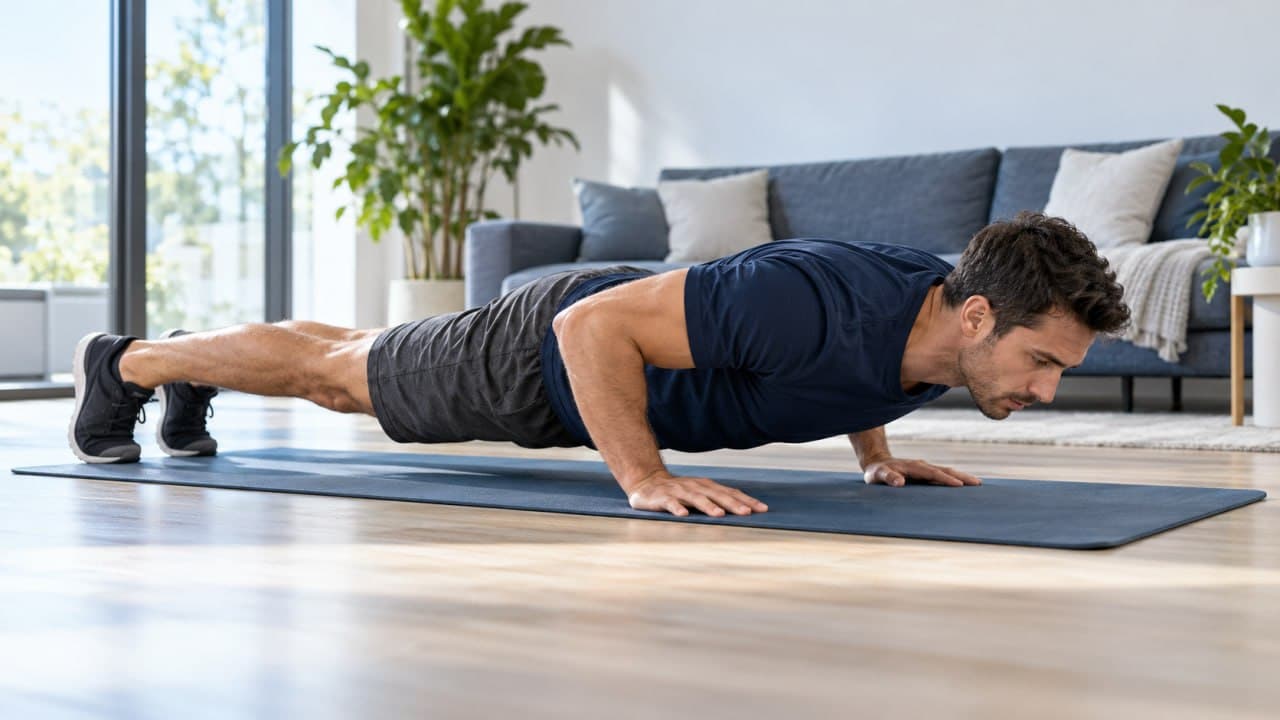
Technique: your body forms a line from head to toe, elbows about 45 degrees from your body, chest to just above the floor.
2. Row and pull-up (pull)
| Level | Variation |
|---|---|
| 1 | row on a sturdy table, knees bent |
| 2 | row under a table or on rings, legs straight |
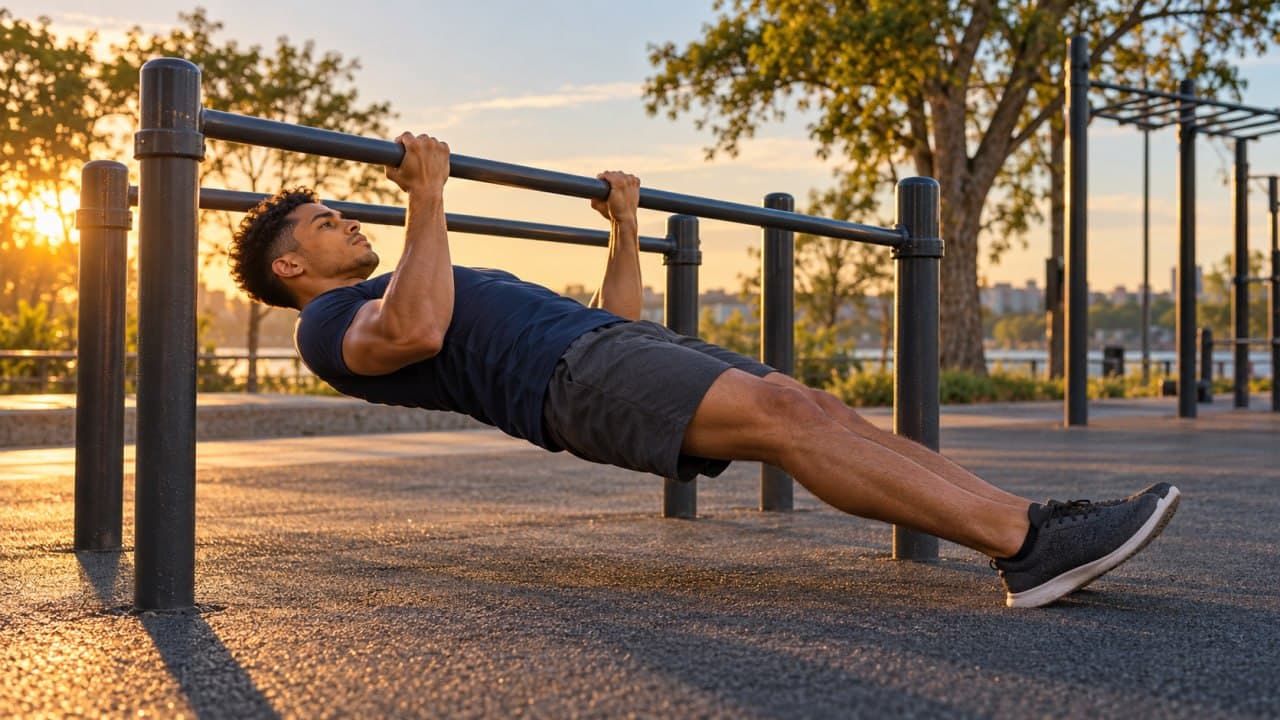
| 3 | hanging from the bar (dead hang) for 20–30 seconds |
| 4 | negative pull-ups – lower slowly over 3–5 seconds |
| 5 | band-assisted pull-up |
| 6 | pull-up |
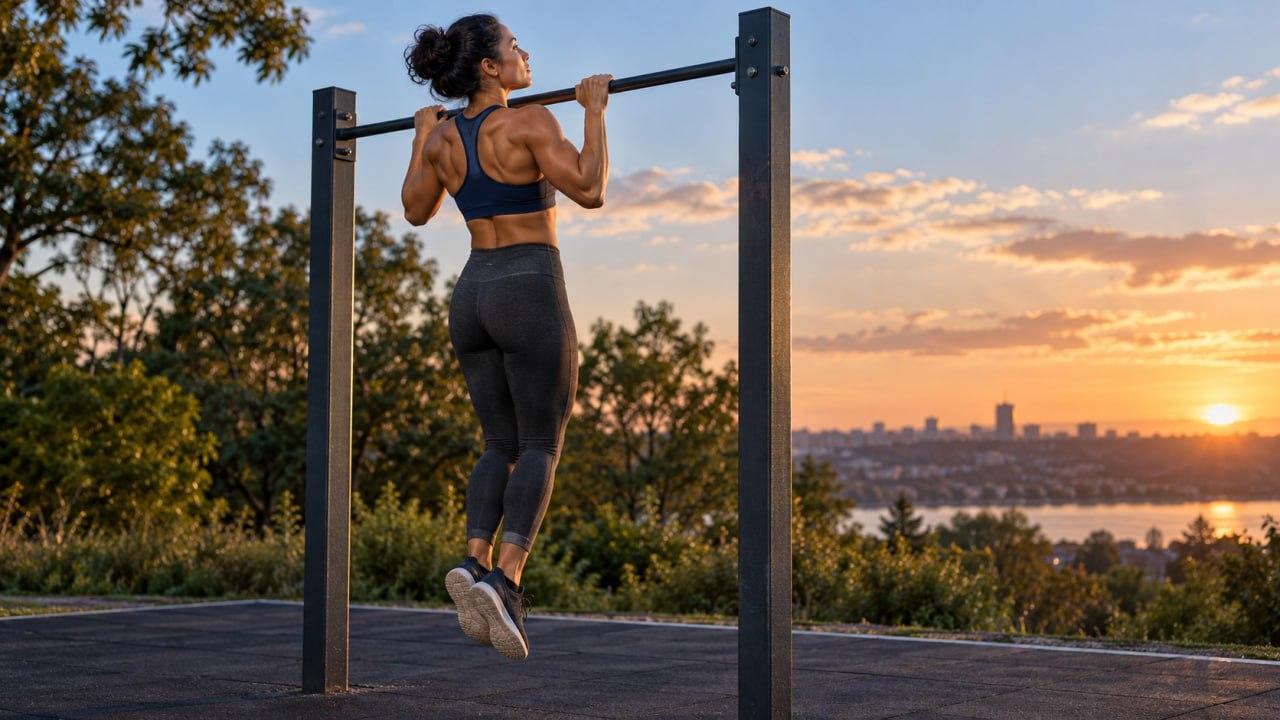
The path from your first hang to ten pull-ups is described in detail in Learning pull-ups.
3. Dip (vertical push downwards)
| Level | Variation |
|---|---|
| 1 | bench dips with bent legs |
| 2 | bench dips with straight legs |
| 3 | negative dips on parallel bars |
| 4 | dips on parallel bars |
Note: dips place a lot of stress on the shoulders. Only go as deep as is pain-free and progress slowly.
4. Squat (legs)
| Level | Variation |
|---|---|
| 1 | squat to a chair (box squat) |
| 2 | bodyweight squat |
| 3 | squat with a pause at the bottom (3 seconds) |
| 4 | Bulgarian split squat |
| 5 | shrimp squat or pistol squat to a box |
| 6 | pistol squat |
The legs are the biggest challenge in calisthenics because they are strong. Single-leg variations are therefore the key. The pistol squat is explained in Learning the pistol squat.
5. Lunge and hips
Reverse lunges, glute bridges and single-leg hip thrusts train the glutes and hamstrings – areas that get too little work from squats alone.
6. Core
| Level | Variation |
|---|---|
| 1 | forearm plank for 30 seconds |
| 2 | dead bug |
| 3 | hollow body hold |
| 4 | hanging knee raise |
| 5 | hanging leg raise |
The 3-day beginner plan
Train Monday, Wednesday and Friday (or with a rest day in between). For each exercise, choose your current progression level.
| Exercise | Sets × reps | Rest |
|---|---|---|
| Squat variation | 3 × 8–12 | 90 s |
| Push-up variation | 3 × 5–12 | 90 s |
| Row/pull-up variation | 3 × 5–12 | 90 s |
| Reverse lunges | 2 × 10 per leg | 60 s |
| Dip variation | 2 × 5–12 | 90 s |
| Core variation | 3 × 20–40 s or 8–12 | 60 s |
Warm-up: 5 minutes of easy movement, arm and hip circles, one light round of the first exercises.
Getting started with calisthenics in 4 steps
- 1
Langkah 1
Test your starting level
For each basic exercise, test the hardest variation you can do 5 to 12 times with clean technique, for example knee push-ups or rows under a table.
- 2
Langkah 2
Set your plan
Train three full-body sessions a week with 2–3 sets per exercise and at least one rest day in between.
- 3
Langkah 3
Progress by the rule
When you manage 12 clean reps in all sets, move to the next harder variation and start again at around 5–6.
- 4
Langkah 4
Record your progress
Write down the variation and reps of every session. After eight weeks, retest the starting exercises.
Equipment: what you really need
- Pull-up bar – for the door, the wall or in the park. What to look for is explained in Doorway pull-up bars: what to look for
- Gymnastic rings – versatile for rows, dips and later muscle-ups, easy to hang from a bar or branch.
- Resistance bands – for assistance with pull-ups and dips.
- Parallettes (optional) – spare your wrists during push-ups and L-sits.
Many cities have free outdoor facilities with bars and parallel bars. Exercise ideas for the bar are collected in Pull-up bar exercises.
How to keep progressing when you run out of variations
At some point the next level is still too hard but the current one is too easy. Intermediate steps help:
- Tempo: a 3–4 second lowering phase makes any exercise harder.
- Pauses: hold for 2–3 seconds in the hardest position.
- Partial movements: practise only the hardest part of the next level.
- Added weight: a backpack full of books makes squats, push-ups and dips harder.
A detailed system is described in Bodyweight progression.
Calisthenics or weights?
| Calisthenics | Training with weights | |
|---|---|---|
| Equipment | minimal | gym or home gym |
| Progression | via leverage and variations, sometimes in big jumps | in small steps (2.5 kg) |
| Legs | hard to load sufficiently | easy and precise |
| Upper body, core, body control | very strong | good |
| Flexibility | can be trained anywhere | tied to a location |
The honest verdict: for the upper body and core, calisthenics is on a par with weight training; for the legs and very high strength goals, it reaches its limits sooner. That's why many successful trainees combine both – for example pull-ups, dips and push-ups with barbell squats and deadlifts. What that looks like in the gym is shown in the 3-day full-body plan.
Common beginner mistakes
Variations that are too hard. If you can only do half push-ups, you are learning a bad movement. One level lower with clean technique brings more.
Forgetting the legs. Many calisthenics plans are upper-body heavy. Take your legs just as seriously.
No system. Doing "a few push-ups" spontaneously every day is better than nothing, but brings less than a plan with progression.
Overloading the wrists. Warm up your wrists before every session and use parallettes or push-up handles if you have discomfort.
Conclusion: your body is the gym
Calisthenics is one of the easiest ways to start strength training: no membership, no commute, hardly any equipment. With clear progressions and a fixed plan, you will get noticeably stronger in the first months – and learn to master your body along the way. How far you can get with building muscle without weights is answered in Building muscle without equipment: does it really work?.
Soalan lazim
Can you build muscle with calisthenics?
Yes. Muscles respond to mechanical tension, not to whether it comes from dumbbells or body weight. What matters is that the exercises are hard enough and progressed regularly – through harder variations, more reps or a slower tempo.
How often should beginners do calisthenics per week?
Three full-body sessions a week with a rest day in between are ideal. On days off you can add light mobility or walks.
What do you need for calisthenics?
To start, a pull-up bar and some floor space are enough. Gymnastic rings, parallettes and resistance bands expand your options but aren't necessary. Alternatively, many parks have free outdoor facilities.
I can't do a pull-up – what now?
Start with rows under a sturdy table or on rings, practise negative pull-ups (slowly lowering from the top position) and hanging from the bar. With band assistance you can train the full movement until your first unassisted pull-up works.
Is calisthenics better than weight training?
Not better, but different. Calisthenics trains body control and needs hardly any equipment, but it's harder to progress for the legs and at very high strength levels. Many people combine both.
Tag
- Calisthenics
- Bodyweight
- Beginners
- Pull-ups
- Push-ups
Tentang penulis
Michael Lohrberg· Pengasas Syrax
Michael Lohrberg mengasaskan Syrax pada 2026. Perkhidmatan tentera dengan misi di luar negara, dalam industri sejak 2010, kerja syif dan dua pekerjaan serentak – LEEK Pulse Pro lahir daripada persoalan berapa banyak pemulihan yang benar-benar tinggal dalam kehidupan seharian. Dalam majalah ini beliau menulis tentang latihan, tidur dan pemulihan – secara praktikal dan berasaskan kajian.
Lagi tentang MichaelArtikel ini untuk maklumat umum dan bukan pengganti nasihat perubatan. Jika anda mempunyai penyakit, sakit atau keraguan, berbincanglah dengan doktor sebelum mengubah latihan atau pemakanan.
Syrax Majalah
Baca seterusnya
 Panduan lengkap
Senaman di rumah & kalistenik
Home Workout Without Equipment: The Complete Full-Body Plan
Build muscle and get fit without a gym, without dumbbells, without excuses. The complete bodyweight plan for beginners and intermediates – with exercise progressions, a weekly schedule and the tricks that make even bodyweight really hard.
13 min bacaanEnglish
Senaman & kumpulan otot
Learning Pull-Ups: From Your First Rep to 10
How to do your first pull-up and progress to ten clean reps: technique, the best progressions from hanging to negative pull-ups, a 3-stage plan, common mistakes and how often you should train.
5 min bacaanEnglish
Senaman di rumah & kalistenik
Building Muscle Without Weights: Does It Really Work?
Can you build muscle without dumbbells and machines? What research says about training with light loads, how to make bodyweight exercises progressively harder, which muscle groups are difficult and a sample plan for three days a week.
5 min bacaanEnglish