Meal prep & receptenGrote gids
Meal Prep: The System for a Whole Week in 2 Hours
With meal prep you eat high-protein, planned meals all week – without cooking every evening. The building-block system, shopping list, shelf life, storage and a concrete two-hour Sunday routine.
 DoorMichael Lohrberg
8 min lezen
Dit artikel is nog niet beschikbaar in het Nederlands. Het wordt getoond in: English.
In het kort
Meal prep works best as a building-block system rather than finished dishes: prepare two protein sources, two carbohydrate sources, two roasted vegetables and two sauces, and combine them differently each day. That way about two hours on Sunday covers four to five days. Cooked food generally keeps three to four days in a fridge at 4–5 °C or below; anything beyond that goes straight into the freezer. Airtight glass containers, fast cooling and a fixed shopping list make the system work in everyday life.
Inhoud
Most nutrition plans don't fail because of knowledge but at 7:30 pm on a Tuesday. The fridge is empty, hunger is big, and it ends with a frozen pizza or a delivery service. Meal prep solves exactly this problem: you decide what you eat once a week – calmly, with a shopping list – instead of every day under time pressure.
This guide shows you a system for preparing food for four to five days in about two hours. It is the pillar article of our Meal Prep & Recipes topic and works for muscle building just as well as for a diet. How much you should eat is covered in Calculating your calorie needs.
Why meal prep works
Meal prep is less a cooking trick than a behaviour trick. Three effects make it so effective:
- Fewer decisions. When you come home tired, you choose the most convenient option. If the healthy option is already prepared, it is the most convenient.
- Predictable nutrients. You know how much protein, how many calories and how much vegetables your meals contain – without tracking every meal individually.
- Less time and money. Shop once, cook once, wash up once. Larger packs are cheaper, and less ends up in the bin.
The building-block system
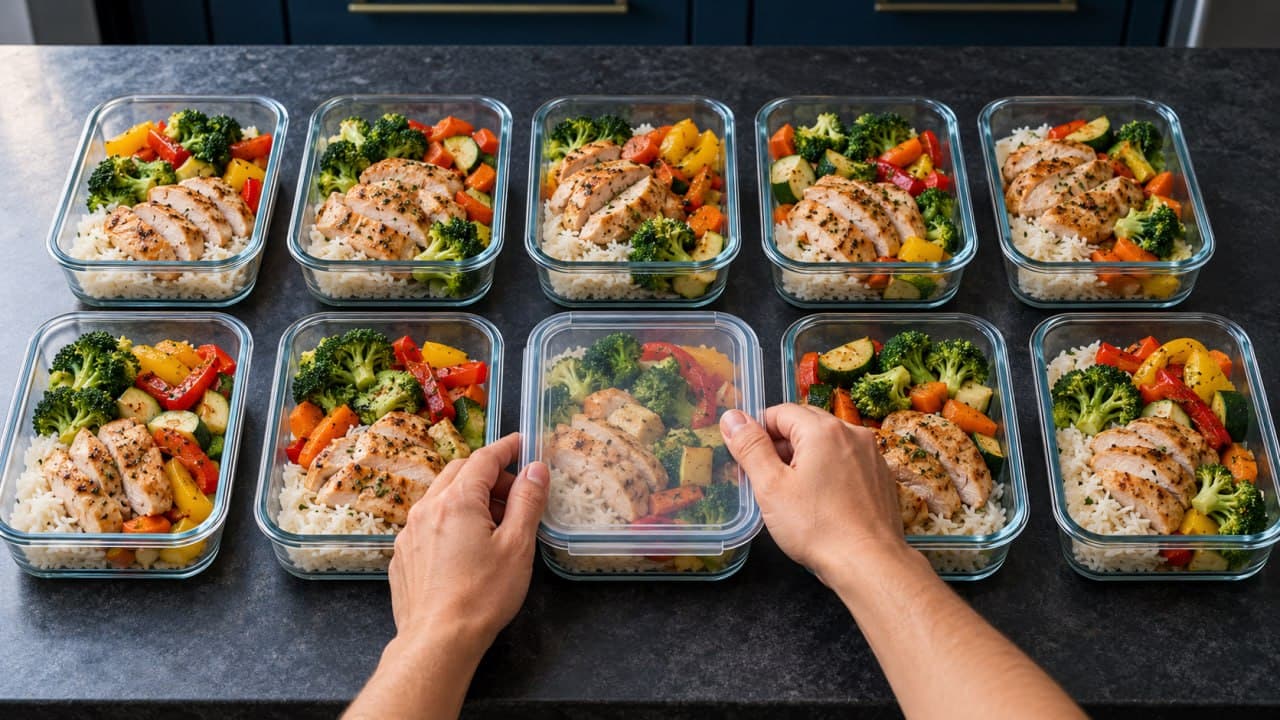
The most common meal prep mistake: five identical boxes of chicken, rice and broccoli. By Wednesday at the latest you can't stand the sight of it. A building-block system works better: you prepare components and assemble a different meal from them every day.
| Building block | Per week | Examples |
|---|---|---|
| Protein | 2 kinds | chicken thighs, minced beef, tofu, lentils, eggs, salmon |
| Carbohydrates | 2 kinds | rice, potatoes, wholegrain pasta, quinoa, sweet potatoes |
| Vegetables | 2–3 kinds | roasted vegetables, broccoli, peppers, courgettes, red cabbage salad |
| Sauce | 2 kinds | yoghurt-herb, peanut-lime, tomato-chilli, pesto |
| Extras | as you like | feta, seeds, avocado, kimchi, fresh herbs |
Two proteins, two carbohydrates, three vegetables and two sauces give you 24 combinations on paper. With changing toppings, that becomes a week in which no day tastes the same.
Proteins: the foundation
For muscle building and satiety, protein is the most important building block. Plan about 30–50 g of protein per main meal. How much you need in total is explained in How much protein do you really need?.
Well suited: chicken thighs (stay juicier than breast), lean minced beef, minced turkey, marinated tofu, lentils and chickpeas, hard-boiled eggs, skyr or low-fat quark for breakfast and snacks.
Less suited: fish reheats poorly and smells – plan it for the first two days or cook it fresh.
Carbohydrates: dosed as needed
The amount depends on your goal and whether it's a training day. On training days it can be more, in a deficit somewhat less. Potatoes and rice are cheap, filling and easy to prepare.
Vegetables: oven instead of pot
Roasted vegetables taste much better reheated than boiled ones. Two trays of peppers, courgettes, onions, broccoli or pumpkin are done in 30 minutes. For variety, add a crunchy raw salad such as red cabbage with apple, which stays fresh for several days.
Sauces: the flavour carrier
Sauces are the trick that turns meal prep from a chore into a pleasure. Store them separately and add them just before eating – so nothing gets soggy.
The shopping list for one week
This list covers five days of lunches and dinners plus breakfast for one person. Adjust the amounts to your needs.
- Protein: 1 kg skinless chicken thighs, 500 g minced beef or turkey, 400 g tofu, 10 eggs, 1 kg skyr
- Carbohydrates: 500 g rice, 1.5 kg potatoes, 500 g oats
- Vegetables: 3 peppers, 2 courgettes, 2 heads of broccoli, 1 small red cabbage, 3 onions, 1 garlic bulb, 1 bag of baby spinach
- Fruit: berries (frozen is fine), 5 bananas, 2 apples
- Sauces and extras: natural yoghurt, peanut butter, limes, passata, fresh herbs, feta, pumpkin seeds
- Pantry: olive oil, soy sauce, paprika, cumin, chilli flakes, salt, pepper
Meal prep for a week in two hours
- 1
Stap 1
Preheat the oven and boil water (0:00)
Preheat the oven to 200 °C and put on a large pot of water for rice or pasta and one for eggs.
- 2
Stap 2
Chop vegetables and roast (0:10)
Chop two trays of vegetables, toss with oil, salt and spices and roast for 25–35 minutes.
- 3
Stap 3
Cook the carbohydrates (0:20)
Cook rice, potatoes or pasta according to the package. Boil eggs for 9 minutes at the same time.
- 4
Stap 4
Prepare the proteins (0:30)
Marinate chicken or tofu and put it in the oven; cook minced meat or lentils in a pan.
- 5
Stap 5
Sauces and extras (1:00)
Mix two sauces, for example yoghurt-herb and peanut-lime. Prepare overnight oats for three days.
- 6
Stap 6
Cool and portion (1:30)
Spread everything out flat to cool, fill the containers, label them and put them in the fridge within two hours at the latest. Freeze portions for days 4 and 5.
The 2-hour routine
The key to a short prep time is working in parallel: while the oven does its job, rice and potatoes cook and you take care of sauces and breakfast. The steps above show the routine with timings. Two tips make it even faster:
- Two trays, two levels. Vegetables on the top tray, chicken on the bottom – both cook at the same time.
- Wash up as you go. Using the waiting times to wash up means you really are done after two hours.
Shelf life and food safety
Meal prep is only a good idea if the food is as safe on Friday as it was on Monday. The most important rules:
| Food | Fridge (≤ 4–5 °C) | Freezer (−18 °C) |
|---|---|---|
| Cooked poultry and minced meat | 3–4 days | 2–3 months |
| Cooked rice | up to approx. 3 days, cool quickly | 1 month |
| Cooked potatoes, pasta | 3–4 days | 1–2 months (potatoes get softer) |
| Roasted vegetables | 4 days | 2 months |
| Hard-boiled eggs (unpeeled) | up to 7 days | not suitable |
| Overnight oats | 3 days | not suitable |
| Yoghurt-based sauces | 3–4 days | not suitable |
The rule of thumb: prepare days 1 to 3 for the fridge; freeze portions for days 4 and 5 straight away and move them to the fridge the evening before to thaw.
Three sample days from one set of building blocks
This is what a week looks like when you have prepared chicken thighs and lentil bolognese as proteins, rice and roast potatoes as carbohydrates, roasted vegetables and red cabbage salad as vegetables, and a yoghurt-herb and a peanut-lime sauce. The values are rounded guide figures for a medium portion.
| Day | Lunch | Dinner | Protein (approx.) |
|---|---|---|---|
| Monday | rice bowl with chicken, roasted vegetables, peanut-lime | roast potatoes with lentil bolognese and feta | 85 g |
| Tuesday | potato salad bowl with chicken, red cabbage, yoghurt-herb | lentil bolognese with rice and baby spinach | 80 g |
| Wednesday | wrap with chicken, red cabbage and yoghurt-herb | rice stir-fry with roasted vegetables, egg and soy sauce | 75 g |
Together with a high-protein breakfast and a snack, you easily reach 120 to 160 g of protein a day – enough for most strength training goals.
Two sauces that rescue everything
Yoghurt-herb sauce (4 portions): 300 g natural yoghurt or skyr, 1 garlic clove finely grated, juice of half a lemon, a handful of chopped herbs (parsley, dill or chives), salt, pepper. Keeps three to four days in the fridge and adds protein too.
Peanut-lime sauce (4 portions): 3 tbsp peanut butter, 2 tbsp soy sauce, juice of one lime, 1 tsp honey or maple syrup, a little chilli, stirred to a creamy consistency with warm water. Higher in calories – ideal for building phases, use sparingly in a deficit.
How much does meal prep cost?
Cooking yourself is almost always cheaper than a canteen or delivery service. With the shopping list above, you'll spend roughly three to five euros per main meal, depending on region, season and quality. Three levers lower the cost further:
- Legumes as a second protein source: lentils, beans and chickpeas cost a fraction of meat.
- Frozen vegetables and berries: just as nutritious, cheaper and no spoilage.
- Bulk packs of rice, oats and skyr.
Meal prep with shift work and little time
Shift workers benefit in particular: prepared meals prevent the night shift from ending with vending-machine snacks. For night shifts, plan lighter, protein-rich meals and little greasy food in the second half of the night. More about eating and sleeping on shifts is in Shift work and sleep.
If even two hours on Sunday are too much, split it up: 45 minutes on Sunday, 45 minutes on Wednesday. Side effect: the second half of the week is fresher.
Containers and equipment
- Glass containers with clip lids – odour-neutral, microwave-safe, durable. Two sizes are enough: about 1 litre for main meals, 0.5 litres for breakfast and snacks.
- Small dressing pots for sauces.
- Two baking trays and baking paper.
- One large pot, one large pan.
- Kitchen scales – at least for the first few weeks, to get a feel for portion sizes.
- Tape and a pen for labelling contents and date.
Meal prep for muscle building or dieting
The system stays the same; only the amounts change:
| Muscle building | Fat loss | |
|---|---|---|
| Calories | slight surplus (+200–300 kcal) | moderate deficit (−300–500 kcal) |
| Protein per meal | 35–50 g | 35–50 g |
| Carbohydrates | generous, especially on training days | moderate, increase the vegetable share |
| Fats | normal | dose consciously (oil, nuts, cheese) |
| Tip | calorie-rich sauces and extras | volume from vegetables and salad |
How to plan a deficit without losing muscle is covered in Lose fat, keep muscle. Specific recipes for building muscle are collected in Recipes for bulking, ideas for dieting in Meal prep for weight loss.
Don't forget breakfast and snacks
If you only prepare lunch and dinner, you often lose the day in the morning or afternoon. Two simple additions close the gap:
- Overnight oats with skyr, oats, berries and a little milk – three jars on Sunday, three on Wednesday. More ideas in High-protein breakfast.
- Snack boxes with hard-boiled eggs, vegetable sticks and hummus or a handful of nuts. More in High-protein snacks on the go.
The most common meal prep mistakes
Too much at once. Cooking seven days ahead sounds efficient but often ends with leftovers in the bin. Start with three to four days.
No sauces. Without flavour, meal prep becomes a chore. Two good sauces matter more than a third protein.
Dressing the salad in advance. Leafy salad goes soggy. Always store the dressing separately.
Starting too complicated. Five new recipes on the first Sunday is a sure way to give up. Start with the building blocks and expand step by step.
Conclusion: plan once, benefit all week
Meal prep is the easiest way to turn good nutrition from a willpower project into something you just do. Two hours on Sunday, a fixed shopping list and a building-block system with good sauces are enough. Start this week with three days – and expand once it's running. If you also want to understand how best to split protein, carbohydrates and fat, continue with Macronutrients: the optimal split.
Veelgestelde vragen
How long does meal prep keep in the fridge?
Cooked meals generally keep three to four days in a fridge at 4–5 °C or below. Rice and poultry are sensitive and should be cooled quickly and eaten within that time. Anything you want to eat later should be frozen right after cooling.
Can you cook rice in advance?
Yes, if you cool it quickly and keep it cold. Cooked rice can contain spores of Bacillus cereus, which produce toxins at room temperature. Spread it out flat, put it in the fridge within an hour and eat it within about three days.
Which containers are best for meal prep?
Glass containers with tight-fitting lids are ideal: they don't absorb odours, are microwave- and dishwasher-safe and last a long time. For on the go, light BPA-free plastic boxes are an alternative.
Is meal prep good for weight loss?
Yes. Prepared, portioned meals make it easier to stick to a calorie deficit and avoid spontaneous snacks. The key is to match portions to your calorie needs and include enough protein and vegetables.
Won't it get boring to eat the same thing every day?
Not with a building-block system: instead of finished dishes, you prepare components and combine them differently each day – with changing sauces, spices and toppings, a few ingredients become many meals.
Tags
- Meal prep
- Batch cooking
- Nutrition
- Protein
- Recipes
- Shopping list
Over de auteur
Michael Lohrberg· Oprichter van Syrax
Michael Lohrberg richtte Syrax op in 2026. Militaire dienst met een buitenlandse missie, sinds 2010 in de industrie, ploegendienst en twee banen tegelijk – de LEEK Pulse Pro ontstond uit de vraag hoeveel herstel er in het dagelijks leven echt overblijft. In het magazine schrijft hij over training, slaap en herstel – praktisch en onderbouwd.
Meer over MichaelDit artikel is bedoeld als algemene informatie en vervangt geen medisch advies. Heb je aandoeningen, pijn of twijfels, overleg dan met je arts voordat je je training of voeding aanpast.
Syrax Magazine