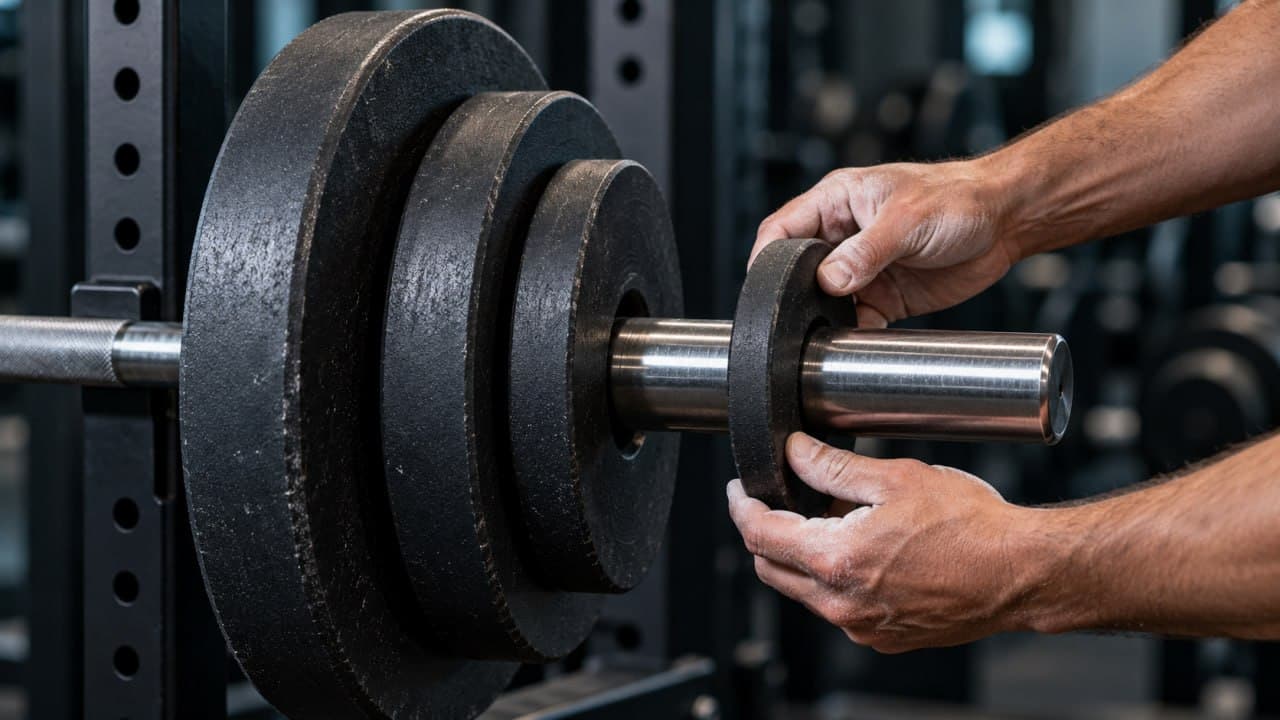
Spieropbouw & krachtGrote gids
Building Muscle: The Complete Guide
How muscles really grow – and what you need to do about it: training, volume, intensity, progression, nutrition, sleep and realistic expectations. The fundamentals guide you will keep coming back to.
 DoorMichael Lohrberg
14 min lezen

Dit artikel is nog niet beschikbaar in het Nederlands. Het wordt getoond in: English.
In het kort
Muscles grow when you regularly take them close to their limit and then give them building material and recovery. In practice: train every muscle group twice a week, do 10–20 hard sets per muscle per week, end each set 0–3 reps short of failure, add weight or reps week by week, eat 1.6–2.2 g of protein per kg of body weight and sleep 7–9 hours. Beginners can realistically build 4–8 kg of muscle in their first year.
Inhoud
Building muscle is one of the most thoroughly researched topics in sports science – and still one of the most confusing. Every week brings a new "secret" training plan, a new supplement, a new guru claiming the opposite of the last one. The result: many people train for years without changing much, or jump from programme to programme before any of them has a chance to work.
This guide clears things up. It explains how muscle growth works biologically, which training variables really matter, how to set up your nutrition, what role sleep plays and which expectations are realistic. It is deliberately thorough – think of it as the foundation for every other article in our Muscle Building & Strength topic.
How muscles grow: the biology in three sentences
Muscle growth, technically hypertrophy, means that individual muscle fibres get thicker because they store more contractile proteins. The trigger is mechanical tension: when a muscle fibre has to work against a heavy load, sensors inside the cell register that stress and switch on signalling pathways that raise the production of new proteins – muscle protein synthesis – for up to 48 hours. If building outpaces natural breakdown over weeks, the muscle grows.
Three consequences follow from this, and they are worth remembering:
- Tension is the stimulus. Not sweat, not the pump, not soreness – but high mechanical tension on as many muscle fibres as possible.
- The stimulus is time-limited. The increase in protein synthesis fades after one to two days. Training a muscle only once a week wastes growth time.
- No building material, no growth. New proteins are made from amino acids in your food. Training without enough protein is like a construction site without deliveries.
Why "close to failure" matters so much
Your body recruits muscle fibres according to the so-called size principle: the small, fatigue-resistant fibres work first, and only as effort increases do the large, powerful fibres join in – and those have the greatest growth potential. In easy sets you finish comfortably, they barely get involved. Only the last, hard reps of a set force them to work.
That is why proximity to failure is one of the most important levers of all. A set of 10 reps where you could have done 6 more is worth far less for muscle growth than a set where, after the tenth rep, only one or two more would really have been possible.
The five training variables that really matter
You can vary hundreds of details in training. For building muscle, though, five variables decide the vast majority of your results. If they are right, almost any sensible programme works. If they are wrong, no clever detail will save you.
1. Training volume: how many sets per muscle?
In strength training, volume is best measured in hard sets per muscle group per week – sets that end close to failure. Meta-analyses show a clear relationship: more sets bring more growth, but with diminishing returns.
A simple guideline for practice:
| Training age | Hard sets per muscle per week |
|---|---|
| Beginner (0–1 year) | 6–12 |
| Intermediate (1–3 years) | 10–16 |
| Experienced (3+ years) | 12–20+ |
Hard sets per muscle per week by training level
Midpoint of the recommended range. More experience tolerates and needs more volume – beginners already grow with just a few sets.
- Beginner (0–1 year)6–12 sets
- Intermediate (1–3 years)10–16 sets
- Experienced (3+ years)12–20+ sets
Gegevens als tabel
| Categorie | Sets per week |
|---|---|
| Beginner (0–1 year) | 6–12 sets |
| Intermediate (1–3 years) | 10–16 sets |
| Experienced (3+ years) | 12–20+ sets |
Important: start at the lower end. More volume is only better if you can recover from it. Jumping straight from 6 to 25 sets mostly accumulates fatigue. How to increase your volume sensibly is explained in Training volume: how many sets per week?.
2. Intensity: how hard does a set have to be?
There are two meanings here that often get mixed up: the load (how much weight relative to your maximum) and the effort (how close to failure). For muscle growth, effort matters more than load.
Studies show that rep ranges from about 5 to 30 produce similar muscle growth as long as the sets end close to failure. In practice, both extremes have drawbacks: very heavy sets of 3 to 5 reps are hard on the joints and require long rests. Very light sets of 25+ reps are unpleasant and often burn out before the muscle is truly exhausted.
The most efficient range for most exercises is therefore 6 to 15 reps – closer to 6 to 10 for compound lifts and 10 to 15 for isolation exercises. A detailed look is in Rep ranges for muscle growth.
3. Frequency: how often per week?
Because muscle protein synthesis stays elevated for only about 24 to 48 hours after a session, it pays to train each muscle at least twice a week. With the same weekly volume, a frequency of two tends to beat one in studies – beyond that, the difference becomes small.
Higher frequency has another practical benefit: you spread your volume. Instead of 16 sets of chest on one day, where the last sets have little quality left, you do 8 twice – and every set counts.
4. Progression: the principle that holds everything together
Your body adapts to the load it receives – and then it stops adapting. If you train with the same weights for the same reps for years, you maintain your condition and nothing more. Progress requires the demand to rise over time: more weight, more reps, more sets or better execution.
That is progressive overload, the single most important principle in strength training. We have dedicated a detailed article to it: Progressive overload – the most important principle for strength and muscle.
5. Exercise selection and technique
A good exercise meets three criteria: it loads the target muscle through a large range of motion, it can be performed stably and safely close to failure, and it can be progressed over weeks.
That argues for a combination of compound lifts such as squats, bench press, rows and deadlift variations, which work many muscles at once and can be loaded heavily, and isolation exercises that target individual muscles – lateral raises for the side delts or hamstring curls, for example.
Clean technique is not an end in itself. It ensures that tension arrives where it is supposed to and that you can train injury-free for years. Our technique guides to the squat and the bench press are a good starting point.
Range of motion: why deep is often better
A long-underestimated detail: research from recent years shows fairly consistently that exercises with a large range of motion, especially those that emphasise the stretched position, produce more growth than half reps. Deep squats build more glute and thigh muscle than half squats, and an incline curl that starts with straight arms is more effective than a curl that only uses the top third of the movement.
That does not make partial reps worthless. At the end of a set, when full reps are no longer possible, a few partials in the stretched position can even extend the stimulus. As a basic rule, though: full range of motion first, then weight.
Turning training into a plan
Theory is good; a plan is better. Depending on how many days per week you can train, different structures make sense.
| Training days | Recommended structure | Who it suits |
|---|---|---|
| 2 | Full body A/B | Very little time, people returning to training |
| 3 | Full body A/B/A | Beginners, busy professionals |
| 4 | Upper/lower | Intermediates, good balance |
| 5–6 | Push/pull/legs or hybrid | Experienced lifters with plenty of time |
For most beginners, a three-day full-body plan is the best choice: every muscle is trained three times a week, the movements are learned quickly and the programme fits into any calendar. We have put together a complete plan including progression: Building muscle for beginners: the 3-day full-body plan.
If you have been training for one to two years, you will often benefit from a four-day upper/lower split. It allows more volume per session without reducing frequency.
Rest between sets: longer than you think
For a long time the rule was "short rests for muscle, long rests for strength". Newer studies show that for compound lifts, longer rests of two to three minutes build more muscle than 60 seconds – simply because you perform better in the next set. For isolation exercises, 60 to 90 seconds are enough. Details in Rest periods in strength training.
Nutrition: building material and energy
Training sets the stimulus; nutrition decides whether it turns into muscle. Three levers matter most – in this order.
Calories: surplus, maintenance or deficit?
Building muscle costs energy. A moderate calorie surplus of about 200 to 300 kcal per day creates the best conditions without unnecessary fat gain. As a guide: in a well-managed building phase you gain about 0.25 to 0.5 per cent of your body weight per week – 200 to 400 grams at 80 kg.
But a surplus is not mandatory in every situation. Beginners, people returning to training and people with a higher body fat percentage can build muscle at maintenance or even in a slight deficit – so-called recomposition. If you want to lose fat at the same time, read our guide Lose fat, keep muscle. How to calculate your needs is covered in Calculating your calorie needs.
Protein: the most important nutrient
The research is clear: for maximum muscle growth, about 1.6 g of protein per kilogram of body weight per day is enough for most people. If you want to be on the safe side or are dieting, aim for up to 2.2 g/kg. Beyond that, there is little extra benefit for muscle growth.
Spread the amount across three to five meals of about 0.3 to 0.4 g/kg each – 25 to 35 grams per meal at 80 kg. The full derivation with tables is in How much protein do you really need?.
Carbohydrates and fats
Carbohydrates are the main fuel for intense strength training. If you cut them hard, you will often notice it in falling performance at higher rep counts. Fats matter for hormone production, among other things – long term you should not drop below about 20 per cent of total calories. Within those guardrails, the split is largely a matter of taste.
Supplements: what really helps
The supplement market lives off people looking for shortcuts. The honest answer: there are hardly any. Two products, however, have solid evidence behind them.
Creatine monohydrate is the most thoroughly researched sports supplement there is. At 3 to 5 grams a day it improves performance in short, intense efforts and, on average, leads to slightly greater gains in muscle and strength. Everything about effects, dosage and myths is in our creatine guide.
Protein powder is not a miracle product but a convenient food. If you cannot cover your protein needs with normal meals, a shake is the easiest solution. More in Whey protein: do you really need protein powder?.
Almost everything else – "testosterone boosters", fat burners, most amino acid products – does measurably little for well-fed people. Our supplement pyramid shows the priorities.
Sleep and recovery: training happens at night
A muscle does not grow during training but afterwards. Training is essentially controlled damage with a signal attached – the adaptation needs time, energy and, above all, sleep.
Studies show that even a few nights of severely shortened sleep lower muscle protein synthesis, impair training performance and shift the balance between anabolic and catabolic hormones unfavourably. Seven to nine hours are therefore not a wellness tip but part of your training plan. Concrete strategies are in Sleep as a performance booster.
Recovery between sessions matters too. A good indicator of how well you are recovering is heart rate variability. How to interpret it and use it for training is explained in Understanding HRV.
Deloads: planned breaks
After four to eight weeks of hard training, fatigue builds up that a normal week does not fully clear. A deload week with roughly half the volume lets this fatigue fade without losing fitness. Many people see a jump in performance afterwards. More in Deload week: when and how.
Cardio and muscle growth: enemy or ally?
Many people avoid cardio because they fear it will "eat" their muscles. That worry is largely unfounded. The so-called interference effect – the observation that combining endurance and strength training can slightly blunt the adaptations – occurs mainly with very high endurance volumes, more with running than with cycling, and above all when both types of training happen back to back without a break.
Moderate endurance training of two to three sessions of 30 to 45 minutes per week, on the other hand, has many benefits: it improves heart health, speeds up recovery between sets and helps you avoid unnecessary fat gain while building. Easy aerobic training that creates little fatigue works best. How to do it is explained in our guide to zone 2 training. If you want to combine both, put endurance and strength on separate days where possible, or leave at least six hours in between.
Building muscle after 40: what changes
From about the age of 30, the body slowly loses muscle mass unless you do something about it – a process that speeds up after 50. The good news: strength training works at any age. Studies show clear gains in strength and muscle mass even in people over 60.
A few things do change. Recovery takes a little longer, tendons and joints need more attention, and muscle responds less strongly to small protein servings. That leads to three adjustments: slightly more protein per meal (closer to 0.4 than 0.3 g/kg), a more thorough warm-up and more moderate rep ranges of 8 to 15 instead of very heavy singles and triples. The basic principle – hard sets, progression, enough volume – stays exactly the same. All the details are in Building muscle after 40.
Realistic expectations: how much is possible?
Fitness social media has thoroughly distorted expectations about building muscle. Many transformations are cleverly lit, pumped up, dehydrated – or simply not natural. Comparing your progress to them quickly leads to frustration.
Realistic numbers for natural lifters with good training and good nutrition:
| Training year | Possible muscle gain per year |
|---|---|
| Year 1 | approx. 4–8 kg |
| Year 2 | approx. 2–4 kg |
| Year 3 | approx. 1–2 kg |
| Year 4 onwards | a few hundred grams to 1 kg |
Possible muscle gain per year of training
Rough guide values with good training and suitable nutrition, midpoint of the ranges. Genetics, age, height and starting point shift the values considerably – the pattern remains: gains roughly halve from year to year.
- Year 1approx. 4–8 kg
- Year 2approx. 2–4 kg
- Year 3approx. 1–2 kg
- Year 4 onwardsa few 100 g to 1 kg
Gegevens als tabel
| Categorie | Muscle gain |
|---|---|
| Year 1 | approx. 4–8 kg |
| Year 2 | approx. 2–4 kg |
| Year 3 | approx. 1–2 kg |
| Year 4 onwards | a few 100 g to 1 kg |
These values vary considerably with genetics, age, height and starting point. But they show the pattern: things move fast at the start, then every kilo of muscle gets more expensive. That is not a sign you are doing something wrong – it is biology. The details are in How fast can you build muscle?.
The 10 most common muscle-building mistakes
Most people do not fail for lack of detailed knowledge but because of a few mistakes that come up again and again.
- Training too easy. Sets end far from failure because they already "feel hard".
- No progression. The same weights and reps for months – and no log.
- Constantly switching programmes. No plan gets enough time to work. Twelve weeks is the minimum.
- Too much volume too soon. Five exercises per muscle and 25 sets overwhelm recovery.
- Too little protein. People who eat little meat, fish or dairy in particular often stay well below 1.6 g/kg.
- Too few calories while building. Eating "clean" but too little leads to puzzling stagnation.
- Too little sleep. Six hours a night sabotage even the best training.
- Lopsided training. Only chest and arms, no legs, no back – which leads to imbalances and posture problems.
- Ego lifting. Weight before technique, half reps, momentum. The result is injuries instead of muscle.
- Impatience. Building muscle is a project measured in years. Giving up after six weeks means never seeing results.
How to get started: your muscle-building roadmap
If you have read this far, you know the principles. Now it is about putting them into practice. The following steps get you on the right track without detours.
Your muscle-building roadmap in 6 steps
- 1
Stap 1
Fix your training days
Put three or four fixed sessions per week in your calendar – with at least one rest day after two sessions. Treat them like business appointments.
- 2
Stap 2
Choose a proven plan
Beginners start with a 3-day full-body plan, intermediates with an upper/lower split. Stick with the plan you choose for at least twelve weeks.
- 3
Stap 3
Set conservative starting weights
In week one, pick weights that let you complete every set cleanly with 2–3 reps in reserve. The first two weeks are for learning technique.
- 4
Stap 4
Log every session
Write down exercise, weight, reps and RIR. Progress with double progression: first reps, then weight.
- 5
Stap 5
Set up your nutrition
Calculate your calorie needs, add a surplus of 200–300 kcal and plan 1.6–2.2 g of protein per kg of body weight – spread across 3–5 meals.
- 6
Stap 6
Review every four weeks
Compare strength numbers, body weight, measurements and photos. If strength and weight stall, increase calories or volume slightly. Plan a deload week after 6–8 weeks.
When a fitness tracker helps – and when it does not
Many people ask whether a wearable helps with building muscle. The honest answer: for the strength training itself, watches and bands add little – a training log matters more than any calorie estimate. They become valuable for recovery: sleep duration, resting heart rate and heart rate variability show you over weeks whether you are handling your volume or whether fatigue is building up. Our article Smartwatch or fitness tracker? gives an overview of useful devices, and Tracking strength training explains which data really matters in the gym.
Conclusion: simple, but not easy
Building muscle is not complicated. Train every muscle twice a week with enough hard sets, progress consistently, eat enough protein and calories, sleep enough – and do it not for twelve weeks but for twelve months. The principles fit on a beer mat. The art lies in applying them consistently once the initial enthusiasm has worn off.
That takes less motivation than system. How to turn training into a fixed habit is covered in Stick with it instead of starting over. And if you want a concrete plan you can start tomorrow: the 3-day full-body plan for beginners is made exactly for that.
Veelgestelde vragen
How fast can you build muscle?
As a beginner with good training and adequate nutrition, around 0.5 to 1 kg of muscle per month is realistic in the first year – roughly 4 to 8 kg per year. In the second year the rate roughly halves, and it slows further after that. Visible changes usually show after 8 to 12 weeks.
How often per week should I train to build muscle?
For most people, 3 to 4 strength sessions per week are ideal. What matters is that each muscle group is trained about twice a week and the total number of hard sets per muscle lands at roughly 10 to 20 per week.
Do I have to lift heavy to build muscle?
Not necessarily heavy, but hard. Muscles grow across rep ranges of about 5 to 30 as long as the set ends close to failure. Moderate ranges of 6 to 15 reps are the most efficient in practice.
Can you build muscle without a calorie surplus?
Yes. Beginners, people returning to training and people with a bit more body fat in particular can lose fat and build muscle at the same time while eating at maintenance. More experienced lifters build muscle more reliably with a slight surplus of about 200 to 300 kcal per day.
How important is sleep for building muscle?
Very important. Even a few nights of short sleep impair recovery, training performance and hormonal conditions. Seven to nine hours per night is the target for anyone who trains.
Do I need supplements to build muscle?
No. Training, total calories, protein and sleep account for most of your results. Creatine monohydrate is the best-supported supplement and can speed up progress slightly; protein powder is a convenient but optional protein source.
Tags
- Muscle building
- Hypertrophy
- Strength training
- Progression
- Training volume
- Protein
Over de auteur
Michael Lohrberg· Oprichter van Syrax
Michael Lohrberg richtte Syrax op in 2026. Militaire dienst met een buitenlandse missie, sinds 2010 in de industrie, ploegendienst en twee banen tegelijk – de LEEK Pulse Pro ontstond uit de vraag hoeveel herstel er in het dagelijks leven echt overblijft. In het magazine schrijft hij over training, slaap en herstel – praktisch en onderbouwd.
Meer over MichaelDit artikel is bedoeld als algemene informatie en vervangt geen medisch advies. Heb je aandoeningen, pijn of twijfels, overleg dan met je arts voordat je je training of voeding aanpast.
Syrax Magazine