
Syrax Data · Movement atlas
Physical activity in Austria: who meets the WHO recommendation?
How many adults in Austria reach 150 minutes of aerobic activity per week and muscle strengthening twice a week? This page shows two views separately: the national analysis by Statistics Austria (18–64 years, 2014 and 2019) and the harmonised Eurostat figures (18+) for comparison with Germany and the EU.
Updated: · Survey October 2018 to September 2019 · CSVJSONAPI· Licence CC BY 4.0
Key facts
- Statistics Austria 2019 (18–64 years): 26 % of men and 21.1 % of women meet both WHO criteria – aerobic activity and muscle strengthening.
- Compared with 2014 the aerobic share has fallen: men from 53.4 % to 48.1 %, women from 52.2 % to 45.1 %.
- The largest decline is among young men (18–29): both criteria 42 % (2014) versus 35.7 % (2019).
- In the EU comparison (Eurostat, 18+), Austria at 21.2 % is above the EU value (13.6 %) and below Germany (25.9 %).
Statistics Austria: 18–64 years, 2014 and 2019
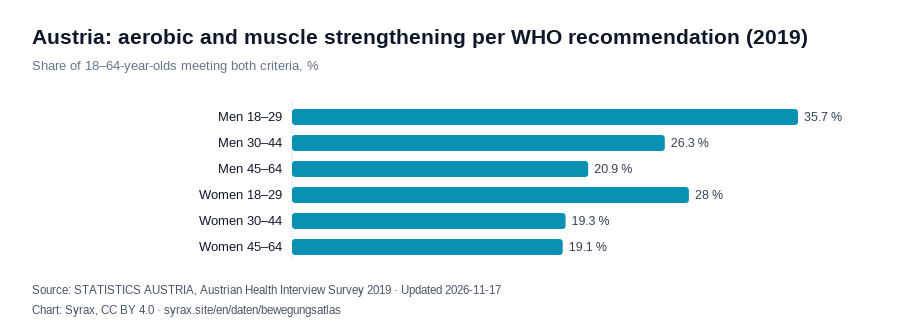
Austria: aerobic and muscle strengthening per WHO recommendation (2019)
Share of 18–64-year-olds meeting both criteria, %. Source: STATISTICS AUSTRIA, Austrian Health Interview Survey 2019.
- Men 18–2935,7%
- Men 30–4426,3%
- Men 45–6420,9%
- Women 18–2928%
- Women 30–4419,3%
- Women 45–6419,1%
Vis data som tabell
| Kategori | % |
|---|---|
| Men 18–29 | 35,7% |
| Men 30–44 | 26,3% |
| Men 45–64 | 20,9% |
| Women 18–29 | 28% |
| Women 30–44 | 19,3% |
| Women 45–64 | 19,1% |
Share or embed this chart
Embed code (source and link included, no cookies, no tracking):
<iframe src="https://syrax.site/embed/bewegung-oesterreich-athis-2019?lang=en" title="Austria: aerobic and muscle strengthening per WHO recommendation (2019)" width="100%" height="352" style="border:0" loading="lazy"></iframe>
Please credit: Source: STATISTICS AUSTRIA, Austrian Health Interview Survey 2019; chart: Syrax (CC BY 4.0).
| Group | Aerobic ≥ 2.5 h 2014 | 2019 | Muscle ≥ 2× 2014 | 2019 | Both 2014 | 2019 |
|---|---|---|---|---|---|---|
| Men 18–64 | 53.4 % | 48.1 % | 34.1 % | 32.9 % | 26.7 % | 26 % |
| Men 18–29 | 62.8 % | 56.2 % | 50.6 % | 45.2 % | 42 % | 35.7 % |
| Men 30–44 | 50.2 % | 47.9 % | 32.5 % | 32.2 % | 24.6 % | 26.3 % |
| Men 45–64 | 52.3 % | 44.2 % | 29.5 % | 27.1 % | 22.9 % | 20.9 % |
| Women 18–64 | 52.2 % | 45.1 % | 30.1 % | 28.4 % | 22.8 % | 21.1 % |
| Women 18–29 | 49.7 % | 51.6 % | 32.1 % | 34.9 % | 24.2 % | 28 % |
| Women 30–44 | 48.7 % | 41.9 % | 26.8 % | 26.4 % | 19.7 % | 19.3 % |
| Women 45–64 | 55.3 % | 44.2 % | 31.5 % | 26.7 % | 24.4 % | 19.1 % |
Source: STATISTICS AUSTRIA, Austrian Health Interview Survey 2014 and 2019, overview 5 (extract). Aerobic activity includes cycling for transport.
Eurostat: Austria, Germany and EU (18+, 2019)
| Indicator | Austria | Germany | EU-27 |
|---|---|---|---|
| WHO recommendation total | 21.2 % | 25.9 % | 13.6 % |
| … men | 24.1 % | 28.9 % | 16.1 % |
| … women | 18.4 % | 23.0 % | 11.3 % |
| ≥ 150 min aerobic | 43.3 % | 47.3 % | 31.0 % |
| Muscle strengthening | 28.7 % | 36.3 % | 19.7 % |
| No aerobic activity | 32.6 % | 28.3 % | 48.4 % |
| Cycling for transport (weekly) | 30.6 % | 33.5 % | 23.1 % |
| ≥ 30 min walk/cycle a day | 20.5 % | 20.4 % | 14.7 % |
| WHO rec. 18-24 | 34.7 % | 45.8 % | 26.9 % |
| WHO rec. 25-34 | 27.5 % | 34.9 % | 20.5 % |
| WHO rec. 35-44 | 21.5 % | 26.4 % | 14.3 % |
| WHO rec. 45-54 | 19.9 % | 24.9 % | 12.6 % |
| WHO rec. 55-64 | 20.3 % | 20.9 % | 10.1 % |
| WHO rec. 65-74 | 18.9 % | 21.7 % | 9.1 % |
| WHO rec. 75+ | 5.6 % | 14.1 % | 5.5 % |
Frequently asked questions
How many Austrians are active enough?
According to Statistics Austria (Health Interview Survey 2019), 26 % of men and 21.1 % of women aged 18–64 meet the WHO recommendation for aerobic and muscle-strengthening activity; the aerobic recommendation alone is met by 48.1 % and 45.1 %.
Why do Statistics Austria and Eurostat figures differ?
Both are based on the same survey but on different age groups: Statistics Austria reports 18–64-year-olds, Eurostat everyone aged 18+. Because older people meet the recommendation less often, the Eurostat value is lower. The tables are therefore kept separate.
Sources
- Statistik Austria: Österreichische Gesundheitsbefragung 2019 – Hauptergebnisse (Wien, September 2020), Übersicht 5: Körperliche Aktivität nach WHO-Empfehlung. Licence: Auszugsweiser Abdruck mit Quellenangabe gestattet (Impressum). Retrieved . Only one summary table (extract) is used with attribution; no charts from the publication.
- Eurostat: European Health Interview Survey (EHIS) Welle 2 (2014) und 3 (2019): hlth_ehis_pe9e, hlth_ehis_pe2e, hlth_ehis_pe3e, hlth_ehis_pe6e (Datenstand 03.01.2024). Licence: Eurostat-Weiterverwendung mit Quellenangabe (Beschluss 2011/833/EU), redaktionelle Inhalte CC BY 4.0. Retrieved . Reuse for commercial or non-commercial purposes is authorised provided the source is acknowledged. Changes (selection, rounding) are indicated.
Citation, licence and corrections
Syrax's selection, processing and charts are licensed under CC BY 4.0; the underlying data keep the licence of their primary source. For individual values, always also cite the primary source. Methodology · Source registry · Press & API
Syrax: „Physical activity in Austria: who meets the WHO recommendation?“, version 2026-11-17.2, as of 17 November 2026, syrax.site/no/daten/bewegungsatlas/oesterreich
Found an error? Please email with a link to the source: syrax.shop@proton.me.
Explained in the magazine: Sleep & Shift Work · Recovery & HRV · Endurance & Running
Solution path · 5 steps
How do I get enough exercise?
Movement atlas Germany → Running for beginners: your first 5 km → Training plan generator → 1RM calculator → …