
Syrax Data · Wearable accuracy
How accurate are wearables? The study register
The Syrax Wearable Evidence Index collects studies that tested fitness trackers, smart rings and smartwatches against reference methods such as the sleep lab, ECG or calorimetry. Each row names the device, metric, situation and the error measure as reported by the study – with DOI and PubMed link to the primary source.
Updated: · 13 studies · 39 results · 53 devices/groups · CSV · JSON
What the studies show
- Wearables detect sleep reliably (86–89% agreement, sensitivity ≥ 0.93), wake much less so (specificity 0.18–0.54).
- For sleep stages, agreement with the sleep lab is only 50–65%.
- Across 24 studies, wrist trackers underestimated total sleep time by 16.9 minutes on average.
- For heart rate, error during activity is on average 30% higher than at rest.
- No device estimated energy expenditure accurately in any major review – mean error exceeded 30%.
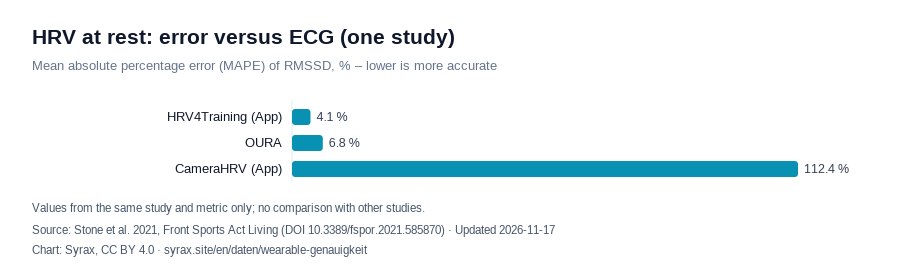
HRV at rest: error versus ECG (one study)
Mean absolute percentage error (MAPE) of RMSSD, % – lower is more accurate. Source: Stone et al. 2021, Front Sports Act Living (DOI 10.3389/fspor.2021.585870).
- HRV4Training (App)4,1%
- OURA6,84%
- CameraHRV (App)112,36%
Dane w tabeli
| Kategoria | % |
|---|---|
| HRV4Training (App) | 4,1% |
| OURA | 6,84% |
| CameraHRV (App) | 112,36% |
Share or embed this chart
Embed code (source and link included, no cookies, no tracking):
<iframe src="https://syrax.site/embed/wearable-hrv-genauigkeit-stone-2021?lang=en" title="HRV at rest: error versus ECG (one study)" width="100%" height="274" style="border:0" loading="lazy"></iframe>
Please credit: Source: Stone et al. 2021, Front Sports Act Living (DOI 10.3389/fspor.2021.585870); chart: Syrax (CC BY 4.0).
By metric area
Sleep
Sleep trackers are tested against polysomnography (PSG) in a sleep lab. They reliably detect whether someone is asleep, but much less well when someone lies awake. Agreement for individual sleep stages is rough.
5 studies · 22 results
Heart rate
Optical heart rate (PPG) is tested against ECG. At rest and during steady exercise it is usually accurate; error increases with changes in intensity. Rest and training values should therefore be considered separately.
5 studies · 6 results
HRV
Wearables derive heart rate variability from the pulse wave. Strictly speaking, this is pulse rate variability (PRV), not ECG-HRV. Measurement timing and duration differ greatly between devices, so values are hardly comparable across devices.
2 studies · 4 results
Oxygen saturation (SpO2)
Wrist SpO2 is usually tested against finger pulse oximeters, rarely against arterial blood gas analysis. Correlations say nothing about absolute deviation in the low range.
1 studies · 1 results
Steps
Step counts are usually tested against hand counting or video. Walking speed has a large influence: wrist trackers count much less accurately at slow speeds.
2 studies · 2 results
Energy expenditure
Calorie expenditure is tested against indirect calorimetry. All major reviews reach the same conclusion: no device studied estimates it accurately.
3 studies · 3 results
Heart rhythm
Irregular pulse notifications are tested against ECG recordings. They are meant as a prompt for medical assessment, not a diagnosis.
1 studies · 1 results
Study finder
39 results
| Device | Metric | Situation | Error measure (original) | Result | Study |
|---|---|---|---|---|---|
| Apple Watch S6 | Sleep/wake detectionSleep | Sleep | Agreement (epochs) | 88 % (κ = 0.30) | Miller et al. 2022Validation study · abstract + full text |
| Garmin Forerunner 245 Music | Sleep/wake detectionSleep | Sleep | Agreement (epochs) | 89 % (κ = 0.35) | Miller et al. 2022Validation study · abstract + full text |
| Polar Vantage V | Sleep/wake detectionSleep | Sleep | Agreement (epochs) | 87 % (κ = 0.44) | Miller et al. 2022Validation study · abstract + full text |
| Oura Ring Gen 2 | Sleep/wake detectionSleep | Sleep | Agreement (epochs) | 89 % (κ = 0.51) | Miller et al. 2022Validation study · abstract + full text |
| WHOOP 3.0 | Sleep/wake detectionSleep | Sleep | Agreement (epochs) | 86 % (κ = 0.44) | Miller et al. 2022Validation study · abstract + full text |
| Somfit | Sleep/wake detectionSleep | Sleep | Agreement (epochs) | 87 % (κ = 0.48) | Miller et al. 2022Validation study · abstract + full text |
| Apple Watch S6 | Sleep stages (wake, light, deep, REM)Sleep | Sleep | Agreement (epochs) | 53 % (κ = 0.20) | Miller et al. 2022Validation study · abstract + full text |
| Garmin Forerunner 245 Music | Sleep stages (wake, light, deep, REM)Sleep | Sleep | Agreement (epochs) | 50 % (κ = 0.25) | Miller et al. 2022Validation study · abstract + full text |
| Polar Vantage V | Sleep stages (wake, light, deep, REM)Sleep | Sleep | Agreement (epochs) | 51 % (κ = 0.28) | Miller et al. 2022Validation study · abstract + full text |
| Oura Ring Gen 2 | Sleep stages (wake, light, deep, REM)Sleep | Sleep | Agreement (epochs) | 61 % (κ = 0.43) | Miller et al. 2022Validation study · abstract + full text |
| WHOOP 3.0 | Sleep stages (wake, light, deep, REM)Sleep | Sleep | Agreement (epochs) | 60 % (κ = 0.44) | Miller et al. 2022Validation study · abstract + full text |
| Somfit | Sleep stages (wake, light, deep, REM)Sleep | Sleep | Agreement (epochs) | 65 % (κ = 0.52) | Miller et al. 2022Validation study · abstract + full text |
| Geräte mit Messung im Schlaf | Heart rate during sleepHeart rate | Sleep | relative agreement | high | Miller et al. 2022Validation study · abstract + full text |
| Geräte mit Messung im Schlaf | HRV (RMSSD) during sleepHRV | Sleep | relative agreement | moderate to high | Miller et al. 2022Validation study · abstract + full text |
| 7 Geräte (Bereich) | Sleep detectedSleep | Sleep | Sensitivity (epochs) | ≥ 0.93 | Chinoy et al. 2021Validation study · abstract only |
| 7 Geräte (Bereich) | Wake detectedSleep | Sleep | Specificity (epochs) | 0.18–0.54 | Chinoy et al. 2021Validation study · abstract only |
| Garmin Vivosmart | Total sleep timeSleep | Sleep | Bias vs PSG (qualitative) | worse than actigraphy | Kainec et al. 2024Validation study · abstract only |
| Fitbit Inspire, Fitbit Versa, Oura Ring, Withings Mat | Total sleep timeSleep | Sleep | Bias vs PSG (qualitative) | comparable to actigraphy | Kainec et al. 2024Validation study · abstract only |
| alle 5 Geräte | REM sleepSleep | Sleep | Bias vs PSG (qualitative) | low | Kainec et al. 2024Validation study · abstract only |
| gepoolt (Handgelenk-Tracker) | Total sleep timeSleep | Sleep | mean difference (min, 95% CI) | −16.9 [−26.3; −7.4] | Lee et al. 2025Meta-analysis · abstract only |
| gepoolt (Handgelenk-Tracker) | Sleep efficiencySleep | Sleep | mean difference (percentage points, 95% CI) | −4.7 [−7.1; −2.3] | Lee et al. 2025Meta-analysis · abstract only |
| gepoolt (Handgelenk-Tracker) | Sleep latencySleep | Sleep | mean difference (min, 95% CI) | +2.6 [0.6; 4.5] | Lee et al. 2025Meta-analysis · abstract only |
| gepoolt (Handgelenk-Tracker) | Wake after sleep onsetSleep | Sleep | mean difference (min, 95% CI) | +13.3 [4.5; 22.0] | Lee et al. 2025Meta-analysis · abstract only |
| gepoolt | Total sleep time, sleep efficiency, wakeSleep | Sleep | Direction of bias | TST/SE over-, WASO underestimated | Agostinho et al. 2026Meta-analysis · abstract only |
| 6 von 7 Geräten | Heart rateHeart rate | Exercise | median error (cycling) | < 5 % | Shcherbina et al. 2017Validation study · abstract only |
| alle 7 Geräte | Energy expenditureEnergy expenditure | mixed | error | no device < 20% | Shcherbina et al. 2017Validation study · abstract only |
| Wearables (gepoolt) | Heart rate: activity vs restHeart rate | mixed | absolute error, relative | +30% during activity | Bent et al. 2020Validation study · abstract only |
| CameraHRV (App) | Resting heart rateHeart rate | Rest | MAPE | 17.26% | Stone et al. 2021Validation study · abstract only |
| HRV4Training (App) | Resting heart rateHeart rate | Rest | MAPE | 2.34% | Stone et al. 2021Validation study · abstract only |
| OURA | RMSSD at restHRV | Rest | MAPE (CCC) | 6.84% (CCC 0.91) | Stone et al. 2021Validation study · abstract only |
| HRV4Training (App) | RMSSD at restHRV | Rest | MAPE (CCC) | 4.10% (CCC 0.98) | Stone et al. 2021Validation study · abstract only |
| CameraHRV (App) | RMSSD at restHRV | Rest | MAPE (CCC) | 112.36% (CCC 0.04) | Stone et al. 2021Validation study · abstract only |
| Apple Watch Series 6 | Oxygen saturationOxygen saturation (SpO2) | Rest | correlation r | 0.81 | Pipek et al. 2021Validation study · abstract only |
| Apple Watch Series 6 | Heart rateHeart rate | Rest | correlation r | 0.995 | Pipek et al. 2021Validation study · abstract only |
| 10 Tracker (Bereich) | StepsSteps | Walking (treadmill) | mean difference from hand count | 0.0–26.4% | Fokkema et al. 2017Validation study · abstract only |
| 9 Marken | Steps (lab)Steps | mixed | authors' assessment | accurate: Fitbit, Apple Watch, Samsung | Fuller et al. 2020Systematic review · abstract only |
| 9 Marken | Energy expenditureEnergy expenditure | mixed | authors' assessment | no brand accurate | Fuller et al. 2020Systematic review · abstract only |
| alle untersuchten Marken | Energy expenditureEnergy expenditure | mixed | MAPE | > 30 % | Germini et al. 2022Systematic review · abstract only |
| Apple Watch | Atrial fibrillation notificationHeart rhythm | Free living | positive predictive value | 0.84 (95% CI 0.76–0.92) | Perez et al. 2019Cohort study · abstract only |
All studies in the register
Agostinho et al. 2026: Are Wearable Sleep-Tracking Devices Reliable Alternatives to Polysomnography? A Systematic Review and Meta-Analysis
Behavioral Sleep Medicine · Meta-analysis · 16 studies, 10 in the meta-analysis · DOI 10.1080/15402002.2026.2673893
Wearables overestimated total sleep time and sleep efficiency and underestimated wake, with large variability between devices. No device was consistently superior. Reasonable for global sleep metrics, not suitable as a stand-alone diagnostic tool or for sleep stages.
Lee et al. 2025: Performance of consumer wrist-worn sleep tracking devices compared to polysomnography: a meta-analysis
Journal of Clinical Sleep Medicine · Meta-analysis · 24 studies, 798 participants · DOI 10.5664/jcsm.11460
Across all wrist-worn trackers, devices underestimated total sleep time and sleep efficiency and overestimated wake after sleep onset. Fitbit did not differ significantly from polysomnography for wake after sleep onset.
Kainec et al. 2024: Evaluating Accuracy in Five Commercial Sleep-Tracking Devices Compared to Research-Grade Actigraphy and Polysomnography
Sensors · Validation study · 53 young adults, one night · DOI 10.3390/s24020635
All devices except the Garmin Vivosmart estimated total sleep time comparably to research-grade actigraphy. All overestimated nights with short wake times and underestimated nights with long ones. Proportional biases were common.
Miller et al. 2022: A Validation of Six Wearable Devices for Estimating Sleep, Heart Rate and Heart Rate Variability in Healthy Adults
Sensors · Validation study · 53 adults, one night (9 h in bed) · DOI 10.3390/s22166317
All six devices agreed with polysomnography 86–89% of the time for “asleep or awake”, but only 50–65% for sleep stages. Devices that recorded heart rate during sleep showed high agreement for heart rate and moderate to high agreement for HRV.
Germini et al. 2022: Accuracy and Acceptability of Wrist-Wearable Activity-Tracking Devices: Systematic Review of the Literature
Journal of Medical Internet Research · Systematic review · 65 studies · DOI 10.2196/30791
Fitbit Charge and Charge HR were consistently accurate for steps, the Apple Watch for heart rate. For energy expenditure, the mean absolute percentage error exceeded 30% for all brands.
Chinoy et al. 2021: Performance of seven consumer sleep-tracking devices compared with polysomnography
Sleep · Validation study · 34 adults, three nights incl. a disrupted night · DOI 10.1093/sleep/zsaa291
All devices detected sleep reliably (sensitivity ≥ 0.93), wake much less so (specificity 0.18–0.54). Most devices were at least as good as actigraphy, the two Garmin models worse. All devices performed worse on disrupted nights.
Stone et al. 2021: Assessing the Accuracy of Popular Commercial Technologies That Measure Resting Heart Rate and Heart Rate Variability
Frontiers in Sports and Active Living · Validation study · 5 adults, 148 trials · DOI 10.3389/fspor.2021.585870
According to the authors, all seven products measured mean resting heart rate accurately; the largest deviation was for CameraHRV (MAPE 17.26%). For RMSSD, errors varied widely: from 4.10% (HRV4Training) and 6.84% (OURA) to 112.36% (CameraHRV).
Pipek et al. 2021: Comparison of SpO2 and heart rate values on Apple Watch and conventional commercial oximeters devices in patients with lung disease
Scientific Reports · Validation study · 100 patients · DOI 10.1038/s41598-021-98453-3
Strong correlation with commercial pulse oximeters for heart rate (r = 0.995) and oxygen saturation (r = 0.81). Skin colour, wrist circumference, wrist hair and nail polish showed no significant effect.
Bent et al. 2020: Investigating sources of inaccuracy in wearable optical heart rate sensors
npj Digital Medicine · Validation study · not stated in the abstract · DOI 10.1038/s41746-020-0226-6
No statistically significant difference in heart rate accuracy across skin tones, but significant differences between devices and activities: absolute error during activity was on average 30% higher than at rest.
Fuller et al. 2020: Reliability and Validity of Commercially Available Wearable Devices for Measuring Steps, Energy Expenditure, and Heart Rate: Systematic Review
JMIR mHealth and uHealth · Systematic review · 158 publications, 9 brands · DOI 10.2196/18694
In the lab, Fitbit, Apple Watch and Samsung measured steps accurately. For heart rate, Apple Watch and Garmin were most accurate, Fitbit tended to underestimate. No brand measured energy expenditure accurately.
Perez et al. 2019: Large-Scale Assessment of a Smartwatch to Identify Atrial Fibrillation
New England Journal of Medicine · Cohort study · 419,297 participants, 450 analysable ECG patches · DOI 10.1056/nejmoa1901183
0.52% received an irregular pulse notification. In 34% of them, the ECG patch worn later showed atrial fibrillation; notifications recorded simultaneously with the ECG matched atrial fibrillation 84% of the time.
Shcherbina et al. 2017: Accuracy in Wrist-Worn, Sensor-Based Measurements of Heart Rate and Energy Expenditure in a Diverse Cohort
Journal of Personalized Medicine · Validation study · 60 adults (29 men, 31 women) · DOI 10.3390/jpm7020003
During cycling, six of seven devices achieved a median heart rate error below 5%; errors were largest during walking. No device estimated energy expenditure with an error below 20%. Errors were higher in men, with higher BMI and darker skin.
Fokkema et al. 2017: Reliability and Validity of Ten Consumer Activity Trackers Depend on Walking Speed
Medicine & Science in Sports & Exercise · Validation study · 31 adults, two 30-minute treadmill tests · DOI 10.1249/mss.0000000000001146
Mean differences from hand counting between 0.0 and 26.4% depending on device and pace. Devices were more accurate at average and brisk walking than at slow walking.
Methodology and limits
Search strategy, selection, extraction rules and limits of the register are on the methodology page. The compilation is licensed under CC BY 4.0; for individual results, always cite the original study. Methodology and limits
Syrax: „How accurate are wearables? The study register“, as of 17 November 2026, syrax.site/pl/daten/wearable-genauigkeit
Changelog
- – First version: 13 studies, extracted from abstracts (Miller 2022 also full text).
Solution path · 4 steps
Which fitness tracker suits me?
Cost and subscription comparison → Measurement accuracy from studies → Battery and repairability → LEEK Pulse Pro (Syrax)