Trening w domu i kalistenikaWielki poradnik
Home Workout Without Equipment: The Complete Full-Body Plan
Build muscle and get fit without a gym, without dumbbells, without excuses. The complete bodyweight plan for beginners and intermediates – with exercise progressions, a weekly schedule and the tricks that make even bodyweight really hard.
 Autor:Michael Lohrberg
13 min czytania
Ten artykuł nie jest jeszcze dostępny po polsku. Wyświetlamy go w języku: English.
W skrócie
A home workout without equipment can build strength and muscle if you take the exercises close to failure and make them gradually harder through progressions. An effective plan includes three full-body sessions a week, each with one exercise for legs (e.g. split squat), pushing (push-up variations), pulling (table rows or towel rows), hips (single-leg glute bridge) and core (plank variations), each for 3 sets of 8–20 reps. When an exercise gets too easy, switch to the next harder variation.
Spis treści
"I don't have time for the gym." "The gym is too far away." "I'm on a business trip." There are plenty of reasons not to train. Not having a gym is not one of them. With your own body weight you can build strength, develop muscle and improve your fitness – in your living room, in a hotel room, in the park. What you need is not equipment but a well-designed plan.
The problem with many home workouts: they consist of endless reps of the same simple exercises. After 50 bodyweight squats you are out of breath, but your legs will not grow from it. The key lies in progressions: exercise variations that get gradually harder – from the wall push-up to the one-arm push-up, from the squat to the pistol squat.
This guide gives you a complete plan for beginners and intermediates, explains the most important exercises with their progressions and shows you how to keep making progress without dumbbells. It is the pillar article of our Home Workouts & Calisthenics topic.
Does building muscle without weights really work?
Yes – with one important caveat. Your muscles do not know whether the resistance comes from a barbell or your body weight. They respond to mechanical tension. And studies show that muscle growth occurs across a wide rep range of about 5 to 30, as long as sets end close to failure. The fundamentals are explained in our muscle-building guide.
Studies comparing push-ups with the bench press at comparable effort found similar gains in strength and chest muscle. The crux is not the tool but the intensity.
The caveat: the stronger you get, the harder it becomes to generate enough tension – especially for the legs, which carry your whole body weight all day anyway. For them you need single-leg exercises and slow execution. And for your back you need creative solutions or a pull-up bar. How far you can get without weights is examined in Building muscle without weights: does it really work?.
The 5 principles of effective home training
1. Close to failure
The most important point. With bodyweight exercises, you should end every set one to three reps short of failure. 20 easy push-ups where you could have done 15 more are not a growth stimulus.
2. Progression through variations
Instead of adding weight, you switch to a harder variation as soon as you can do more than about 20 clean reps. Every exercise has a progression ladder – more on that in a moment.
3. Tempo as a tool
A squat with a three-second descent, a one-second pause at the bottom and a powerful drive up is a completely different stimulus from a quick bounce. Slow, controlled reps increase tension considerably. More on the principle in Time under tension.
4. Single-leg and single-arm
Shifting your weight onto one side doubles the load per leg or arm. Single-leg exercises are the most important trick for challenging your legs without weights.
5. Log it
Home training is no exception: no records, no systematic progression. Note the variation, reps and tempo. The principle is explained in Progressive overload.
The exercises and their progressions
A complete full-body workout covers five movement patterns: legs (squat pattern), hips (hip extension), push, pull and core. For each there is a progression ladder from easy to hard. Start at the level where you can do 8 to 15 clean reps.
Legs: from the squat to the pistol squat
| Level | Exercise | Note |
|---|---|---|
| 1 | Chair squat (sit to stand) | sit on the chair, stand up |
| 2 | Bodyweight squat | full depth |
| 3 | Squat, 3 s down, 2 s pause at the bottom | increases tension |
| 4 | Split squat (static lunge) | single-leg load |
| 5 | Bulgarian split squat (rear foot elevated) | considerably harder |
| 6 | Shrimp squat / skater squat | pre-stage for the pistol |
| 7 | Pistol squat (single-leg squat) | the king of leg exercises |
The Bulgarian split squat is perhaps the most valuable leg exercise for home: your rear foot rests on a chair or sofa and your front leg carries almost all of your body weight. Even trained people reach their limits. More in Bulgarian split squat, and we explain the king of leg exercises in Learning the pistol squat.
Hips: from the glute bridge to the Nordic curl
| Level | Exercise |
|---|---|
| 1 | Two-leg glute bridge |
| 2 | Glute bridge with a pause at the top (3 s) |
| 3 | Single-leg glute bridge |
| 4 | Single-leg glute bridge, shoulders elevated on the sofa |
| 5 | Single-leg Romanian deadlift (balance + hamstrings) |
| 6 | Nordic curl (eccentric, feet anchored under the sofa) |
The back of the legs is often neglected in home training. Nordic curls – you kneel with your feet anchored and slowly lower yourself forwards – are one of the hardest hamstring exercises there is. Start with a few very slow reps and catch yourself with your hands.
Push: from the wall to the one-arm push-up
| Level | Exercise |
|---|---|
| 1 | Wall push-up |
| 2 | Push-up with hands on a table or sofa |
| 3 | Knee push-up |
| 4 | Standard push-up |
| 5 | Push-up with a pause at the bottom / 3 s descent |
| 6 | Feet-elevated push-up |
| 7 | Archer push-up (weight on one arm) |
| 8 | One-arm push-up |
In addition, dips between two sturdy chairs or on the edge of the sofa train the triceps and lower chest, and pike push-ups (hips high, head towards the floor) train the shoulders. We show clean push-up technique and twelve variations in Perfecting the push-up.
Pull: the hardest part at home
Without a bar, pulling is the biggest challenge. These options work:
| Level | Exercise | You need |
|---|---|---|
| 1 | Towel row on a door | towel, sturdy closed door |
| 2 | Table row (under a sturdy table) | solid table |
| 3 | Table row with feet elevated | table, chair |
| 4 | Negative pull-ups (slow lowering) | pull-up bar |
| 5 | Pull-ups | pull-up bar |
A pull-up bar is by far the most worthwhile purchase for home. Which models are safe and which exercises they make possible is covered in Pull-up bar at home: the best exercises and Doorway pull-up bars: safe or risky?. If you have no option at all, you will find alternatives in Back training at home.
Core: more than crunches
| Level | Exercise |
|---|---|
| 1 | Plank on the knees |
| 2 | Plank (forearm plank) |
| 3 | Side plank |
| 4 | Plank with alternating arm or leg raises |
| 5 | Hollow body hold |
| 6 | Ab wheel / body saw (feet on a towel, slide the body forwards and backwards) |
| 7 | Dragon flag (advanced) |
The core's main job is to stabilise – to prevent rotation, overextension and sideways bending. Plank variations and hollow body holds train exactly that function. More on sensible ab training in Core training: trunk stability beyond crunches and Planks and variations.
Technique for the four core exercises
Clean technique is particularly important with bodyweight exercises, because there is no external resistance to "punish" errors. Sloppy execution quietly makes the exercise easier.
Bulgarian split squat: stand about one big step in front of a chair or sofa and rest the top of your rear foot on the seat. Your weight is on your front leg. Lower yourself straight down until your back knee almost touches the floor; your front knee may travel past your toes. Your torso stays upright or leans slightly forward – the latter emphasises the glutes. Drive up through your whole front foot. If you wobble, hold onto a wall with one hand at first.
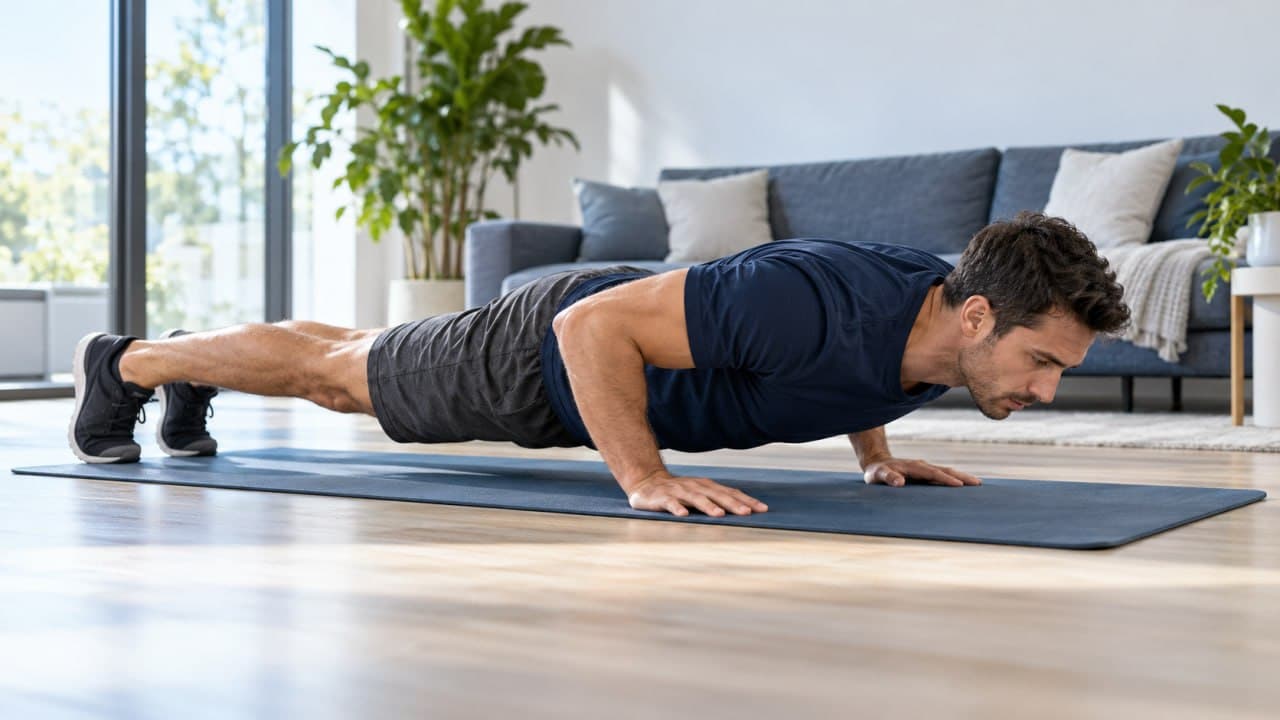
Push-ups: hands slightly wider than shoulder-width, fingers pointing forward, body in a line from head to heel. Brace your abs and glutes so your hips do not sag. Lower yourself until your chest almost touches the floor; your elbows point about 45 degrees away from your body, not out to the side like a T. Press up powerfully without letting your shoulders roll forward. The parallels to the bench press are no coincidence – the technique principles from our bench press guide apply here too.
Table rows: lie on your back under a sturdy table so that your chest is roughly under the edge. Grip the edge shoulder-width apart, brace your body like an upside-down plank and pull your chest to the edge of the table. Squeeze your shoulder blades together at the top. The flatter your body, the harder the exercise; with bent legs it gets easier.
Single-leg glute bridge: lie on your back with one foot planted close to your glutes and the other leg bent in the air. Drive up through your heel until your shoulder, hip and knee form a line. Squeeze your glutes hard for a second at the top without arching your lower back. If you feel your hamstrings instead of your glutes, move your foot slightly closer to your body.
The training plan: 3 days a week
The plan is structured as full-body training: every session trains all movement patterns. You train three times a week on non-consecutive days, for example Monday, Wednesday and Friday, alternating between session A and B.
| Session A | Sets × reps | Session B | Sets × reps |
|---|---|---|---|
| Bulgarian split squat (level as appropriate) | 3 × 8–15 per leg | Squat with 3-2-1 tempo | 3 × 10–20 |
| Push-ups (level as appropriate) | 3 × 8–20 | Pike push-ups | 3 × 6–12 |
| Table rows / pull-ups | 3 × 6–15 | Towel rows / negative pull-ups | 3 × 6–12 |
| Single-leg glute bridge | 3 × 10–15 per side | Nordic curl (negative) | 3 × 3–6 |
| Plank | 3 × 30–60 s | Hollow body hold | 3 × 20–40 s |
| — | — | Chair dips | 2 × 8–15 |
Rest: 60 to 120 seconds between sets. Duration: about 35 to 45 minutes including the warm-up. Progression: once you reach the top rep count in all sets, move to the next level of the progression ladder.
Your first home workout
- 1
Krok 1
Clear some space and warm up
Clear an area of about 2 × 2 metres. Warm up for 5 minutes with jumping jacks, arm circles, bodyweight squats and hip circles.
- 2
Krok 2
Legs: split squats
3 sets of 8–15 reps per leg. Lower slowly until your back knee almost touches the floor, then drive up powerfully.
- 3
Krok 3
Push: push-ups
3 sets to 1–2 reps short of failure. Too hard? Put your hands on a raised surface. Too easy? Elevate your feet.
- 4
Krok 4
Pull: table rows
3 sets of 8–15 reps under a sturdy table. Keep your body straight and pull your chest to the edge of the table.
- 5
Krok 5
Hips: single-leg glute bridge
3 sets of 10–15 reps per side. Hold for a second at the top and squeeze your glutes hard.
- 6
Krok 6
Core: plank
3 sets of 30–60 seconds. Body straight as a board, abs and glutes tensed.
- 7
Krok 7
Log it
Note the exercise, variation, reps and how it felt. Next time, try to do one more rep.
Advanced option: 4 days upper/lower
If three sessions are no longer enough or you are very strong, split your training: two upper-body days with two push and two pull exercises plus core each, and two lower-body days with two leg and two hip exercises each. That allows more volume per muscle group. Ready-made plans for advanced bodyweight training are in Calisthenics training plan for intermediates.
How to make bodyweight hard: 7 tricks
When the next level of the progression ladder is still too hard, these tools help bridge the gap:
- Slow lowering: three to five seconds in the lowering phase.
- Pauses in the hardest position: two seconds at the bottom of the squat or push-up.
- One-and-a-half reps: all the way down, halfway up, all the way down again, all the way up – counts as one.
- Greater range of motion: push-ups between two books, split squats with the front foot elevated.
- A backpack as weight: a backpack filled with books or water bottles makes squats, push-ups and lunges much harder. More in Home workout with a backpack.
- Mechanical drop sets: switch straight from the hard variation to an easier one when nothing more is possible – for example from feet-elevated push-ups to standard ones.
- Shorter rests: for muscular endurance and conditioning; less suitable for muscle growth.
More systematic methods are in Bodyweight progressions: how to make exercises harder.
Minimal equipment: what is really worth it
You can manage completely without equipment, but a few inexpensive purchases expand your options enormously:
| Equipment | Price (approx.) | Benefit |
|---|---|---|
| Pull-up bar | €20–60 | solves the pulling problem, pull-ups, hanging leg raises |
| Resistance bands | €20–40 | rows, face pulls, assistance with pull-ups |
| Gymnastic rings | €30–50 | rows, dips, push-ups – extremely versatile |
| Adjustable dumbbells | from about €100 | makes leg training much easier |
| Exercise mat | €15–30 | comfort for floor and core exercises |
With a pull-up bar and resistance bands for under €100 combined, you have an almost complete gym. More on bands in Resistance bands and on rings in Ring training. If you want to expand later, you will find the roadmap in Setting up a home gym.
Conditioning and fat loss at home
Strength training at home combines well with conditioning. One or two short circuits a week with burpees, mountain climbers, squat jumps and high knees in an interval format improve endurance. Easy movement – brisk walks or cycling – forms the foundation. The difference between the two approaches is explained in our HIIT guide and the zone 2 guide.
For fat loss, the same applies at home as in the gym: training preserves and builds muscle; nutrition decides what happens to fat. How to combine the two is covered in Lose fat, keep muscle.
Twelve weeks of home workouts: what progress can look like
How realistic is visible progress at home? A typical course for someone with no training experience who trains three times a week on this plan:
| Point in time | Legs | Push | Pull |
|---|---|---|---|
| Week 1 | Squat, 3 × 15 | Knee push-ups, 3 × 10 | Towel rows, 3 × 10 |
| Week 4 | Split squat, 3 × 12 per leg | Push-ups, 3 × 8 | Table rows with bent legs, 3 × 10 |
| Week 8 | Bulgarian split squat, 3 × 10 per leg | Push-ups, 3 × 15 | Table rows with straight legs, 3 × 10 |
| Week 12 | Bulgarian split squat with tempo, 3 × 12 | Feet-elevated push-ups, 3 × 12 | Negative pull-ups, 3 × 5 |
So progress shows up not in kilograms but in climbing the progression ladder. If you keep your log consistently, you will see in black and white how much stronger you have become – and usually in the mirror too.
Motivation at home: beating distraction
The biggest challenge of home training is not the equipment but your head. At home there is no gym atmosphere, no other people training and countless distractions. Three habits help enormously: a fixed training spot in your home where the mat is already laid out, a fixed appointment in your calendar and a clear start routine – training clothes on, phone on flight mode, playlist on. If you link training to an existing habit, such as straight after work, you skip it less often. More strategies are in No motivation to train: 15 strategies against procrastination.
Training on the go: hotel room, park, holiday
The big advantage of bodyweight training: it travels with you. In a hotel room, Bulgarian split squats using the bed, feet-elevated push-ups on a chair, towel rows on the bathroom door and planks work without any problem. In the park, benches, railings and bars offer everything you need for a complete workout. Ready-made programmes are in Hotel room workout and Outdoor training: calisthenics in the park.
The most common home workout mistakes
Training too easy. A hundred easy squats do not build muscle. Every set must challenge you.
Always the same exercises in the same variation. No progression, no progress – at home just as in the gym.
Forgetting to pull. Only push-ups and squats lead to an imbalance between chest and back. Pull at least as much as you push.
No fixed appointment. At home the way to training is short, but the distractions are big. Plan fixed times as you would for a gym visit.
No warm-up. Just because there is no dumbbell involved does not mean your joints and tendons are automatically ready. Five minutes are enough.
Impatience with hard progressions. If you try to force one-arm push-ups or pistol squats after three weeks, you skip levels – and are more likely to get injured than stronger. Every rung of the ladder has its purpose.
Nutrition: no building material, no growth
Even the best bodyweight plan achieves little if your nutrition does not play along. For muscle growth, the same principles apply at home as in the gym: enough calories – ideally a slight surplus – and about 1.6 to 2.2 grams of protein per kilogram of body weight, spread across several meals. How to put that into practice day to day is explained in How much protein do you really need? and the meal prep guide.
Conclusion: no gym, no excuse
A home workout without equipment is not a stopgap but a fully-fledged form of training – if you approach it correctly. With progression ladders, slow reps, single-leg exercises and consistent logging, you can build strength and muscle at home that you can be proud of. And with a pull-up bar and a few bands, you have everything you need for under €100.
If you want to go deeper into bodyweight training, Calisthenics for beginners is the next step. And if you do switch to the gym later, you will take a solid foundation with you – the 3-day full-body plan builds directly on it.
Najczęstsze pytania
Can you build muscle without equipment?
Yes. Muscles respond to mechanical tension, not to where the resistance comes from. If sets end close to failure and the exercises get harder through progressions, beginners and intermediates in particular can build significant muscle with their own body weight.
How often should I train at home?
Three full-body sessions a week on non-consecutive days are ideal for most people. If you have more time, you can switch to four sessions split into upper and lower body.
How do I train my back without a pull-up bar?
Good options are rows under a sturdy table, towel rows on a closed door, reverse push-ups between two chairs and superman variations for the lower back. In the long run, a pull-up bar is the cheapest worthwhile investment.
How many reps for bodyweight exercises?
For muscle growth, 8 to 20 reps per set are ideal, with the set ending one to three reps short of failure. If you can do more than 20 to 25 clean reps, it is time for a harder variation.
How long should a home workout last?
30 to 45 minutes including the warm-up is enough for a complete full-body workout. What matters is not the duration but that every set is hard enough.
Tagi
- Home workout
- Bodyweight
- Calisthenics
- Training without equipment
- Full-body training
- Training plan
O autorze
Michael Lohrberg· Założyciel Syrax
Michael Lohrberg założył Syrax w 2026 roku. Służba wojskowa z misją zagraniczną, od 2010 roku w przemyśle, praca zmianowa i dwa etaty jednocześnie – LEEK Pulse Pro powstał z pytania, ile regeneracji naprawdę zostaje w codziennym życiu. W magazynie pisze o treningu, śnie i regeneracji – praktycznie i w oparciu o badania.
Więcej o MichaeluTen artykuł ma charakter ogólnoinformacyjny i nie zastępuje porady lekarskiej. Jeśli masz choroby, odczuwasz ból lub masz wątpliwości, porozmawiaj z lekarzem przed zmianą treningu lub diety.
Syrax Magazyn