
Whey or Isolate? Concentrate and Isolate in an Honest Comparison
Whey protein or whey isolate – what's the difference, and which is worth it? Eduard Boehm compares protein content, lactose, fat, calories, tolerance, muscle building and price per 25 g of protein, explains hydrolysate and clear whey and shows how to tell from the label what's really inside.
 DeEduard Boehm
8 min de citit
Acest articol nu este încă disponibil în limba română. Este afișat în: English.
Pe scurt
Whey concentrate and whey isolate both come from whey and provide high-quality protein with an almost identical amino acid profile. Isolate is filtered more heavily: the raw material contains at least 90 percent protein and hardly any lactose or fat, while concentrate usually has 70 to 80 percent protein with some milk sugar. Per 30 g serving that typically means 1 to 2 g more protein, around 10 to 20 kcal less and 1 to 3 g less lactose. For muscle building the difference is practically irrelevant at the same protein intake. Isolate is worthwhile mainly if you are lactose-sensitive, get bloated from concentrate or want a clear, refreshing drink; concentrate is creamier, more versatile and cheaper per gram of protein. In the Syrax range, 25 g of protein cost about €1.47 (concentrate) and €1.76 (clear whey isolate). The ingredients list is what counts: product names such as 'iso' or 'designer' are not protected terms.
Cuprins
"Whey or isolate?" is the most common question about protein powder after "How much protein do I need?" The advertising answer is usually: isolate is purer, therefore better, therefore more expensive. The food chemistry answer is more sober. Both are the same protein – just filtered to different degrees. Here I show with figures what that means for tolerance, calories and your wallet.
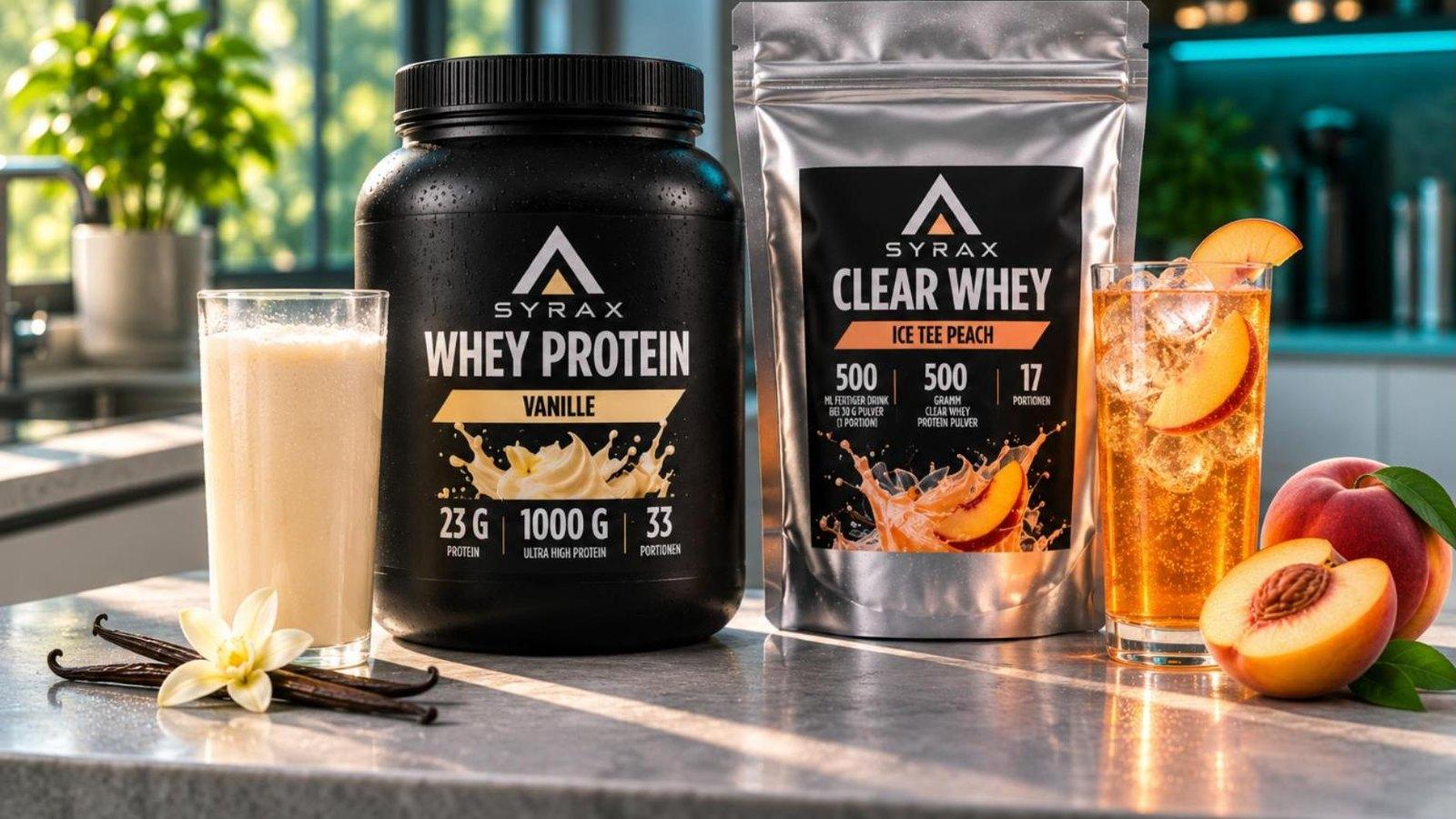
For transparency: in the Syrax shop we carry a classic concentrate (Premium Whey) and an isolate in the form of clear whey. We don't have a classic, creamy isolate. So I first compare the forms in general and then our two products.
The short answer
- Concentrate (WPC) is the all-round whey: creamy, cheaper, with some lactose and fat.
- Isolate (WPI) is filtered more heavily: more protein per gram, hardly any lactose, hardly any fat – more expensive.
- For muscle the difference is irrelevant at the same protein intake.
- Isolate is worthwhile if you are lactose-sensitive, get bloated or want a clear, light drink.
How whey becomes concentrate and isolate
Both forms start the same way: cheese-making leaves behind whey, a thin liquid with little protein, lots of water and milk sugar. Membrane filters separate the whey protein from water, lactose and minerals.
- Concentrate: filtration is stopped when the raw material contains around 70 to 80 percent protein. The rest is lactose, fat and minerals – and they are exactly what makes the shake creamy and milky.
- Isolate: it is filtered further, often with additional processes such as microfiltration or ion exchange. According to the common industry definition, an isolate contains at least 90 percent protein in dry matter; lactose and fat are usually below one percent.
- Hydrolysate: concentrate or isolate that has additionally been split into shorter protein fragments with enzymes.
The amino acid profile remains almost the same in all forms. Filtering is not about "better" protein but about fewer accompanying substances.
Concentrate, isolate and hydrolysate at a glance
| Concentrate (WPC) | Isolate (WPI) | Hydrolysate (WPH) | |
|---|---|---|---|
| Protein in the raw material | usually 70–80% | at least 90% | 80–90%+ (depending on base) |
| Lactose | a few percent | usually under 1% | low |
| Fat | a few percent | usually under 1% | low |
| Taste, texture | creamy, milky | lighter, thinner with water | often bitter |
| With milk, for baking | very good | good (classic), poor (clear) | possible |
| Price per gram of protein | cheapest | higher | highest |
| Makes sense for | most people | lactose-sensitive people, clear fans | hardly any benefit for recreational sport |
Protein share in the raw material
Typical ranges for whey protein raw materials before flavouring and sweeteners are added. Finished, flavoured powders are a few percentage points lower.
- Concentrate (WPC)approx. 70–80%
- Hydrolysate (WPH)approx. 80–90%
- Isolate (WPI)at least 90%
Afișează datele ca tabel
| Categorie | Protein share |
|---|---|
| Concentrate (WPC) | approx. 70–80% |
| Hydrolysate (WPH) | approx. 80–90% |
| Isolate (WPI) | at least 90% |
What the difference means per serving
Percentages sound like a lot; per shake it looks modest. Using our two products as an example, 30 g of powder each according to the label:
| Per 30 g serving | Syrax Premium Whey (concentrate, vanilla) | Syrax Clear Whey (isolate, iced tea peach) |
|---|---|---|
| Protein | 23.4 g | 24.7 g |
| Protein per 100 g powder | 78.1 g | 82.3 g |
| Energy | 119 kcal | 105 kcal |
| Carbohydrates (lactose) | 1.3 g | < 0.1 g |
| Fat | 2.5 g | < 0.1 g |
| Preparation | water or milk, creamy | 500 ml water, clear |
| Allergens | milk, soy | milk, gluten (barley malt extract) |
| Price per 25 g of protein | approx. €1.47 | approx. €1.76 |
Concentrate and isolate per serving
Values according to the labels of the Syrax products per 30 g serving, made with water. Differences per shake: 1.3 g more protein, 14 kcal less and just over 1 g less lactose with the isolate.
- Concentrate
- Isolate (clear whey)
- Protein (g)Concentrate: 23.4 gIsolate (clear whey): 24.7 g
- Carbohydrates (g)Concentrate: 1.3 gIsolate (clear whey): < 0.1 g
- Fat (g)Concentrate: 2.5 gIsolate (clear whey): < 0.1 g
Afișează datele ca tabel
| Categorie | Concentrate | Isolate (clear whey) |
|---|---|---|
| Protein (g) | 23.4 g | 24.7 g |
| Carbohydrates (g) | 1.3 g | < 0.1 g |
| Fat (g) | 2.5 g | < 0.1 g |
The differences are real but small: 1.3 g more protein, 14 kcal less and just over 1 g less lactose per shake. With two shakes a day that is about 28 kcal – less than a teaspoon of oil.
Lactose: the real reason for isolate
The most important difference is not the protein but the milk sugar. Concentrate contains a little of it, but not none. Whether that bothers you depends on your sensitivity.
- Guide: In 2010 EFSA concluded that most people with lactose maldigestion tolerate up to 12 g of lactose at once with no or only minor symptoms. Sensitivity is very individual, though.
- For comparison: a glass of milk (250 ml) contains about 12 g of lactose, a shake with Syrax Premium Whey and water about 1.3 g, a clear whey shake less than 0.1 g.
- In practice: if you tolerate milk in your coffee, you usually tolerate concentrate with water too. If even small amounts bother you, take isolate.
Bloated despite isolate?
Then the culprit is often not lactose but:
- sugar alcohols such as sorbitol, xylitol or maltitol, which have a laxative effect in large amounts,
- thickeners such as inulin or guar gum,
- drinking large amounts too quickly on an empty stomach.
A look at the ingredients list usually clarifies this. Our Premium Whey is sweetened with sucralose, the clear whey with sucralose and acesulfame K – both without sugar alcohols.
Isolate and muscle building: no measurable advantage
What counts for muscle is how much protein arrives and how much leucine it contains. Both are practically the same per gram of protein for concentrate and isolate. Isolate provides slightly more protein per gram of powder – if you want to compensate, simply use 2 g more of the concentrate.
There are no long-term studies showing more muscle gain with isolate than with concentrate at the same protein intake. The total amount remains decisive: a meta-analysis found the additional benefit of protein for strength and muscle largely exhausted at around 1.6 g per kilogram of body weight (Morton et al., 2018). Whether you reach that amount with concentrate, isolate or quark doesn't matter to your muscles.
Hydrolysate doesn't change this either. It is absorbed slightly faster, but if the daily amount is right, that plays no role for recreational athletes. The German consumer advice centre therefore considers isolate and hydrolysate unnecessary for healthy people.
What isolate brings when losing weight
In a calorie deficit every calorie counts – but isolate is more of a rounding error here. Typically it is 10 to 20 kcal less per shake. Much more effective:
- Water instead of milk: saves over 100 kcal per shake (250 ml of low-fat milk).
- Keep protein high across the day: protects muscle in a deficit.
- Shake as a snack instead of an extra: replaces pastries or bars rather than coming on top.
Isolate is still pleasant when dieting if it comes as clear whey: a large, cold, fruity drink of 500 ml feels like more than a small shake.
"Iso", "Designer", "Pro": what product names reveal
In short: nothing binding. Terms such as "iso whey", "designer whey", "pro whey" or "premium" are product names, not protected designations. Even "whey" itself is not legally regulated, as the German consumer advice centre points out. A product called "iso" can be a pure isolate, a blend with concentrate or something else entirely.
This is how to find out what's inside:
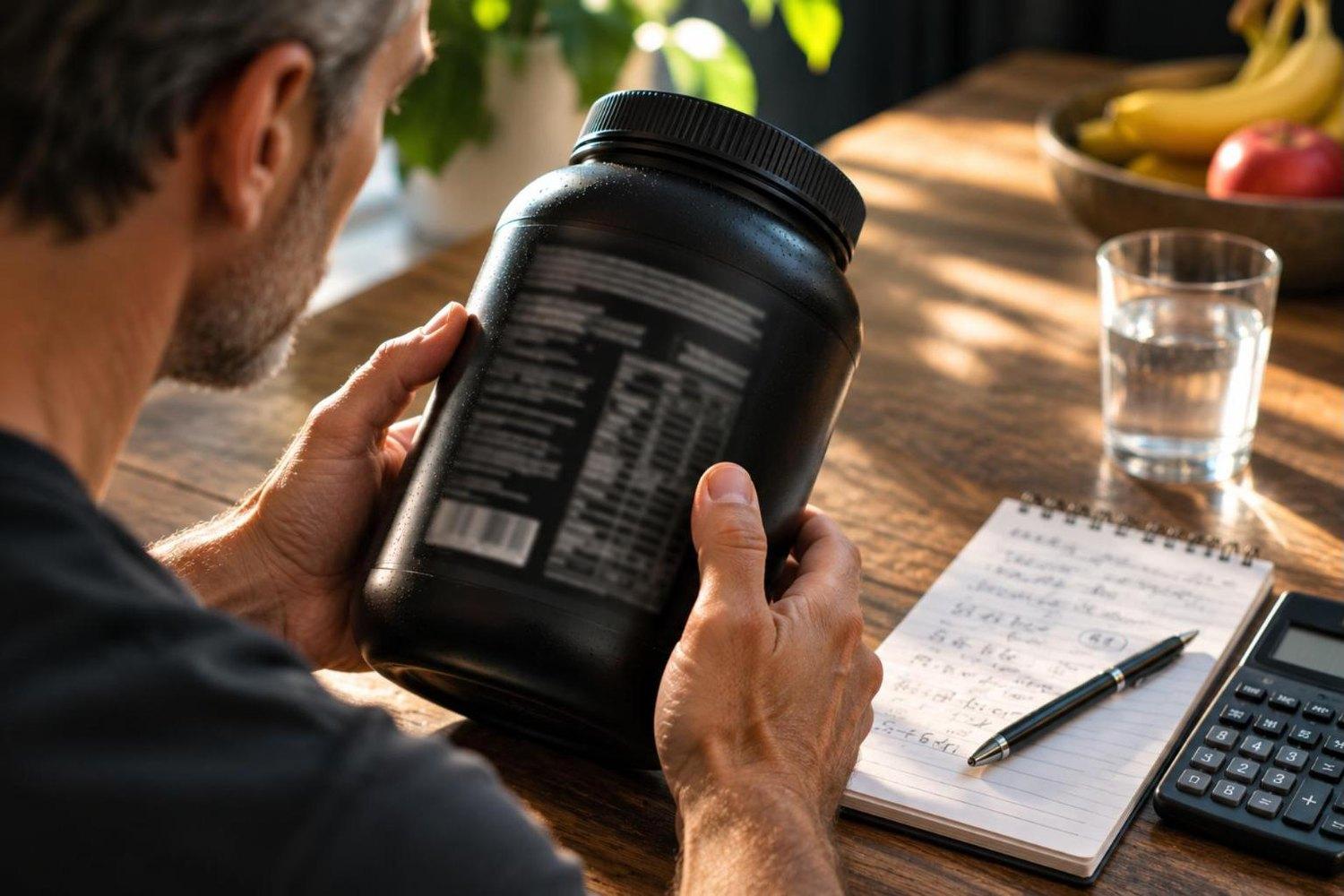
- Read the ingredients list. Ingredients are listed in descending order of quantity. "Whey protein isolate" first means: mostly isolate. "Whey protein concentrate, whey protein isolate" means: mostly concentrate with some isolate.
- Check protein per 100 g. Flavoured isolates are usually around 80 to 90 g, flavoured concentrates around 70 to 80 g.
- Check carbohydrates per 100 g. Well under 2 g points to isolate, 4 to 8 g to concentrate.
- Check fat per 100 g. Isolates are usually under 2 g, concentrates at 5 to 8 g.
| Label signal | points to concentrate | points to isolate |
|---|---|---|
| First ingredient | whey protein concentrate | whey protein isolate |
| Protein per 100 g (flavoured) | approx. 70–80 g | approx. 80–90 g |
| Carbohydrates per 100 g | approx. 4–8 g | usually under 2 g |
| Fat per 100 g | approx. 5–8 g | usually under 2 g |
| Texture | creamy | thinner or clear |
If you are looking for the complete buying checklist – including amino spiking, lab reports and price per gram of protein – you'll find it in How to recognise good whey protein.
What does the difference cost?
Isolate is more complex to produce, which is reflected in the price. For our products:
Price per 25 g of protein
Syrax products at regular prices, as of November 2026. With isolate you mainly pay for less lactose and fat, not for more effect.
- Premium Whey (concentrate)approx. €1.47
- Clear Whey (isolate)approx. €1.76
Afișează datele ca tabel
| Categorie | Price per 25 g of protein |
|---|---|
| Premium Whey (concentrate) | approx. €1.47 |
| Clear Whey (isolate) | approx. €1.76 |
That's about 30 cents per shake, or about €9 a month with one shake a day. For someone who tolerates concentrate well, the money is better spent elsewhere – for example on creatine, which costs around €5 a month.
Which whey suits you?
| Your situation | Recommendation | Why |
|---|---|---|
| You tolerate dairy well | concentrate | cheaper, creamier, versatile |
| Lactose-sensitive, even small amounts bother you | isolate | hardly any milk sugar |
| Bloating with concentrate | try isolate, check ingredients | often lactose, sometimes sugar alcohols |
| Shake with milk, porridge, baking | concentrate | texture and taste |
| In summer, after sport, refreshing | clear whey (isolate) | clear, light, cold |
| Strict diet, every calorie counts | both, with water | difference only 10–20 kcal |
| Milk protein allergy | neither | plant-based powder |
| Coeliac disease | check the label | our clear whey contains gluten |
Common mistakes
- Buying isolate because "purer = better". For muscle, the amount of protein counts, not the degree of filtration.
- Believing the product name. "Iso" in the name is no proof – the ingredients list is.
- Confusing lactose intolerance with milk protein allergy. With an allergy, isolate doesn't help.
- Mixing isolate with milk. Then the lactose advantage is gone.
- Mixing clear whey with milk. It is acidified and can curdle.
Conclusion: tolerance decides, not purity
Isolate is not the better whey, but the more digestible and lighter one. If you tolerate concentrate well, you get the same protein and a creamier shake for less money. If you react to milk sugar or prefer something clear in summer, isolate is a real solution – and you pay a fair premium for it.
What whey can do in general and how much of it you need is covered in the whey protein guide. Werner did the direct taste and everyday comparison between creamy whey and clear whey in Whey or clear whey?.
Sources: EFSA: Scientific Opinion on lactose thresholds in lactose intolerance and galactosaemia (2010) · Verbraucherzentrale: Whey protein – what you should know about milk whey protein (2026) · Morton et al.: Meta-analysis of protein supplementation and resistance training (2018) · Jäger et al.: ISSN Position Stand – Protein and Exercise (2017) · Tang et al.: Whey, casein and soy after resistance exercise (2009) · Labels and product specifications of Syrax Premium Whey and Syrax Clear Whey (as of November 2026)
Întrebări frecvente
What is the difference between whey and whey isolate?
Both are whey protein. Isolate is filtered more heavily and contains at least 90 percent protein in the raw material and hardly any lactose or fat. Concentrate usually contains 70 to 80 percent protein and some milk sugar and fat. The amino acid profile is almost the same.
Is isolate better for building muscle?
Not measurably, if the amount of protein is the same. Both provide all essential amino acids and a similar amount of leucine. What matters for muscle building is your daily protein intake together with training, not the form of the powder.
Is whey isolate lactose-free?
Almost, but not always completely. Good isolates contain less than 1 g of lactose per 100 g of powder, some products considerably less. Whether a product may be labelled lactose-free depends on the exact content – the label is what counts. With a milk protein allergy, isolate is also unsuitable.
Is isolate worth it for weight loss?
Only a little. Per serving, isolate typically saves 10 to 20 kcal and a little fat and carbohydrate. Over the day this hardly matters. It is more important to make your shake with water instead of milk and to get enough protein overall.
Which is better: designer whey or iso whey?
You can't tell from the name, because 'designer' or 'iso' are product names, not protected terms. What counts is the ingredients list: does it say whey protein concentrate, whey protein isolate or a blend, and in which order? Protein content, lactose and price follow from that.
What is whey hydrolysate?
Hydrolysate is whey protein that has been split into shorter fragments with enzymes. It is absorbed slightly faster, tastes more bitter and is more expensive. For recreational athletes it brings no measurable everyday advantage over concentrate or isolate.
Is clear whey an isolate?
Yes. Clear whey is a whey protein isolate that is additionally acidified. This keeps the protein dissolved and makes the drink clear and refreshing like iced tea. Syrax Clear Whey provides 24.7 g of protein per 30 g serving with less than 0.1 g of carbohydrates and fat.
Etichete
- Whey isolate
- Whey protein
- Concentrate
- Lactose
- Protein powder
- Product comparison
Despre autor
Eduard Boehm· Autor despre nutriție, nutrienți și suplimente
Eduard Boehm se ocupă intens de zeci de ani de nutriție, suplimente alimentare și influența lor asupra organismului. În Revista Syrax își îmbină experiența îndelungată cu cunoștințele actuale despre suplimente, nutrienți și o alimentație conștientă – cu atenție la etichetă, doză și studii.
Mai multe despre EduardAcest articol are caracter informativ și nu înlocuiește sfatul medical. Dacă ai afecțiuni, dureri sau nelămuriri, discută cu medicul înainte de a-ți schimba antrenamentul sau alimentația.
Syrax Magazin
Citește în continuare

Suplimente
Whey Protein: What It Is, What It Does and How Much You Really Need
Eduard Boehm's complete whey guide: what whey protein is, the difference between protein and whey, nutrition and calories, effects, the right amount, water or milk, side effects and whether too much whey is harmful – with label values, cost per 25 g of protein and clear decision aids.
14 min de cititEnglish
Suplimente
Whey or Clear Whey? Nutrition, Tolerance and Price in an Honest Comparison
Classic whey protein or clear whey isolate? Werner Ludmann compares protein, leucine, lactose, calories, taste and cost per 25 g of protein – with label evidence for the Syrax products and a clear recommendation of when each powder fits.
9 min de cititEnglish
 Ghid mare
Suplimente
How to Assess Supplements: Reading the Label, Dose, Upper Limits and Lab Report
How good is a dietary supplement really? Eduard Boehm shows step by step how to read labels, check the dose against reference values and BfR maximum levels, understand lab reports, assess additives and calculate the price per effective serving – explained using real labels and analyses of Syrax products.
14 min de cititEnglish