LEEK Pulse Pro in Detail: The Fitness Tracker Without a Display or Subscription
No screen, no cloud, no subscription, up to 30 days of battery: the LEEK Pulse Pro deliberately takes a different path from smartwatches. What the band measures, how the analysis works, where its limits are – and who it is worth it for.
 Autor:Michael Lohrberg
13 min čítania
Tento článok zatiaľ nie je dostupný v slovenčine. Zobrazuje sa v jazyku: English.
Plná transparentnosť: tento článok sa týka LEEK Pulse Pro – produktu spoločnosti Syrax, vydavateľa tohto magazínu.
V skratke
The LEEK Pulse Pro is a fitness band without a display or GPS that focuses on heart rate, HRV, SpO2, stress, sleep stages and activity, and uses them to calculate sleep, recovery and strain scores. What sets it apart: up to 30 days of battery life, no cloud – your data stays on your smartphone – and no subscription: every feature is included in the purchase price. The app currently runs on Android. It suits anyone who wants to keep an eye on recovery and strain without wearing another smartwatch. If you need GPS tracks, a display or smartwatch features, a sports watch is the better choice.
Obsah
Smartwatches can do almost anything today: make calls, pay, navigate, answer messages, stream music. And that is exactly the problem for many people. If you mainly want a device to understand your training, sleep and recovery better, you end up wearing a small computer on your wrist that vibrates constantly, needs charging every night and sends your health data to some cloud.
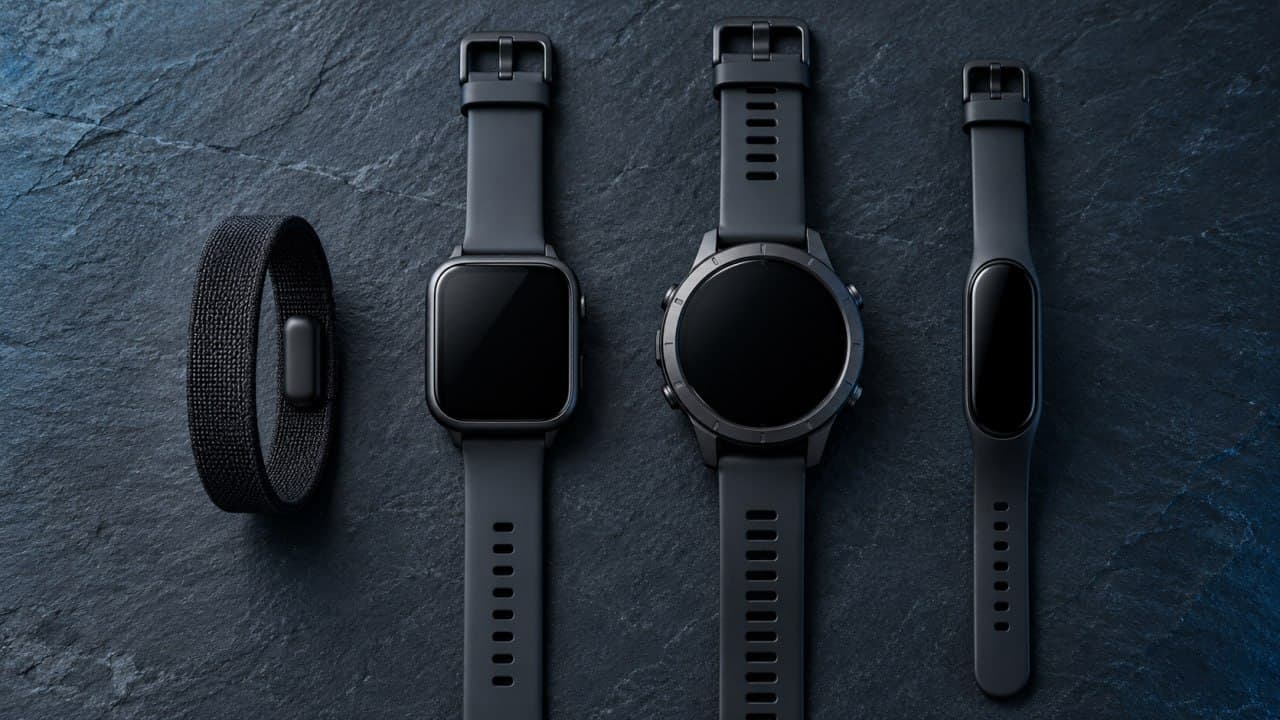
The LEEK Pulse Pro deliberately goes the opposite way. No display. No GPS. No cloud. No subscription. Instead, a slim band that stays on your wrist around the clock, lasts up to 30 days without charging and concentrates on what really matters for training and recovery: heart rate, heart rate variability, sleep, strain and recovery.
In this article we show what the band measures, how the analysis works, where the concept's strengths lie – and where it deliberately draws limits. The article belongs to the Wearables & Tracking topic.
Key specifications at a glance
| Feature | LEEK Pulse Pro |
|---|---|
| Form factor | Fitness band without display |
| Sensors | optical heart rate sensor (PPG), SpO₂, 6-axis motion sensor (IMU) |
| Metrics | heart rate, HRV, blood oxygen saturation (SpO2), stress, sleep stages, steps, activity |
| Analysis | sleep, recovery and strain scores, heart rate zones |
| Sport modes | over 236 |
| GPS | no built-in GPS |
| Battery life | up to 30 days, charges in about 2 hours |
| Water resistance | IP68 – showering and swimming possible |
| Connectivity | Bluetooth Low Energy 5.3 |
| App | LEEK app, currently Android only (Android 8.0 or later) |
| Data storage | on the smartphone, no cloud |
| Subscription | none |
| Price | 179,90 € |
| Availability | first series launches end of 2026 |
The concept: why a tracker without a display?
At first glance, a fitness tracker without a screen looks like a step backwards. At second glance, it is a consistent decision that makes the device better for a particular purpose.
First: battery life. The display and GPS receiver are among the biggest power consumers in any wearable. Doing without both gains an enormous amount of runtime. Instead of charging every night or every other day, you put the band on its charger about once a month. That sounds like convenience, but it has a tangible benefit for data quality: gaps hardly ever occur. If you charge your smartwatch at night, you do not measure your sleep – and sleep is central to assessing recovery.
Second: distraction. A band without a display does not vibrate with every email, shows no notifications and does not invite you to keep looking at your wrist. For many people that is a real plus – especially during sleep and free time.
Third: focus. The concept is not about replacing your smartphone on your wrist but about one question: how well recovered am I, and how much load can my body handle today? You do not answer that question in seconds on a tiny display, but calmly in the app.
The concept is not new – other recovery trackers also do without a display. What is new is the combination with no cloud and no subscription. How the band compares with the Apple Watch, Garmin, Whoop and Fitbit is examined in a separate, detailed article: LEEK Pulse Pro vs. Apple Watch, Garmin, Whoop and Fitbit.
What the LEEK Pulse Pro measures
Heart rate in everyday life and in training
The optical sensor measures heart rate via light reflection at the wrist. In everyday life, the band records heart rate at regular intervals to save battery; during training it switches to a second-by-second mode that captures the course of the effort in detail. From this the app calculates heart rate zones, time in each zone and the overall load of a session.
For training with steady effort – walking, easy running, cycling, rowing – a wrist sensor is a good tool. In strength training and short intervals, optical sensors reach fundamental limits; more on that below.
Resting heart rate and HRV
Two of the most valuable values a wearable provides are resting heart rate and heart rate variability at night. Together they show whether your nervous system is in recovery or stress mode. If your resting heart rate rises over several days while your HRV falls, that is often the first signal of too much load, too little sleep or an oncoming infection. How to read these values is explained in detail in Understanding HRV.
Blood oxygen saturation (SpO2)
The band estimates blood oxygen saturation optically. In healthy people at rest it is typically in the high nineties and varies little. The value becomes interesting mainly during sleep and at altitude. Important: as with all fitness trackers, the SpO2 measurement is a wellness value and no substitute for a medical pulse oximeter. What the value can and cannot show is covered in SpO2 during sleep.
Stress
From heart rate and HRV, the band derives a stress assessment over the day. It shows when your body was under tension – in a meeting, in a traffic jam, after the third coffee. For many people that is surprisingly honest feedback. How such values are generated is explained in Measuring stress with a wearable.
Sleep stages
Using movement and heart rate, the band distinguishes between deep sleep, REM sleep, light sleep and wake phases. Added to that are total sleep time, when you fell asleep and interruptions. No wrist-based measurement replaces a sleep lab – but for trends over weeks, such as the effect of alcohol, late meals or a new evening routine, this data is very valuable. More on the stages in Sleep stages explained.
Steps, activity and over 236 sport modes
Steps, active time and calorie burn are part of the basic package. For training, over 236 sport modes are available, from strength training to running and cycling to martial arts and ball sports. The modes help classify and analyse your sessions. Calorie figures are – as with all wearables – estimates and should be understood as a trend, not an exact number. The background is in Calorie burn on your watch: why the number lies.
Sleep, recovery, strain: the three core scores
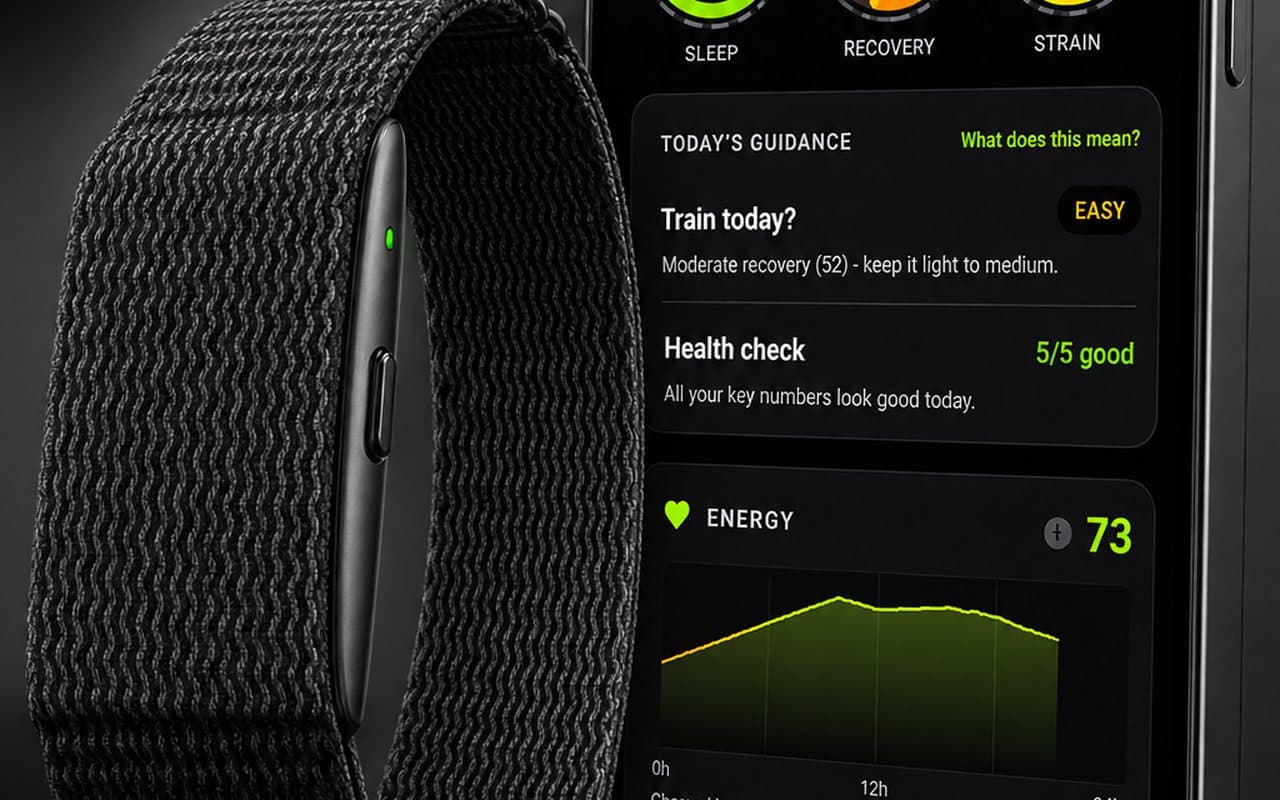
Raw data is good; decision aids are better. The app condenses the measurements into three core scores that together form a simple system:
| Score | What it reflects | What you use it for |
|---|---|---|
| Sleep | duration, stages, interruptions, regularity | Did you sleep enough and well enough? |
| Recovery | resting heart rate, HRV and sleep compared with your normal range | How ready is your body for load today? |
| Strain | cardiovascular load from training and everyday life | How much did you demand of your body today? |
The interplay is the real benefit: a high recovery score is an invitation to train hard today; a low one is the signal to reduce load. The strain score shows you whether you actually adjust your load accordingly – or whether you still go full throttle on bad days. How to turn this into concrete training decisions is shown in the practical article Training with data: how to get more out of every workout with the LEEK Pulse Pro.
Privacy: your data stays with you
Health data is among the most sensitive information there is. It reveals when you sleep, how stressed you are, when you are getting ill and how fit you are. Many wearable providers store this data on their own servers to analyse it, synchronise it and offer additional features.
The LEEK Pulse Pro uses a different model: your data stays on your smartphone. There is no cloud to which heart rate, sleep or HRV are uploaded, and no account without which the device does not work. That has clear advantages:
- Privacy: your health data is not on third-party servers.
- Independence: no dependence on server infrastructure or business models that can change.
- No ongoing costs: without cloud infrastructure, there is no reason for a subscription either.
There is also a downside that honesty requires us to mention: without a cloud there is no web dashboard in the browser, and the data is tied to your smartphone. If you change or lose your phone, you should find out about the app's transfer options beforehand. General questions about fitness data and privacy are covered in Privacy and fitness trackers.
Cost: what the band really costs over three years
The purchase price is only half the story. Some recovery trackers only work with a paid membership; other manufacturers unlock advanced analyses for a monthly fee. Over the typical two to three years you use a wearable, that adds up.
| Model | Cost in year 1 | Cost over 3 years |
|---|---|---|
| LEEK Pulse Pro (no subscription) | 179,90 € | 179,90 € |
| Recovery tracker with mandatory membership at €199/year | €199 | €597 |
| Recovery tracker with mandatory membership at €264/year | €264 | €792 |
The membership figures correspond to the annual prices quoted for Whoop in Germany (as of 2025/2026, source below). Prices can change; the calculation mainly illustrates the principle. More in Fitness trackers without a subscription: what you really pay.
The limits: what the LEEK Pulse Pro cannot do
We build this band – which is precisely why an honest list of its limitations belongs here. You should know these points before buying:
App currently Android only. The LEEK app is currently available exclusively for Android (version 8.0 or later). The band cannot currently be used with an iPhone.
No GPS. If you want to record route, pace and elevation when running or cycling, you need another device or your smartphone. For runners who train by pace, a GPS sports watch is the better choice.
No display. You cannot read the time, live heart rate or training data on your wrist. If you want to keep checking your heart rate during interval training, you will miss that.
Optical heart rate in strength training. This applies to all wearables with a wrist sensor: when you grip the bar tightly and bend your wrist, optical measurement becomes less accurate. Wrist sensors typically underestimate the load in strength training. For strength athletes, sleep, resting heart rate and HRV are therefore the more valuable data – not heart rate during sets. More in Wearables for strength training: what they can't do (yet).
Everyday heart rate at intervals. To enable the long battery life, the band does not measure every second outside of training but at intervals. That is enough for resting heart rate and daily trends, but not for a seamless second-by-second curve across the whole day.
No medical functions. No ECG, no blood pressure measurement, no skin temperature. The band is a training and wellness tool, not a medical device.
No smartwatch features. Payments, music, apps – none of that exists. That is intentional, but it should be clear.
Silné stránky
- Up to 30 days of battery – hardly any data gaps, even during sleep
- No cloud: health data stays on your smartphone
- No subscription, every feature included in the price
- Focus on sleep, recovery and strain instead of feature overload
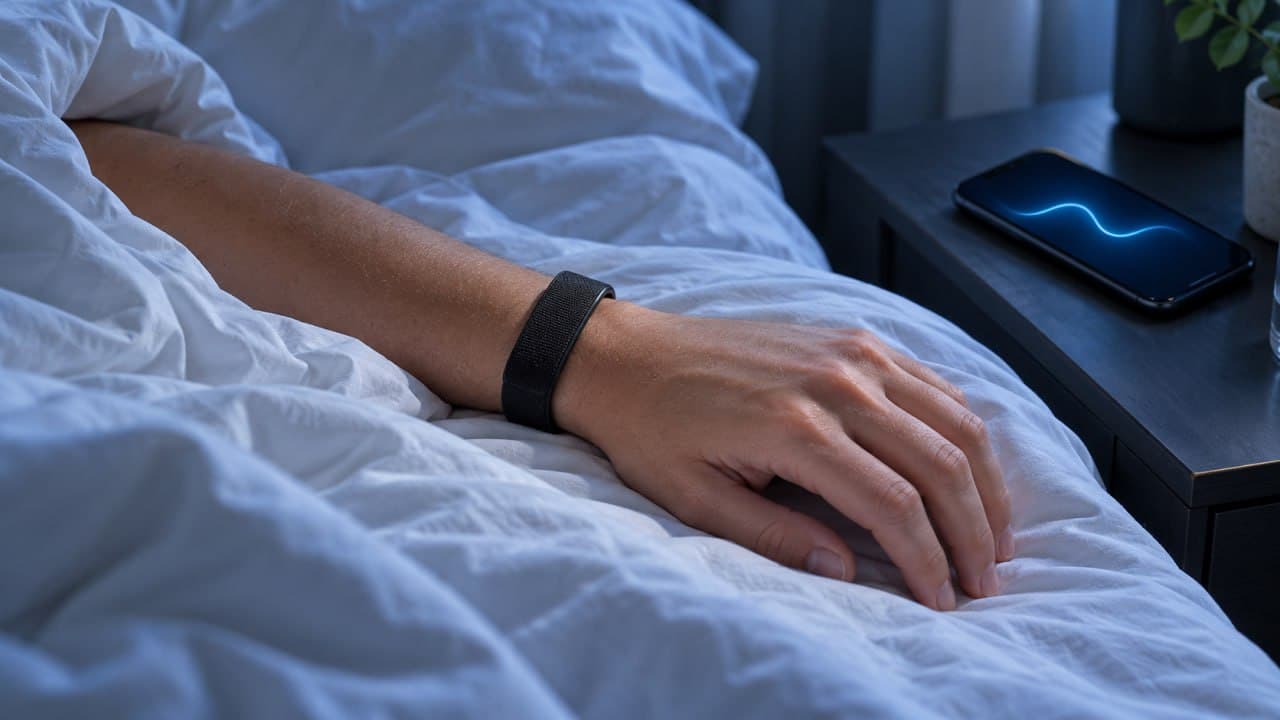
- No display, no distraction, comfortable to sleep in
- Over 236 sport modes
- IP68: showering and swimming possible
Obmedzenia
- App currently Android only
- No GPS – no route or pace recording
- No display – live values only in the app
- Optical heart rate limited in strength training (as with all wrist sensors)
- Everyday heart rate at intervals rather than every second
- No web dashboard, data tied to your smartphone
- First series only launches at the end of 2026
Three scenarios from everyday training
How does a band without a display fit into everyday life? Three typical user profiles show where the concept plays to its strengths.
The strength athlete with four sessions a week
Tobias trains on an upper/lower split and wants to make progress on the squat and bench press. He does not need his heart rate during sets – he has his training log for that. He is interested in something else: why do some weeks go brilliantly and others feel sluggish? After a month with the band he sees a clear pattern: in weeks with less than seven hours of sleep a night, his recovery scores are low, and those are exactly the weeks in which he stalls in training. Since then he moves his heaviest sessions to days with a good recovery score and puts in lighter technique sessions on red days. That is not rocket science – but without data he would not have seen the pattern. How to structure your training plan in general is covered in the muscle-building guide.
The hybrid athlete with strength and endurance
Jan combines three strength sessions with two easy bike rides and one interval session per week. For him the strain score is particularly useful: it shows how much total load accumulates over the week. He controls his easy rides using the heart rate zones in the app so that they really stay easy – a common mistake in zone 2 training. He records distance and speed with his bike computer; the band adds heart rate, strain and the night's recovery data.
The manager with little time and a lot of stress
Stefan trains twice a week and runs at the weekend. His biggest issue is not training but everyday life: long days, late emails, restless sleep. The stress assessment shows him in black and white that his body is under tension until late in the evening on office days – and that nights after the second glass of wine are noticeably worse. For him the band is less a training device than an honest mirror. The fact that he does not have to take it off at night to charge it is crucial: the sleep data is the most valuable to him. Strategies against the stress-sleep cycle are provided in Sleep as a performance booster.
Everyday use and comfort
A band that is meant to be worn for 30 days straight has to disappear in everyday life. The display-free concept helps: there is no screen lighting up at night, no reason to take the band off while cooking or at the office, and no notifications pulling you out of concentration. For heart rate measurement, as with any optical sensor: the band should fit well without constricting and be worn about a finger's width above the wrist bone. During training it can make sense to tighten it slightly. General tips on the right fit are in How to wear a fitness tracker correctly.
Who is the LEEK Pulse Pro for?
Well suited for:
- Strength athletes and hybrid athletes who want to manage their recovery without wearing a sports watch.
- People with a lot of stress at work who want to see how sleep, everyday life and training are connected.
- The privacy-conscious who do not want to put their health data in a cloud.
- The subscription-weary who want to pay once and be done.
- Watch lovers who wear their mechanical watch on the left wrist and an inconspicuous band on the right.
Less suited for:
- Runners and cyclists who train by pace and distance – a GPS sports watch is the better choice here. Criteria in Heart rate watches for runners.
- People who want smartwatch features – notifications, payments, apps.
- Anyone who needs medical measurements – that is what certified medical devices and medical diagnostics are for.
How to get the most out of the band
A tracker measures – results come from decisions. Three habits make the difference:
- Wear the band consistently, including at night. Recovery values are generated during sleep. Every night without the band is a gap in your baseline.
- Give it time. The first two to four weeks serve to learn your personal normal range. Interpret individual values cautiously during this phase.
- Act on trends, not daily values. A poor recovery score after a long evening is normal. Three bad days in a row are a signal.
You will find a step-by-step guide for the first days in Setting up the LEEK Pulse Pro: the first 7 days, and how to build the values into your training plan is shown in Training plan with recovery-based adjustments.
What we will publish after the series launch
This article describes the concept and features. After the series launch, we will document in a separate report – with a disclosed methodology – what only everyday use can show:
- Battery life under real conditions – with daily training and continuous sleep tracking.
- Plausibility of heart rate values compared with a chest strap in zone 2 sessions, intervals and strength training.
- Stability of sleep and recovery scores over several weeks and how they respond to alcohol, stress and hard training blocks.
- Everyday usability of the app: how quickly do you find the information you need for a training decision?
You will find the report after publication at 30 days of battery in everyday life: LEEK Pulse Pro field report.
Conclusion: a tool with a clear focus
The LEEK Pulse Pro is not a smartwatch replacement and does not want to be. It is a consistently focused tool for one question: how well recovered am I, and how much can I do today? For that it brings the right ingredients – resting heart rate, HRV, sleep stages, stress and strain, summarised in sleep, recovery and strain scores. The long battery life ensures gap-free data; the no-cloud privacy concept and the absence of a subscription clearly set it apart from many competitors.
If you need GPS, a display or smartwatch features, you will not be happy here. But if you do not miss those things and above all want to train, sleep and recover better, the LEEK Pulse Pro offers a well-thought-out package at a fair price with no follow-up costs. Whether it is the right choice for you compared directly with the big brands is clarified in our big comparison.
Sources and status: product information from Syrax, as of October 2026. Whoop membership prices in Germany according to the nextpit Whoop buying guide (accessed October 2026).
Časté otázky
How much does the LEEK Pulse Pro cost?
You will find the current price in the Syrax shop. There is no subscription – every feature of the app is included in the purchase price. The first series launches at the end of 2026.
Does the LEEK Pulse Pro need a subscription?
No. Unlike some recovery trackers that only work with a paid membership, the LEEK Pulse Pro has no ongoing fees. The analysis happens in the companion app on your smartphone.
Does the LEEK Pulse Pro work with an iPhone?
Not at the moment. The LEEK app is currently only available for Android (Android 8.0 or later, Bluetooth 5.0). If you use an iPhone, you should know this before buying.
Does the LEEK Pulse Pro have GPS?
No, the band has no built-in GPS. It therefore does not record routes, pace or distances when running or cycling. It measures heart rate, strain and activity without GPS.
How long does the LEEK Pulse Pro battery last?
Up to 30 days. This is made possible partly by doing without a display and GPS. As with any wearable, actual battery life depends on usage, for example the number of workouts recorded. The band is fully charged in about two hours.
Where is my data stored?
On your smartphone. There is no cloud to which health data is uploaded. That protects your privacy but also means there is no web dashboard in the browser.
Does the LEEK Pulse Pro measure blood pressure or ECG?
No. The band measures heart rate, HRV, blood oxygen saturation, stress, sleep stages and activity. Blood pressure, ECG and skin temperature are not part of its feature set. Like all fitness trackers of this kind, it is not intended for medical measurements.
Štítky
- LEEK Pulse Pro
- Syrax
- Fitness tracker
- Wearables
- Recovery
- Sleep tracking
O autorovi
Michael Lohrberg· Zakladateľ Syrax
Michael Lohrberg založil Syrax v roku 2026. Vojenská služba so zahraničnou misiou, od roku 2010 v priemysle, zmenová prevádzka a dve zamestnania súčasne – LEEK Pulse Pro vznikol z otázky, koľko regenerácie v bežnom živote skutočne zostáva. V magazíne píše o tréningu, spánku a regenerácii – prakticky a s oporou vo výskume.
Viac o MichaeloviTento článok slúži na všeobecnú informáciu a nenahrádza lekársku radu. Ak máte ochorenia, bolesti alebo pochybnosti, poraďte sa pred zmenou tréningu či stravy s lekárom.
Syrax Magazín