
Normal Values at a Glance: Resting Heart Rate, HRV, Sleep, Oxygen and Activity
Which values are normal? Resting heart rate, heart rate variability, oxygen saturation, sleep duration by age, physical activity and steps per day – all reference values from professional bodies and large studies on one page, with sources.
 Avtor:Michael Lohrberg
7 min branja
Ta članek še ni na voljo v slovenščini. Prikazan je v jeziku: English.
Na kratko
These reference values apply to healthy adults: resting heart rate 60 to 100 beats per minute, very fit athletes as low as around 40. Oxygen saturation is 95 to 100 percent; values below 90 percent are considered low. Adults should sleep 7 to 9 hours, from age 65 7 to 8. The WHO recommends 150 to 300 minutes of moderate or 75 to 150 minutes of vigorous activity per week. For the risk of death, the benefit of additional steps levelled off at about 6,000 to 8,000 steps from age 60 and at 8,000 to 10,000 in younger people. There is no fixed normal value for HRV: in short-term measurements, RMSSD averaged 42 milliseconds in healthy adults, ranging from 19 to 75. More important than any normal value is your personal trend.
Vsebina
Normal values are reference values that professional bodies and large studies describe for healthy people. They help you interpret what your fitness tracker shows in the morning: is a resting heart rate of 72 normal? Is 38 milliseconds of HRV low? Are 6.5 hours of sleep enough?
The answers are scattered across heart clinics, sleep societies, the WHO and scientific journals. This page brings them together with sources. It is part of the Wearables & Tracking topic.
All normal values at a glance
| Value | Reference value for healthy adults | Source |
|---|---|---|
| Resting heart rate | 60–100 beats per minute; very fit athletes around 40 | Mayo Clinic |
| Resting heart rate in daily life (tracker data) | average 65 beats per minute, range 40–109 | Quer et al. 2020 |
| HRV (RMSSD, short-term) | mean 42 ms, range 19–75 ms | Nunan et al. 2010 |
| HRV (SDNN, short-term) | mean 50 ms, range 32–93 ms | Nunan et al. 2010 |
| Oxygen saturation (SpO2) | 95–100%; below 90% is considered low | Mayo Clinic |
| Sleep duration | 7–9 hours (18–64 years), 7–8 hours (65+) | National Sleep Foundation 2015 |
| Physical activity | 150–300 min moderate or 75–150 min vigorous per week | WHO 2020 |
| Steps | benefit levels off at 6,000–8,000 from age 60, at 8,000–10,000 below | Paluch et al. 2022 |
Resting heart rate: 60 to 100 – but everyone has their own
For adults, a resting heart rate of 60 to 100 beats per minute is considered normal. Very fit athletes may be around 40 beats (Mayo Clinic).
Resting heart rate in adults
Reference values in beats per minute, measured at rest. Source: Mayo Clinic. A low heart rate is often normal in trained people; with symptoms such as dizziness it should be checked.
- Very fit athletes · 40–60 bpmaround 40 possible
- Normal range · 60–100 bpm60–100
- Elevated · 100–120 bpmover 100 at rest
How different a "normal" resting heart rate can be is shown by an analysis of 92,457 adults who wore a tracker for at least 35 weeks between 2016 and 2018: the average daily resting heart rate was 65 beats per minute, and the range between individuals was 40 to 109. The personal normal value of two healthy people can therefore differ by as much as 70 beats (Quer et al., PLOS ONE 2020).
Within one person, however, resting heart rate stayed fairly stable. It was lowest in July and highest in January. Yet 20 percent of participants had at least one week in which it fluctuated by 10 beats or more.
HRV: no fixed normal value
Heart rate variability describes the fluctuations between individual heartbeats. The most comprehensive review of normal values to date comes from 44 studies with 21,438 healthy adults (Nunan et al., Pacing and Clinical Electrophysiology 2010):
| HRV measure | Mean (standard deviation) | Range |
|---|---|---|
| RMSSD | 42 ms (15) | 19–75 ms |
| SDNN | 50 ms (16) | 32–93 ms |
| Interval between heartbeats | 926 ms (90) | 785–1,160 ms |
These values come from short-term ECG measurements, usually over a few minutes lying down. Wearables measure differently, often across the whole night, and calculate values with their own algorithms. So: compare your HRV with yourself, not with others. How to read it correctly is explained in Understanding HRV.
Oxygen saturation: 95 to 100 percent
Healthy pulse oximeter readings range from 95 to 100 percent. Values below 90 percent are considered low (Mayo Clinic). Slightly lower values are possible during sleep and at altitude.
Oxygen saturation (SpO2)
Reference values for pulse oximeter readings at rest. Source: Mayo Clinic. Wrist-worn wearables measure less accurately than finger clips – check unusual values with a pulse oximeter and have them assessed by a doctor.
- Low · 85–90%below 90%
- Below normal range · 90–95%90–94%
- Normal · 95–100%95–100%
How accurately optical sensors measure saturation and where their limits lie is shown in the data overview on tracker accuracy.
Sleep duration by age
In 2015, an 18-member expert panel of the National Sleep Foundation recommended how much sleep healthy people need at every age (Hirshkowitz et al., Sleep Health 2015):
| Age group | Recommended sleep duration |
|---|---|
| Newborns (0–3 months) | 14–17 hours |
| Infants (4–11 months) | 12–15 hours |
| Toddlers (1–2 years) | 11–14 hours |
| Preschoolers (3–5 years) | 10–13 hours |
| School-age children (6–13 years) | 9–11 hours |
| Teenagers (14–17 years) | 8–10 hours |
| Young adults (18–25 years) | 7–9 hours |
| Adults (26–64 years) | 7–9 hours |
| Older adults (65+) | 7–8 hours |
Recommended sleep duration: lower limit by age
Minimum recommended hours of sleep per day. Source: National Sleep Foundation (Hirshkowitz et al. 2015).
- School-age children9–11 h
- Teenagers8–10 h
- Adults7–9 h
- 65 and over7–8 h
Prikaži podatke v tabeli
| Kategorija | h |
|---|---|
| School-age children | 9–11 h |
| Teenagers | 8–10 h |
| Adults | 7–9 h |
| 65 and over | 7–8 h |
The panel stresses that needs vary from person to person and that shorter or longer sleep can be appropriate in individual cases. But anyone who habitually sleeps far outside the range should look into the cause. What a tracker can do here is covered in the sleep tracker comparison. How long people in Germany actually sleep and how common sleep problems are is shown on the data page Sleep in Germany.
Physical activity: the WHO recommendation
The World Health Organization updated its physical activity recommendations in 2020 (Bull et al., British Journal of Sports Medicine 2020):
| Group | Recommendation |
|---|---|
| Adults | 150–300 minutes moderate or 75–150 minutes vigorous per week, or a combination |
| Children and adolescents | an average of 60 minutes moderate to vigorous per day |
| All age groups | regular muscle-strengthening activity and less sitting |
The WHO stresses that some activity is better than none and that more is better for health. The evidence was not sufficient to set a fixed limit for sitting.
Steps per day
A meta-analysis of 15 cohorts with 47,471 adults found that the risk of death fell with more steps – in people aged 60 and over up to about 6,000 to 8,000 steps a day, in younger people up to about 8,000 to 10,000 (Paluch et al., The Lancet Public Health 2022). So 10,000 is a good but not a magic number. How accurately bands count is explained in the step counter wristband guide.
How to use normal values correctly
- Know your own normal range first. Wear your tracker for two to four weeks and note the average and the variation.
- Trends instead of daily values. A single high resting heart rate after a short night is normal. What stands out is a sustained deviation over several days.
- Same conditions. Compare values at the same time of day and with the same device.
- Symptoms come first. Shortness of breath, chest pain, dizziness or palpitations should be checked by a doctor – whatever the table says.
Cite this overview
Do you write about health values or wearables? You are welcome to use the tables on this page. Please name the original source and link to this overview, for example:
Syrax Magazin: "Normal Values at a Glance: Resting Heart Rate, HRV, Sleep, Oxygen and Activity", syrax.site/en/magazin/normal-values-resting-heart-rate-hrv-sleep
How the LEEK Pulse Pro helps
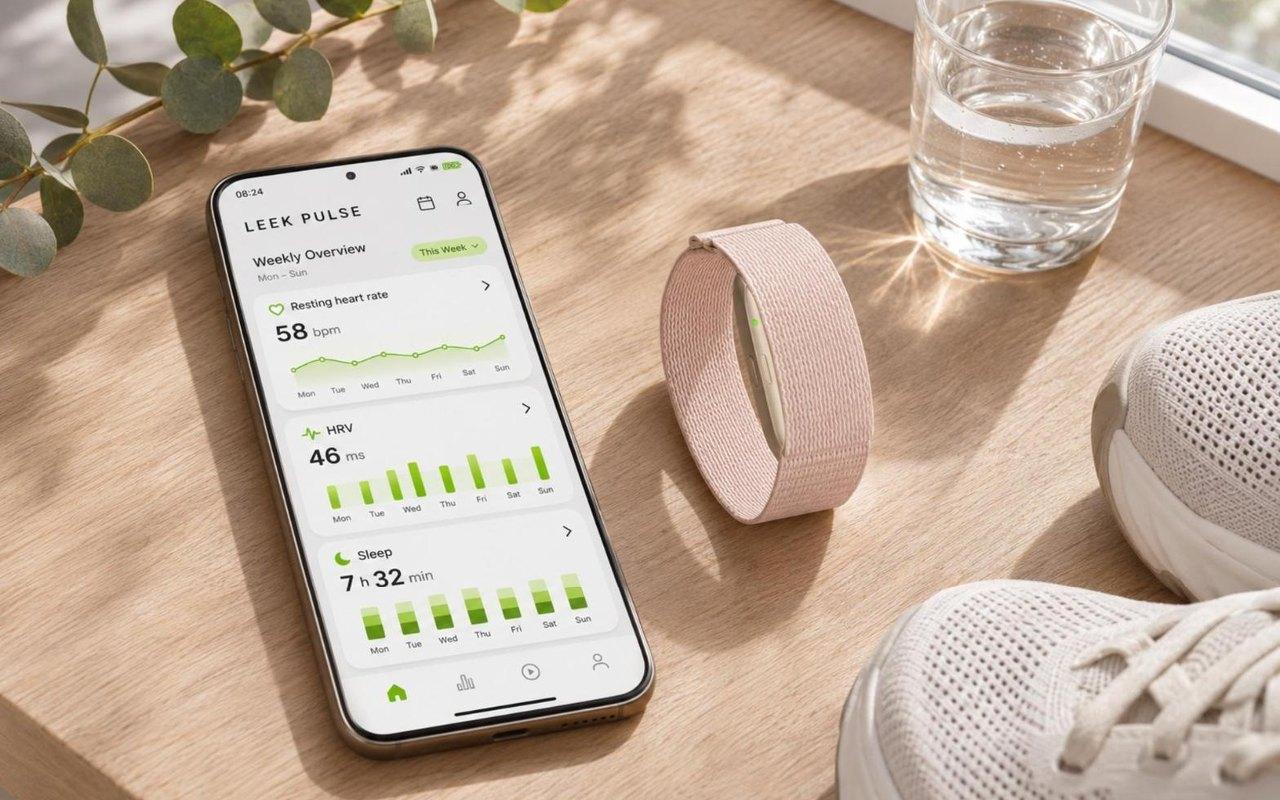
The LEEK Pulse Pro measures resting heart rate, HRV, oxygen saturation, sleep and steps around the clock and shows weekly and monthly trends in the app. With up to 30 days of battery life there are hardly any gaps – important if you want to know your personal normal range. The app is free and without a subscription, and the data stays on your smartphone; it is currently only available for Android. More in LEEK Pulse Pro in detail.
Conclusion: reference value and personal trend
Normal values give you a framework, but not a yardstick for every single day. If you know your own values over weeks, you will notice changes much earlier than any table. Use the overview for orientation – and above all pay attention to how your values develop compared with yourself.
Sources:
- Bull FC et al. (2020): World Health Organization 2020 guidelines on physical activity and sedentary behaviour. British Journal of Sports Medicine 54(24):1451–1462.
- Hirshkowitz M et al. (2015): National Sleep Foundation's sleep time duration recommendations: methodology and results summary. Sleep Health 1(1):40–43.
- Nunan D et al. (2010): A quantitative systematic review of normal values for short-term heart rate variability in healthy adults. Pacing and Clinical Electrophysiology 33(11):1407–1417.
- Paluch AE et al. (2022): Daily steps and all-cause mortality: a meta-analysis of 15 international cohorts. The Lancet Public Health 7(3):e219–e228.
- Quer G et al. (2020): Inter- and intraindividual variability in daily resting heart rate and its associations with age, sex, sleep, BMI, and time of year. PLOS ONE 15(2):e0227709.
- Mayo Clinic: Heart rate: What's normal? (accessed 17 November 2026).
- Mayo Clinic: Hypoxemia (low blood oxygen) (accessed 17 November 2026).
Pogosta vprašanja
What resting heart rate is normal?
For adults, 60 to 100 beats per minute is considered normal. Very fit endurance athletes can be around 40. In a study of over 92,000 tracker users, the average resting heart rate was 65 beats per minute.
What HRV value is normal?
There is no universal normal value. In a review of 44 studies, RMSSD in healthy adults averaged 42 milliseconds, ranging from 19 to 75. Values from different devices are hardly comparable – your own trend is what counts.
What oxygen saturation is normal?
Healthy pulse oximeter readings range from 95 to 100 percent. Values below 90 percent are considered low and should be checked by a doctor, especially with shortness of breath or other symptoms.
How much sleep does an adult need?
The US National Sleep Foundation recommends 7 to 9 hours of sleep for young adults and adults, and 7 to 8 hours from age 65. Teenagers need 8 to 10 hours, school-age children 9 to 11.
How much physical activity per week does the WHO recommend?
Adults should do 150 to 300 minutes of moderate or 75 to 150 minutes of vigorous activity per week, plus regular muscle-strengthening activity. Children and adolescents should average 60 minutes of moderate to vigorous activity a day.
Oznake
- Normal values
- Resting heart rate
- HRV
- Sleep duration
- Oxygen saturation
- Steps
- Fitness tracker
O avtorju
Michael Lohrberg· Ustanovitelj podjetja Syrax
Michael Lohrberg je leta 2026 ustanovil Syrax. Vojaška služba z misijo v tujini, v industriji od leta 2010, izmensko delo in dve službi hkrati – LEEK Pulse Pro je nastal iz vprašanja, koliko regeneracije v vsakdanu dejansko ostane. V magazinu piše o treningu, spanju in regeneraciji – praktično in na podlagi raziskav.
Več o MichaeluTa članek je splošna informacija in ne nadomešča zdravniškega nasveta. Če imaš bolezni, bolečine ali dvome, se pred spremembo treninga ali prehrane posvetuj z zdravnikom.
Syrax Magazin
Beri naprej
Nosljive naprave in sledenje
How Accurate Are Fitness Trackers? The Research in Numbers
Steps, heart rate, HRV, sleep, calories, oxygen and heart rhythm: what independent validation studies show about the accuracy of fitness trackers and smartwatches – all key figures with sources on one page.
11 min branjaEnglish
 Veliki vodnik
Regeneracija in HRV
Understanding HRV: What Heart Rate Variability Reveals About Your Recovery
HRV is probably the most valuable metric a wearable can provide – and the most often misunderstood. What it measures, which values are normal, how to measure it properly and how to guide your training with it.
13 min branjaEnglish
Nosljive naprave in sledenje
Sleep Trackers Compared: Band, Ring, Watch or Mat – What Really Measures
Sleep trackers come as wristbands, smartwatches, rings, under-mattress mats or apps. What they measure, how accurate they are compared with a sleep lab, which type suits whom and what to look for when buying – with studies and an honest assessment.
9 min branjaEnglish