
Discipline vs. Motivation: What Really Gets You to Your Goal
Motivation is a feeling, discipline is a system. Why both work differently than you think, which kind of motivation lasts, how to build discipline without torturing yourself and what helps on bad days.
 作者:Michael Lohrberg
閱讀時間 5 分鐘

本文尚未提供繁體中文版,目前以 English 顯示。
重點摘要
Motivation is a fluctuating feeling; discipline is the ability to act according to a plan even when the feeling is missing. But long-term success rarely belongs to those with the most willpower – it belongs to those with the best systems: fixed routines, little friction, small minimum versions and goals that match their own values. Motivation that comes from enjoyment, a sense of competence and personal meaning lasts far longer than outside pressure. You build discipline best by making decisions in advance instead of fighting for them every day.
目錄
"I just lack discipline." Hardly any sentence is heard more often when a training resolution has failed. Behind it is the idea that successful people have more willpower – and that if you don't have it, you're just not made for regular training.
Research paints a different picture. People who keep going for years usually struggle less with themselves than others – because they have shaped their environment and everyday life so that the struggle never happens in the first place. This article explains how motivation and discipline really work. It belongs to the Mindset & Habits topic.
Two terms that are often confused
| Motivation | Discipline | |
|---|---|---|
| What it is | a feeling, an inner drive | the ability to act according to a plan |
| Availability | fluctuates daily | can be trained and relieved |
| Typical role | starting, new goals | keeping going, bad days |
| Limit | fades when novelty wears off | exhausting when everything requires willpower |
Both are useful – but neither alone lasts. What lasts is a system: routines that become so natural that they need neither motivation nor discipline. How to build such routines is covered in the pillar article Stick with it instead of starting over.
Which motivation lasts?
Psychology roughly distinguishes between external and internal motivation. Self-determination theory, one of the best-researched theories of motivation, describes three basic needs that nourish internal motivation: autonomy (I decide for myself), competence (I'm getting better) and relatedness (I belong).
| Type of motivation | Example | Durability |
|---|---|---|
| Outside pressure | "My doctor says I have to." | low |
| Guilt | "I ate too much, so I have to train." | low, often stressful |
| Personal meaning | "I want to go hiking with my kids in 20 years." | high |
| Enjoyment and competence | "I like the feeling of getting stronger." | very high |
What that means in practice:
- Autonomy: choose forms of training that suit you instead of a plan you hate.
- Competence: make progress visible – with a training log or tests every few weeks.
- Relatedness: train with others, in a class or with a partner.
The willpower myth
For a long time, the theory held that willpower is a limited resource that runs out over the course of the day. However, large replication studies involving many labs could not reliably confirm this effect. Regardless, experience shows: when tired, stressed or hungry, people tend to choose the convenient option.
The practical consequence is the same: don't rely on willpower in the decisive moment. Make the decision beforehand.
7 strategies for more discipline without the torture
1. Make decisions in advance. Fixed training days and times in your calendar, a fixed plan. When the moment comes, there's nothing left to weigh up.
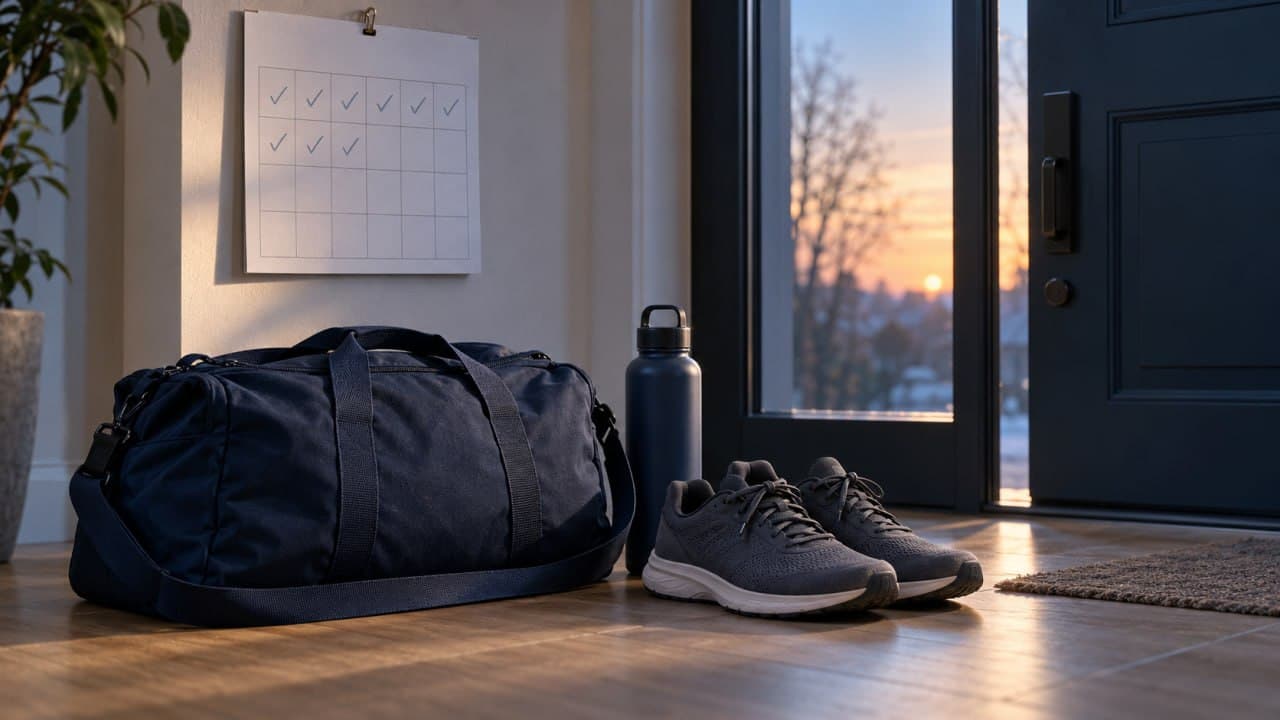
2. Remove friction. Pack your bag the night before, choose a gym on your way, lay out your clothes. The easier the start, the less often you need to push yourself.
3. Agree on a minimum version. Ten minutes count. Often it becomes more – and if not, the chain stays intact.
4. Temptations out, aids in. What isn't within reach, you don't have to refuse. What is visibly ready, you're more likely to use.
5. Identity instead of outcome. "I am someone who trains" carries further than "I want to lose five kilos".
6. Self-compassion instead of self-criticism. Studies show that people who are kind to themselves after setbacks are more likely to get back on track than those who condemn themselves.
7. Celebrate progress. Small wins – the first complete week, a new personal best – reinforce the behaviour.
Example: two ways through a stressful week
Jonas relies on his motivation. On Monday he's full of energy; on Tuesday a long working day gets in the way; on Wednesday he feels too tired; on Thursday "the week isn't worth it any more". Result: one session, a guilty conscience, a restart next Monday.
Miriam has a system. Her three sessions are in her calendar, her bag is in the car. On the long Tuesday she does the minimum version – 20 minutes of compound lifts. On Wednesday, after a bad night, she swaps a hard session for an easy one. Result: three sessions, none of them perfect, the habit intact.
The difference isn't willpower but preparation.
Goals that motivate rather than paralyse
Goals can drive you or frustrate you. The key differences:
- Process goals ("train three times a week") are in your hands; outcome goals ("ten kilos less") only partly. Combine both, but measure mainly the process.
- Short horizons: a goal for the next six to eight weeks motivates more than an annual goal.
- Personal meaning: write down why the goal matters to you.
How to formulate goals concretely is explained in Setting fitness goals.
Bad days: when a break is wiser
Discipline doesn't mean ignoring warning signs. On some days, an easy session or a break is the disciplined decision:
- with illness, fever or symptoms below the neck,
- after several nights with very little sleep,
- with pain that goes beyond muscle soreness,
- when recovery values such as resting heart rate and HRV deviate clearly from your normal range over several days – more in Understanding HRV.
If you have had no drive at all for a long time, look more closely: overload, lack of sleep or health causes may be behind it. More on motivation slumps in No motivation to train? What really helps.
Building mental strength
Discipline grows with the experience of being able to rely on yourself. Every agreement with yourself that you keep – even a small one – strengthens that trust. Self-confidence in sport builds on this too. More on the subject in Mental strength in training and Self-confidence in sport.
Conclusion: fight less, plan better
You don't need more discipline, but fewer situations in which you need it. Shape your everyday life so that training is the easiest option, connect it with things that matter to you and make progress visible. Then the system will carry you through the days when motivation is missing. A plan that is well suited to getting started is the 3-day full-body plan.
常見問題
Which matters more: discipline or motivation?
Both have their role: motivation helps you start, discipline helps you keep going. Most important is a system of routines and habits that makes both less necessary, because training no longer has to be decided anew every day.
How do you become more disciplined?
By making decisions in advance (fixed training times), reducing obstacles, starting with small steps and making successes visible. Discipline is less a character trait than the result of good planning and the repeated experience that you can rely on yourself.
Why do I lose motivation after a few weeks?
Initial motivation often thrives on novelty and quick progress. Both fade after a few weeks. If you haven't built a routine by then and don't connect training with your own values or enjoyment, you lose your drive.
Is willpower a limited resource?
The idea that willpower tires like a muscle and runs out was popular for a long time. Newer, large-scale studies, however, could not reliably confirm the effect. What is certain: when tired, stressed or hungry, people tend to make convenient choices – which is why routines that don't need willpower help.
What to do on days with no drive at all?
Agree on a minimum version, for example ten minutes or just the first exercise. Motivation often only comes once you start. And if it doesn't, the habit is still strengthened. With persistent lack of drive over weeks, also consider lack of sleep, overload or health causes.
標籤
- Discipline
- Motivation
- Mindset
- Willpower
- Habits
- Self-confidence
Syrax 雜誌
延伸閱讀
 完整指南
心態與習慣
Stick With It Instead of Starting Over: Workout Habits That Last
Why motivation isn't enough and how training becomes a fixed habit: if-then plans, a minimum version, habit stacking, handling setbacks and an 8-week plan – based on habit research.
閱讀時間 8 分鐘English