
心態與習慣完整指南
Stick With It Instead of Starting Over: Workout Habits That Last
Why motivation isn't enough and how training becomes a fixed habit: if-then plans, a minimum version, habit stacking, handling setbacks and an 8-week plan – based on habit research.
 作者:Michael Lohrberg
閱讀時間 8 分鐘

本文尚未提供繁體中文版,目前以 English 顯示。
重點摘要
Habits form through repetition in the same context, not through motivation. Decide when and where you train (an if-then plan), link training to an existing routine and define a minimum version for bad days, such as ten minutes. In a well-known study it took a median of 66 days for a new behaviour to become automatic – with a wide range. A single missed day hardly matters; what counts is never skipping twice in a row.
目錄
Every January the gyms are full; by March they are empty again. That rarely comes down to a lack of knowledge or poor training plans. It is because most people rely on motivation – and motivation is an unreliable partner. It is there when you need it least and missing on exactly the days that matter.
People who have been training for years usually don't have more willpower. They have a habit. Training is as natural to them as brushing their teeth – not a decision that has to be made anew every day. This guide shows you how to get there. It is the pillar article of our Mindset & Habits topic.
Motivation vs. habit
| Motivation | Habit | |
|---|---|---|
| Driver | feeling, goal, enthusiasm | trigger in everyday life |
| Stability | fluctuates strongly | holds even on bad days |
| Energy required | high – every session is a decision | low – runs largely automatically |
| Typical course | strong start, quick decline | slow start, then stable |
Motivation is valuable for getting started. To stick with it, you need a system that works without it. How discipline and motivation interact is explored in Discipline vs. motivation.
How habits form in the brain
A habit is a behaviour that is started automatically by a trigger. Psychology describes it as a loop:
- Trigger – a situation, a time, a place or a previous action.
- Behaviour – the workout.
- Reward – the good feeling afterwards, a ticked-off session, visible progress.
The more often this loop runs in the same context, the stronger the connection becomes. At some point the trigger is enough and the behaviour starts almost by itself.
The figure comes from a University College London study in which participants built a new everyday habit. Two findings are especially important for you: it takes longer than the often-quoted 21 days. And a single missed day had hardly any effect on the result.
Build a workout habit in 4 steps
- 1
步驟 1
Write an if-then plan
Write down exactly when, where and what you train: "If it's 6 pm on Monday, Wednesday or Friday, I go straight from work to the gym and do workout A or B."
- 2
步驟 2
Define a minimum version
Define a version you can manage even on bad days, for example ten minutes or just the first exercise. It counts as done.
- 3
步驟 3
Remove obstacles
Pack your gym bag the night before, lay out your clothes, choose a gym on your way to work. Every minute of effort removed increases the likelihood.
- 4
步驟 4
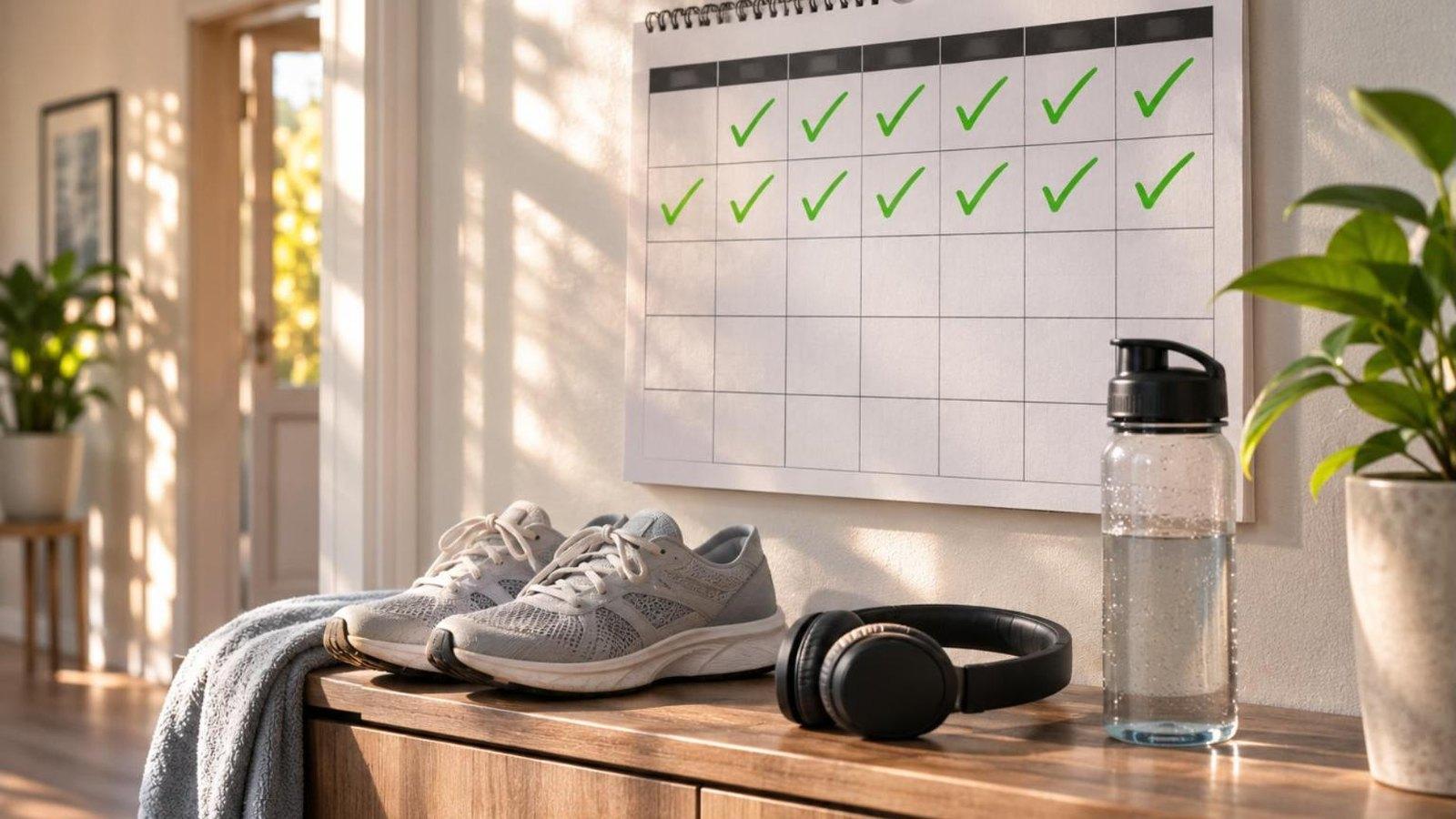
Make it visible and never skip twice
Tick off every session in a calendar. If you miss a session, the next one is mandatory – skipping twice in a row is the one rule you never break.
Strategy 1: the if-then plan
The most effective single technique for building new behaviours is called an implementation intention in research – an if-then plan. Instead of "I want to train more", you decide:
"If it's 6 pm on Monday, Wednesday or Friday, I go straight from work to the gym."
The plan links the behaviour to a concrete trigger. Numerous studies show that people with such plans carry out their intentions considerably more often than people with goals alone. The reason: the decision has already been made. When the moment comes, you no longer need to weigh it up.
How to write a good one:
- Specific days and a time instead of "three times a week".
- A specific place and the route there.
- A specific programme – you know what you will train. A proven plan is the 3-day full-body plan.
Strategy 2: habit stacking
New habits stick better when they attach to existing ones. This "stacking" uses a trigger that happens every day anyway:
- "After my morning coffee, I do ten minutes of mobility."
- "After I close my laptop, I put on my training shoes."
- "After brushing my teeth in the evening, I pack my gym bag for tomorrow."
The 10-minute mobility routine is particularly well suited as a first stacked habit because it is small, daily and needs no equipment.
Strategy 3: the minimum version
The most dangerous sentence for any habit is: "It's not worth it today." The solution is a minimum version so small that it is doable even on bad days:
- ten minutes instead of an hour
- only the first exercise of the plan
- a walk instead of a run
The minimum version counts as done. That sounds like cheating, but it is the heart of the matter: you strengthen the habit – the trigger and the action – even on days when performance isn't the focus. Often ten minutes turn into a normal session anyway once you have started.
Strategy 4: reduce friction
Every small obstacle between you and training lowers the likelihood that it happens. Conversely: the easier the start, the more often you start.
| Friction | Solution |
|---|---|
| Bag has to be packed in the morning | pack it the night before, put it by the door |
| Gym is in the wrong direction | choose a gym on your way to work or train at home |
| Unclear what to train | a fixed plan, in an app or on paper |
| Training clashes with appointments | block training times in your calendar |
| No equipment at home | minimal setup, see Setting up a home gym |
Strategy 5: make progress visible
Rewards consolidate habits. In training, the biggest reward – visible change – is unfortunately delayed. That is why you need interim rewards:
- Tick off the calendar. A chain of crosses is surprisingly motivating.
- Record your weights. Rising numbers in your training log show progress long before the mirror does.
- Watch your health data. A falling resting heart rate or more stable sleep are early wins. How that works is explained in Tracking habits.
Setbacks: the "never twice" rule
Holidays, illness, project stress – every training routine gets interrupted at some point. What matters is not whether it happens but what happens afterwards. Two thinking errors turn a lapse into quitting:
- All-or-nothing thinking: "The week is ruined anyway."
- Perfectionism: "If I can't do the whole plan, it's not worth it."
A simple rule helps: never skip twice in a row. One missed session is normal; two are the beginning of a new pattern. After longer breaks, a deliberately easy return at 50–70 percent of your previous weights helps – more in Returning to strength training.
Environment and social support
Habits don't form in a vacuum. The people and places around you make training easier or harder:
- Create commitment. A fixed appointment with a training partner, a class you have to book or a session with a coach raise the barrier to cancelling.
- Tell the people around you. If your partner, family or colleagues know your training times, you get fewer competing appointments.
- Find like-minded people. In an environment where training is normal, it becomes normal for you too – that applies to running groups just as much as to your regular gym.
What matters is that training doesn't depend entirely on others. If your partner cancels, your if-then plan still applies.
Habits for difficult life situations
Parents with young children. Time windows are short and unpredictable. Rely on two fixed 30-minute sessions plus a daily minimum version at home. A plan without equipment such as the home workout removes the commute from the equation.
Shift work. Fixed times don't work, but fixed sequences do: "after my first sleep following the early shift" or "before the late shift" are good triggers. More on planning around changing shifts in Shift work and sleep.
Lots of travel. Hotel-room bodyweight workouts or a resistance band in your suitcase keep the chain alive. On the road, the minimum version is your best friend.
Avoiding boredom without breaking the system
After a few months, routine can become monotonous. The solution is variety within the structure, not a constantly new plan:
- Swap exercise variations (for example dumbbell instead of barbell bench press) while keeping the movement patterns.
- Every eight to twelve weeks, a new training block with slightly changed rep ranges.
- Set small goals: a new record on one exercise, a run along a new route.
The habit remains the same trigger at the same time – only the content may change.
Identity: from "I'm trying" to "I am"
An underestimated factor is how you think about yourself. "I'm trying to get fitter" is a project with an end date. "I am someone who trains" is an identity. People act consistently with their self-image – those who see themselves as someone who trains skip sessions less often. Every completed session, even the minimum version, is a small piece of evidence for this identity.
Your 8-week plan
| Week | Focus | Goal |
|---|---|---|
| 1–2 | if-then plan, minimum version, bag packed the night before | 6 of 6 sessions, however short |
| 3–4 | start a training log, record weights | see the first increases |
| 5–6 | habit stacking with daily mobility | establish a daily mini habit |
| 7–8 | write a setback plan, set goals for the next 3 months | secure the routine |
How to set goals that motivate rather than frustrate is explained in Setting fitness goals.
The most common habit mistakes
Too much at once. Five training days, a new diet and meditation at the same time – that is overwhelming. Start with one habit and build on it.
Goals without a plan. "Lose ten kilos" is a goal, not a behaviour. Habits come from concrete actions.
Waiting for the right moment. Monday, next month, after the holiday – the perfect start never comes. You can begin the minimum version today.
Starting too hard. Training to exhaustion every day in the first week makes you associate training with suffering. At the start, showing up counts, not performance.
Conclusion: start small, never skip twice
The people you have seen in the gym for years have no secret. They have built training into their everyday life so that it no longer needs a daily decision. With an if-then plan, a minimum version and the "never twice" rule, you can do it too. And on days when nothing works at all, read No motivation to train? What really helps.
常見問題
How long does it take to build a habit?
In a study from University College London, it took a median of 66 days for a new behaviour to become largely automatic, with a range from 18 to more than 250 days. Complex habits such as training tend to take longer than simple ones like drinking a glass of water with breakfast.
What should I do when motivation is missing?
Don't wait for motivation. Plan training like a fixed appointment, use a minimum version for bad days and simply start with the first set. Motivation often only appears once you are doing it.
Is it bad to skip a training day?
No. In habit research, a single missed day had hardly any effect on building the habit. It only becomes a problem when one lapse turns into a series. Hence the rule: never skip twice in a row.
Morning or evening training – which is better for the habit?
The best time is the one you can stick to most reliably. In the morning there are fewer disruptions from the day; in the evening there is often more energy. What matters is a fixed time that can be linked to an existing routine.
Does a training partner help you stick with it?
Yes, for many people significantly. A fixed appointment increases commitment, and training together is often more fun. Make sure the session doesn't depend entirely on your partner – otherwise training is cancelled whenever they cancel.
標籤
- Habits
- Motivation
- Discipline
- Mindset
- Workout routine
Syrax 雜誌
延伸閱讀

心態與習慣
Discipline vs. Motivation: What Really Gets You to Your Goal
Motivation is a feeling, discipline is a system. Why both work differently than you think, which kind of motivation lasts, how to build discipline without torturing yourself and what helps on bad days.
閱讀時間 5 分鐘English
 完整指南
訓練課表
Muscle Building for Beginners: The 3-Day Full-Body Plan
The training plan for your first 12 weeks in the gym: three full-body sessions a week, six compound exercises, clear rules for weight, sets and rest – and when to switch to a split.
閱讀時間 9 分鐘English