
Pull-Up Bar at Home: The Best Exercises
The 15 best pull-up bar exercises for home – for back, arms, abs and grip strength, sorted by difficulty from hanging to the muscle-up. With technique tips, two ready-made workouts for beginners and advanced trainees and advice on safe mounting.
 ByMichael Lohrberg
6 min read
In short
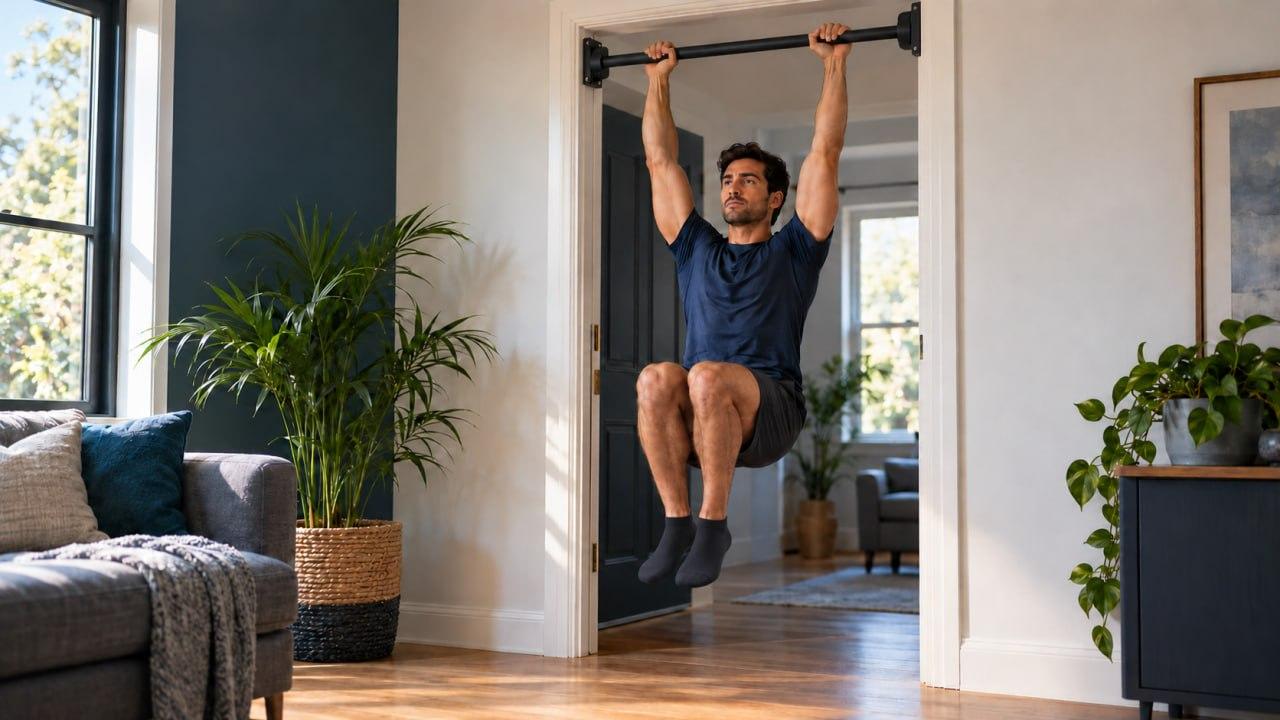
With a pull-up bar, you can train your back, biceps, forearms and abs at home as effectively as in a gym. The key exercises are active hangs, scapula pulls, negative pull-ups, pull-ups and chin-ups with different grips, hanging knee and leg raises, toes-to-bar and, for advanced trainees, archer pull-ups, L-sit pull-ups and muscle-ups. Beginners start with hangs, negatives and band assistance; three sessions a week with 2–4 exercises are enough for clear progress. A safely mounted bar and clean, full reps are essential.
Contents
A pull-up bar is perhaps the best fitness equipment per euro: it often costs less than a month's gym membership, takes up no space and closes the biggest gap in home training – pulling. Push-ups, squats and planks work anywhere. For a strong back and powerful arms, you need something to pull yourself up on.
This article shows you the 15 best bar exercises, sorted by difficulty, with technique tips and two ready-made workouts. It belongs to the Home Workout & Calisthenics topic. If you're still working on your first pull-up, the path there is in Learning pull-ups.
The 15 exercises at a glance
| No. | Exercise | Level | Main muscles |
|---|---|---|---|
| 1 | Active hang (dead hang) | beginner | grip, shoulders |
| 2 | Scapula pulls | beginner | lower traps, lats |
| 3 | Negative pull-ups | beginner | back, biceps |
| 4 | Band-assisted pull-ups | beginner | back, biceps |
| 5 | Hanging knee raises | beginner | abs, hip flexors |
| 6 | Pull-up (overhand) | intermediate | lats, upper back |
| 7 | Chin-up (underhand) | intermediate | lats, biceps |
| 8 | Neutral-grip pull-up | intermediate | back, brachialis |
| 9 | Hanging leg raises | intermediate | abs, hip flexors |
| 10 | Hanging windscreen wipers | intermediate | obliques |
| 11 | Isometric holds (top, middle) | intermediate | back, arms |
| 12 | Toes-to-bar | advanced | abs, lats |
| 13 | Archer pull-up | advanced | one-sided back and arm |
| 14 | L-sit pull-up | advanced | back, abs |
| 15 | Muscle-up | advanced | back, chest, triceps |
Level 1: beginner
1. Active hang (dead hang)
Hang from the bar with a shoulder-width grip, arms straight. "Active" means: draw your shoulders slightly down away from your ears without bending your arms. Goal: 3 × 20–60 seconds. This builds grip strength and gets shoulders and tendons used to the load.
2. Scapula pulls
From a passive hang, pull only your shoulder blades down and slightly together – your body rises a few centimetres, arms stay straight. Goal: 3 × 8–12. This exercise teaches the starting movement of every clean pull-up.
3. Negative pull-ups
Jump or step from a chair into the top position (chin over the bar) and lower yourself under control over 3–5 seconds. Goal: 3 × 3–6. You are stronger eccentrically than when pulling up, so the exercise works before you can do a full pull-up.
4. Band-assisted pull-ups
A resistance band looped over the bar and hooked under your foot or knee takes weight off at the bottom. Goal: 3 × 5–10. Choose the band so the last two reps are hard, and use thinner bands over time.
5. Hanging knee raises
From a hang, pull your knees to your chest under control, tilting your pelvis slightly, and lower without swinging. Goal: 3 × 8–15. One of the best ab exercises there is – and grip training on the side.
Level 2: intermediate
6. Pull-up (overhand)
Slightly wider than shoulder-width, palms facing away. Shoulders down, drive your elbows towards your hips until your chin is over the bar, then lower under control. Goal: 3–5 × 3–10.
7. Chin-up (underhand)
Shoulder-width, palms facing you. The biceps contribute more, and many people manage one or two more reps here. Goal: 3–4 × 5–12.
8. Neutral-grip pull-up
If your bar has parallel handles: palms facing each other. For many people, this variation is the gentlest on shoulders and elbows. Goal: 3–4 × 5–12.
9. Hanging leg raises
Like knee raises, but with straight legs to at least hip height. The long lever makes the exercise much harder. Goal: 3 × 6–12.
10. Hanging windscreen wipers
From a hang, draw your knees up and rotate them under control from side to side. Goal: 3 × 6–10 per side. Trains the obliques and core control.
11. Isometric holds
Hold a position for 10–30 seconds: at the very top (chin over the bar), at 90 degrees at the elbow or just below. Goal: 3 × 15–30 seconds. Ideal for strengthening weak points.
Level 3: advanced
12. Toes-to-bar
Bring your feet up to the bar with straight legs – strictly, without kipping. Goal: 3 × 5–10. One of the most demanding ab exercises, which also works the lats.
13. Archer pull-up
Wide grip; one arm pulls, the other stays almost straight and only assists. Alternate sides. Goal: 3 × 3–6 per side. The precursor to the one-arm pull-up.
14. L-sit pull-up
A pull-up with legs extended horizontally. The abs work isometrically throughout. Goal: 3 × 3–8.
15. Muscle-up
An explosive pull-up to chest height, transition over the bar and a support hold on top. Prerequisites are about 8–10 clean pull-ups and strong dips. For dynamic exercises like this, the bar should be bolted to the wall or ceiling – not wedged in a door frame.
Two ready-made workouts
Workout A: beginner (3× per week)
| Exercise | Sets × reps | Rest |
|---|---|---|
| Active hang | 3 × 20–30 s | 60 s |
| Scapula pulls | 3 × 8–10 | 60 s |
| Negative pull-ups | 3 × 3–5 | 90–120 s |
| Hanging knee raises | 3 × 8–12 | 60 s |
Workout B: advanced (2–3× per week)
| Exercise | Sets × reps | Rest |
|---|---|---|
| Pull-ups (overhand) | 4 × 5–8 | 2 min |
| Chin-ups | 3 × 6–10 | 90 s |
| Archer pull-ups | 3 × 3–5 per side | 2 min |
| Toes-to-bar | 3 × 6–10 | 90 s |
| Isometric hold at the top | 2 × max. | 90 s |
Always train with about 1–2 reps in reserve. When you reach the top of the range in all sets, switch to the harder variation.
How to build your workout
Your pull-up bar workout in 5 steps
- 1
Step 1
Check the bar
Before every session, check that the bar is secure: pull on it firmly and briefly hang with bent legs before loading your full weight.
- 2
Step 2
Warm up
Five minutes of arm and shoulder circles, band pull-aparts or light push-ups, then two sets of active hangs and scapula pulls.
- 3
Step 3
Main exercise
Start with the hardest pulling exercise for your level, for example negative pull-ups or pull-ups, 3–5 sets with 1–2 reps in reserve.
- 4
Step 4
Accessory work
Add a second pulling variation, such as chin-ups, and an ab exercise such as hanging knee raises, 3 sets each.
- 5
Step 5
Grip and finish
Finish with one set of dead hangs to just short of grip failure and record reps and variations in your training log.
The bar as part of a complete plan
A pull-up bar covers pulling and abs. For balanced training, add:
- Pushing: push-ups, pike push-ups, dips between two chairs.
- Legs: squats, Bulgarian split squats, lunges.
- Hips and glutes: single-leg glute bridges.
A complete full-body plan without further equipment is in Home workout without equipment; how to build muscle that way is explained in Building muscle without weights. For a structured start in calisthenics, see Calisthenics for beginners.
Safety: mounting and load
| Bar type | Advantages | Limits |
|---|---|---|
| Pressure-mounted doorway bar | cheap, no drilling | only for controlled exercises, door frame must be sturdy |
| Leverage doorway bar (hooks over the frame) | quick to mount, multiple grips | load on the top of the door frame, no swinging |
| Wall-mounted bar, bolted | very stable, more room for legs | drilling required, load-bearing wall |
| Ceiling-mounted bar | maximum freedom of movement | mounting effort, load-bearing ceiling |
Before buying, check the stated load capacity and suitable frame width, and follow the mounting instructions. Test the bar before every session. Take care with old door frames or plasterboard walls. What to look for when buying is described in Doorway pull-up bars: safe or risky?
Common mistakes
Half reps. Only full range of motion counts: arms straight at the bottom, chin over the bar at the top.
Momentum instead of strength. Kipping has its place in competitive CrossFit, not in building strength at home – and puts dangerous loads on doorway bars.
Only pull-ups. Without pressing exercises, imbalances develop between chest and back.
Going to failure too often. Elbows and forearm tendons need time to adapt to a lot of pulling. Increase volume slowly.
Conclusion: the best home equipment for your upper body
With a pull-up bar and the right exercise progression, you can train your back and arms at home just as effectively as in a gym. Start at your level, progress through the variations and combine the bar with pushing and leg exercises. That turns a small piece of equipment in your door frame into a complete training system. If you want to challenge your shoulders and body control further, the next challenge is in Learning the handstand; resistance bands are a good addition for pulling exercises in tight spaces.
Frequently asked questions
Which muscles do you train on a pull-up bar?
Mainly the latissimus dorsi, middle and lower trapezius, rhomboids, biceps, forearms and grip. With hanging ab exercises, you also train the straight and oblique abdominals and the hip flexors.
What can I do on a pull-up bar if I can't do a pull-up yet?
Active hangs, scapula pulls, negative pull-ups with slow lowering, band-assisted pull-ups and hanging knee raises. These exercises specifically build the strength for your first full pull-up.
How often should I train on a pull-up bar?
Two to three times a week with at least one rest day in between is ideal for most people. Light sets such as brief hangs or single easy pull-ups spread through the day are also possible, as long as elbows and shoulders stay symptom-free.
Are doorway pull-up bars safe?
Yes, if the bar and door frame suit each other and the bar is mounted correctly. Check the maximum load, the frame width and the condition of the door frame. For dynamic exercises such as kipping or muscle-ups, bars bolted to the wall or ceiling are better suited.
Can I build muscle with a pull-up bar?
Yes. Pull-ups and their variations are very effective upper-body exercises. Combined with push-ups, leg exercises and adequate nutrition, a pull-up bar is enough for a complete muscle-building plan at home.
Tags
- Pull-up bar
- Home workout
- Calisthenics
- Back training
- Ab training
- Grip strength
About the author
Michael Lohrberg· Founder of Syrax
Michael Lohrberg founded Syrax in 2026. Military service with a deployment abroad, in industry since 2010, shift work and two jobs in parallel – the LEEK Pulse Pro grew out of the question of how much recovery is really left in everyday life. In the magazine he writes about training, sleep and regeneration – practical and grounded in the research.
More about MichaelThis article is for general information and does not replace medical advice. If you have pre-existing conditions, pain or any doubts, talk to your doctor before changing your training or diet.
Also available in: Deutsch
Syrax Magazine
Read next
Exercises & Muscle Groups
Learning Pull-Ups: From Your First Rep to 10
How to do your first pull-up and progress to ten clean reps: technique, the best progressions from hanging to negative pull-ups, a 3-stage plan, common mistakes and how often you should train.
5 min read
 Big guide
Home Workouts & Calisthenics
Home Workout Without Equipment: The Complete Full-Body Plan
Build muscle and get fit without a gym, without dumbbells, without excuses. The complete bodyweight plan for beginners and intermediates – with exercise progressions, a weekly schedule and the tricks that make even bodyweight really hard.
13 min read
Home Workouts & Calisthenics
Building Muscle Without Weights: Does It Really Work?
Can you build muscle without dumbbells and machines? What research says about training with light loads, how to make bodyweight exercises progressively harder, which muscle groups are difficult and a sample plan for three days a week.
5 min read