
Sleep as a Performance Booster: 7 Strategies for Better Recovery
Sleep is the most effective and cheapest recovery tool there is. Why it matters so much for strength, endurance and muscle growth – and seven strategies to fall asleep faster, sleep deeper and train better recovered.
 ByMichael Lohrberg
5 min read
In short
Sleep is when muscles repair, the nervous system recovers and hormones such as growth hormone are released. Just a few nights of too little sleep impair strength, endurance and concentration. The seven most effective strategies: a fixed wake-up time, at least seven hours of sleep opportunity, morning light, a caffeine cut-off about eight hours before bed, little alcohol, a cool, dark bedroom and a fixed evening routine. If you sleep poorly despite good habits, have it checked by a doctor.
Contents
There is no supplement, massage gun or ice bath that does as much for your recovery as a good night's sleep. Yet sleep is often the first thing cut when the day is too short. That is an expensive trade: if you sleep too little, you train harder for less result.
This article explains why sleep does so much and gives you seven strategies that demonstrably help. It belongs to the Recovery & HRV topic.
What happens during sleep
Sleep runs in cycles of about 90 minutes in which light, deep and REM sleep alternate. Each phase has its own job:
| Sleep stage | What happens | Relevance for athletes |
|---|---|---|
| Light sleep | transition, the body winds down | buffer between stages |
| Deep sleep | growth hormone, tissue repair, immune system | physical recovery, muscle growth |
| REM sleep | memory, learning, emotional processing | motor learning, motivation, mood |
Deep sleep dominates the first half of the night, REM sleep the second. So if you sleep too little, you lose mainly REM sleep; if you go to bed late and get up early, you lose both. More in Sleep stages explained.
What lack of sleep does to your training
- Less strength and endurance: even one short night can noticeably reduce training performance, especially with long or repeated efforts.
- Higher perceived exertion: the same weight feels heavier.
- Slower muscle growth: lack of sleep shifts the hormone balance – less testosterone, more cortisol. More in How to increase testosterone naturally.
- More hunger: sleep deprivation increases appetite, especially for calorie-dense food.
- Higher injury risk: studies in young athletes found a higher injury risk with less than eight hours of sleep.
Conversely, a well-known study from Stanford showed that basketball players who extended their sleep over several weeks to about ten hours in bed sprinted faster and shot more accurately.
The 7 strategies
1. A fixed wake-up time
Your body clock needs an anchor. The wake-up time is better suited than bedtime because you control it directly. Keep it within about an hour even at weekends. Sleeping until noon on Saturday creates "social jet lag" and makes it hard to fall asleep on Sunday night.
2. Enough sleep opportunity
If you want to sleep seven hours, you need to spend about seven and a half to eight hours in bed – nobody sleeps straight through from lying down to the alarm. Count backwards from your wake-up time and plan your evening accordingly. How much sleep do I need? helps you find your personal need.
3. Morning light, evening dark
Bright light in the morning sets your body clock and makes you sleepy earlier in the evening. Ten to twenty minutes outdoors – even on a cloudy day – is much brighter than any indoor lighting. In the evening the opposite applies: dimmed, warm light and less screen time.
4. Caffeine with an expiry date
Caffeine blocks the receptors for adenosine, the messenger of sleep pressure. Its half-life is about five hours, considerably longer in some people. A coffee at 4 pm is still half active at 9 pm. Rule of thumb: no caffeine in the eight hours before bed. If you use caffeine deliberately for training, dosage and timing are in Caffeine as a performance booster.
5. Limit alcohol
Alcohol makes you drowsy but worsens the second half of the night: less REM sleep, more waking, a higher overnight resting heart rate. Many people see the effect clearly in their recovery data the next morning. More in Alcohol and sleep.
6. Cool, dark, quiet
Your body temperature needs to drop slightly to fall asleep. A bedroom of about 16–19 °C helps. Blackout, earplugs and a phone outside the bedroom do the rest. All the basic rules are collected in Sleep hygiene: the 12 rules that really count.
7. A fixed evening routine
The brain learns through repetition. A consistent sequence in the last hour before bed becomes, over time, a signal that "it's nearly sleep time".
An evening routine for better sleep
- 1
Step 1
60 minutes before: dim the lights
Switch off ceiling lights and use warm, dimmed light. Put screens in night mode or put them away.
- 2
Step 2
45 minutes before: clear your head
Write tomorrow's to-dos and open thoughts on a piece of paper. What is on paper doesn't need to be held in your head.
- 3
Step 3
30 minutes before: wind down your body
A warm shower, light stretching or a few minutes of calm breathing with a longer exhale.
- 4
Step 4
15 minutes before: prepare the bedroom
Open the window briefly, darken the room, charge your phone out of reach.
- 5
Step 5
Go to bed when you're sleepy
Go to bed when your eyes get heavy. If you're not asleep after 20 minutes, get up briefly and do something calm in dim light.
Aligning training and sleep
Training time: moderate evening training barely disturbs sleep for most people. If you sleep badly after very intense sessions, do them earlier or leave a gap of one to two hours.
Plan more sleep after hard days: on days with a high load, it pays to go to bed 30 minutes earlier.
Dinner: a protein-rich evening meal supports overnight recovery. Very large, fatty meals shortly before bed, on the other hand, can disturb sleep.
Naps: after a short night, 10 to 30 minutes in the early afternoon help. More in Power nap: how to take the perfect nap.
Measuring sleep – useful or stressful?
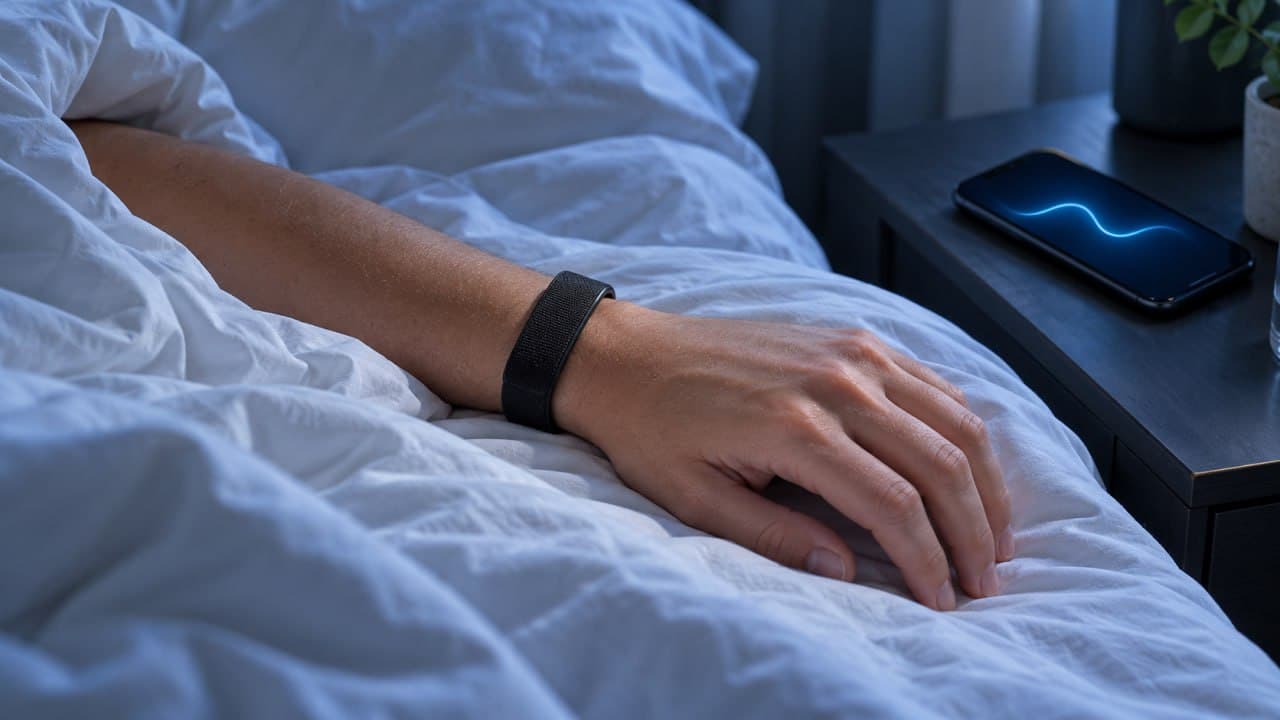
Wearables can show how long and how regularly you sleep and how alcohol, late meals or stress affect resting heart rate and heart rate variability. Sleep stage detection on the wrist is an estimate, but trends over weeks are meaningful. How to interpret recovery values is explained in Understanding HRV; which device is suitable in Smartwatch or fitness tracker?.
A note: if the data puts you under pressure and you sleep worse because your score was bad, pause tracking for a while or only look at weekly trends.
If it still doesn't work
Sometimes there is more behind it than poor habits. Get medical advice if:
- problems falling or staying asleep last several weeks,
- you are very sleepy or nod off during the day,
- a partner notices breathing pauses or loud snoring,
- tingling or an urge to move your legs stops you falling asleep.
For persistent insomnia, a specific form of behavioural therapy (CBT-I) is considered the first-line treatment – often more effective than sleeping pills.
Shift work as a special case
If you work rotating or night shifts, you can't follow many of these rules literally. The principles still apply – adapted to changing times. The complete guide is in Shift work and sleep.
Conclusion: the cheapest performance boost
More and better sleep is the easiest performance boost there is – free, without side effects and with effects on strength, endurance, body composition and mood. Start with one strategy, such as the fixed wake-up time, and add another each week. How to further ease muscle soreness after hard sessions is covered in Muscle soreness: what really helps.
Frequently asked questions
How much sleep do athletes need?
Most adults need seven to nine hours of sleep. Athletes with high training volumes often benefit from the upper end. Studies in athletes who extended their sleep showed improvements in sprint times, reaction speed and mood.
Do muscles grow during sleep?
Yes, sleep is an important phase for repair and growth. More growth hormone is released in deep sleep, and lack of sleep shifts the hormone balance in an unfavourable direction. Studies show that sleep deprivation can measurably slow muscle growth.
Is exercising in the evening bad for sleep?
Not for most people. In studies, moderate evening training usually barely disturbs sleep. Very intense sessions shortly before bed can delay falling asleep for some people – then a gap of one to two hours helps.
Does an afternoon nap help recovery?
A short nap of 10 to 30 minutes can improve sleepiness and performance, especially after a short night. Longer naps in the late afternoon, however, can disturb your night's sleep.
When should you see a doctor about sleep problems?
If problems falling or staying asleep last several weeks, you are very sleepy during the day, snore loudly, have observed breathing pauses or your legs are restless in the evening, a medical check makes sense.
Tags
- Sleep
- Recovery
- Performance
- Sleep quality
- Muscle building
About the author
Michael Lohrberg· Founder of Syrax
Michael Lohrberg founded Syrax in 2026. Military service with a deployment abroad, in industry since 2010, shift work and two jobs in parallel – the LEEK Pulse Pro grew out of the question of how much recovery is really left in everyday life. In the magazine he writes about training, sleep and regeneration – practical and grounded in the research.
More about MichaelThis article is for general information and does not replace medical advice. If you have pre-existing conditions, pain or any doubts, talk to your doctor before changing your training or diet.
Also available in: Deutsch
Syrax Magazine
Read next
 Big guide
Recovery & HRV
Understanding HRV: What Heart Rate Variability Reveals About Your Recovery
HRV is probably the most valuable metric a wearable can provide – and the most often misunderstood. What it measures, which values are normal, how to measure it properly and how to guide your training with it.
13 min read
 Big guide
Sleep & Shift Work
Shift Work and Sleep: The Guide for Rotating and Night Shifts
How to get enough restful sleep despite early, late and night shifts: understanding your body clock, using light deliberately, sleep times for every shift, naps, caffeine, eating at night and training on shifts.
8 min read