
Standing Overhead Press: Technique and Variations
How to do the standing barbell overhead press correctly: setup, grip width, bar path, breathing and core tension, the most common mistakes, variations from dumbbells to landmine, programming for strength and muscle and what to do about shoulder pain.
 OlehMichael Lohrberg
6 min bacaan
Artikel ini belum tersedia dalam Bahasa Melayu. Ia dipaparkan dalam: English.
Ringkasnya
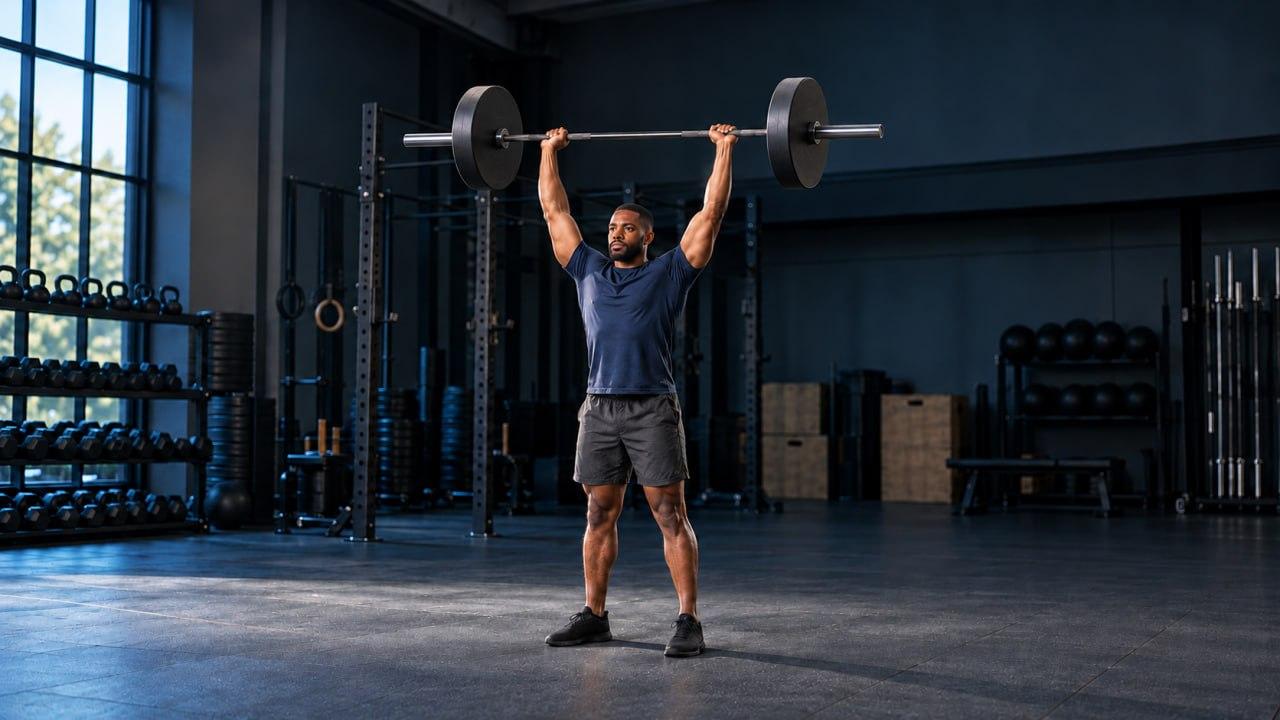
In the standing overhead press, you press the barbell from the rack position in front of your collarbones straight overhead. Key points are a grip just outside the shoulders, forearms vertical under the bar, braced glutes and abs, a straight bar path close past your face and a finish with the bar over mid-foot and your head moved slightly forward 'through the window'. The most common mistakes are an arched lower back, too wide a grip and a bar path far in front of the body. For muscle growth, 6–12 reps work well; for strength, 3–6.
Kandungan
The standing overhead press – often simply called "the press" – is one of the oldest and most honest strength exercises there is. No bench under your back, no momentum from your legs: you stand, the bar rests on your shoulders, and you press it overhead. Hardly any exercise shows so directly how strong your upper body really is and how well you can tense your body as a unit.
This guide shows you the technique step by step, the most common mistakes, the best variations and how to fit the exercise into your plan. It belongs to the Exercises & Muscle Groups topic.
Why the standing overhead press is so valuable
- Shoulders and triceps: the front and side deltoids and the triceps do the main work.
- Full-body tension: core, glutes and legs must stabilise so that force isn't lost.
- Healthy overhead position: pressing overhead cleanly and regularly maintains mobility and stability in the shoulder girdle.
- Carry-over: stronger shoulders help with bench presses, pull-ups and many everyday movements.
Which muscles work?
| Muscle | Role |
|---|---|
| Front deltoid | prime mover, raises the upper arm forward and up |
| Side deltoid | assists, especially in the upper part |
| Triceps | extends the elbow, decisive for the lockout |
| Upper chest | helps at the start of the movement |
| Trapezius and serratus | rotate and lift the shoulder blade upward |
| Core, glutes, legs | stabilise the body as a column |
The technique step by step
The standing overhead press in 6 steps
- 1
Langkah 1
Set up the bar
Set the rack at roughly sternum height. Grip the bar just outside your shoulders, thumbs around the bar, wrists straight.
- 2
Langkah 2
Take the starting position
With the bar on the front of your shoulders, take a step back. Feet hip-width, forearms vertical, elbows slightly in front of the bar.
- 3
Langkah 3
Build tension
Breathe deep into your belly, squeeze glutes and abs hard, pull your ribs down. Your body forms a stable column.
- 4
Langkah 4
Move your head out of the way
Pull your chin back slightly so the bar can travel straight up past your face.
- 5
Langkah 5
Press vertically
Press the bar straight up. As soon as it passes your forehead, push your head slightly forward under the bar.
- 6
Langkah 6
Lockout and lower
At the top, bar, shoulders, hips and mid-foot are in one line, with shoulders actively shrugged up. Lower under control along the same path to the starting position.
Grip width and wrists
Grip the bar so that your forearms are vertical under the bar in the starting position – seen from the front and side. For most people, the grip is just outside the shoulders. The bar sits low in the palm, close to the wrist, not in the fingers. That keeps the wrist straight and transfers force directly.
The bar path
The bar should move as vertically as possible. Your face is in the way – so you briefly pull your chin back and push your head forward as soon as the bar has passed your forehead. Many describe this as "looking through the window": at the end, your ears are roughly level with your upper arms.
Breathing and core tension
Before each rep, breathe deep into your belly, brace your abs and glutes and hold your breath while pressing. Breathe out at the top or after lowering and rebuild tension. This technique is called the Valsalva manoeuvre and stabilises the spine. With high blood pressure or cardiovascular disease, check it with a doctor first and rather work with moderate weights and steady breathing.
The lockout
At the top, your elbows are straight, your shoulders actively "shrugged up" and the bar is over the middle of your feet. This active end position matters for healthy shoulders: it puts the shoulder blade in a favourable position.
The most common mistakes
| Mistake | Consequence | Fix |
|---|---|---|
| Arched back, torso leaning back | load on the lower back, loss of strength | brace glutes and abs, ribs down, reduce weight |
| Bar in front of the body | long levers, poor lockout | chin back, bar close to the face, push head through after it passes |
| Grip too wide | unfavourable shoulder load, less strength | forearms vertical under the bar |
| Bent wrists | wrist pain, loss of strength | bar low in the palm, wrists straight |
| Elbows far behind the bar | bar drifts forward | elbows slightly in front of the bar at the start |
| No active lockout | unstable end position | actively shrug shoulders towards your ears at the top |
| Legs bouncing | the press turns into a push press | keep knees straight, use only deliberately as a variation |
Variations for every goal
| Variation | Feature | Good for |
|---|---|---|
| Seated dumbbell shoulder press | each side works separately, backrest supports | muscle growth, imbalances |
| Standing dumbbell shoulder press | lots of stabilisation | core and shoulders |
| Neutral-grip dumbbells | palms facing each other | sensitive shoulders |
| Push press | drive from the legs | strength, explosiveness, heavier loads |
| Landmine press | angled pressing path, single-arm possible | shoulders with limited overhead mobility |
| Z press | seated on the floor without back support | core control, strict technique |
| Pike push-up and handstand push-up | bodyweight | home workouts, calisthenics |
If you train at home without a barbell, you'll find suitable exercises in Home workout without equipment. The path to a free handstand is described in Learning the handstand.
Programming: sets, reps, frequency
| Goal | Sets × reps | Reserve | Frequency |
|---|---|---|---|
| Strength | 3–5 × 3–6 | 1–3 reps | 1–2× per week |
| Muscle growth | 3–4 × 6–12 | 1–2 reps | 1–2× per week |
| Technique/beginner | 3 × 8 | 3 reps | 2× per week |
Many plans combine one heavy barbell session and one lighter dumbbell session per week. For the side delts, lateral raises are also worthwhile, as they are only partly challenged by pressing.
Progression
The standing overhead press is an exercise where progress comes more slowly than with squats or deadlifts – the muscles involved are smaller. Instead of 2.5 kg jumps, micro plates of 0.5–1.25 kg or double progression help: first increase reps within the target range, then the weight. How to plan progress systematically is explained in Progressive overload.
Where in the plan?
Put the overhead press early in the session while triceps and shoulders are fresh – on an upper-body day, for example, after the bench press or alternating with it. In the upper/lower split, it works well as the main lift of the second upper-body day.
Mobility: are you ready for overhead?
A simple test: stand with your back, glutes and the back of your head against a wall and raise your straight arms overhead. If your thumbs reach the wall without your lower back leaving it, you have sufficient overhead mobility. If not, the causes often lie in a stiff upper back or tight chest and lat muscles. Mobility drills from the 10-minute mobility routine and targeted exercises for shoulder mobility help. Until then, the landmine press is a good alternative.
Shoulder pain?
Pulling or stabbing pain in the shoulder when pressing often has technical causes: too wide a grip, the bar in front of the body, no active end position or increasing the weight too quickly. Reduce the weight, check your technique and temporarily switch to pain-free variations. Persistent pain, pain at night or pain radiating into the arm should be assessed by a doctor or physiotherapist.
Conclusion: the most honest upper-body lift
The standing overhead press forgives no shortcuts – that's exactly what makes it so valuable. If you master the technique, you'll build strong shoulders and arms, strengthen your core and maintain healthy overhead mobility. Start with moderate weight, perfect the bar path and progress patiently in small steps. The other big compound lifts make good partners in your plan: the bench press, the squat and the deadlift. How to train the shoulder all round is described in Shoulder training: broad shoulders without joint pain.
Soalan lazim
Which muscles does the overhead press work?
Mainly the front and side deltoids and the triceps. The upper chest, trapezius and serratus anterior assist. Standing, the core, glutes and legs also work intensively as stabilisers.
Is the standing or seated overhead press better?
Standing, you also train core stability and full-body tension and build functional strength. Seated, you can load the shoulders more in isolation and usually move a bit more weight. Both variations are well suited to muscle building – many plans combine them.
How wide should you grip for the overhead press?
Just outside the shoulders, so that in the starting position your forearms are vertical under the bar when seen from the front and side. Too wide a grip shortens the path but loads the shoulders less favourably and costs strength.
Why does my lower back arch during the overhead press?
Usually because of a lack of core tension, too much weight or limited mobility in the shoulders and upper back. Squeezing glutes and abs hard, pulling the ribs down and reducing the weight help in most cases.
How much should you be able to overhead press?
That depends heavily on years of training, body weight and build. As a rough guide, many lifters' standing overhead press is around 60 to 70 percent of their bench press. More important than comparisons is your own progress.
Is the overhead press bad for your shoulders?
No – with clean technique, adequate mobility and sensible progression it is a safe and very effective exercise. With existing shoulder problems, a variation such as the landmine press or neutral-grip dumbbell press may feel better. Persistent pain should be assessed by a doctor or physiotherapist.
Tag
- Overhead press
- Shoulder press
- Shoulder training
- Barbell
- Technique
- Compound lifts
Tentang penulis
Michael Lohrberg· Pengasas Syrax
Michael Lohrberg mengasaskan Syrax pada 2026. Perkhidmatan tentera dengan misi di luar negara, dalam industri sejak 2010, kerja syif dan dua pekerjaan serentak – LEEK Pulse Pro lahir daripada persoalan berapa banyak pemulihan yang benar-benar tinggal dalam kehidupan seharian. Dalam majalah ini beliau menulis tentang latihan, tidur dan pemulihan – secara praktikal dan berasaskan kajian.
Lagi tentang MichaelArtikel ini untuk maklumat umum dan bukan pengganti nasihat perubatan. Jika anda mempunyai penyakit, sakit atau keraguan, berbincanglah dengan doktor sebelum mengubah latihan atau pemakanan.
Syrax Majalah
Baca seterusnya
Senaman & kumpulan otot
Bench Press: Technique, Mistakes and Variations for a Stronger Chest
The most popular exercise in the gym – and one of the most often performed incorrectly. Grip width, shoulder blades, arch, bar path, breathing and leg drive: how to press more weight, build more chest and protect your shoulders.
13 min bacaanEnglish
 Panduan lengkap
Senaman & kumpulan otot
How to Squat Properly: Technique, Mistakes, Variations
The squat is the king of exercises – and the one most often performed badly. Step by step to perfect technique: stance, breathing, depth, knees, back, common mistakes and the right variation for your body.
13 min bacaanEnglish
Senaman & kumpulan otot
How to Deadlift Properly: The Complete Technique Guide
The deadlift step by step: stance, grip, bracing, the pull and the lowering – plus the most common mistakes, variations from sumo to trap bar, lifting belts, programming and what to consider with back pain.
5 min bacaanEnglish