
Syrax Data · Sleep atlas
Syrax sleep atlas: how do Germany, Austria, Switzerland and the USA sleep?
The sleep atlas brings together official figures on sleep problems and sleep duration from Germany (RKI, Destatis, KKH), Austria (Statistics Austria), Switzerland (Federal Statistical Office) and the USA (CDC/NCHS). Every figure states definition, survey year, population and source. Countries are not ranked against each other, because questions, time windows and age groups differ.
Updated: · 4 countries, 6 sources · CSVJSONAPI· Licence CC BY 4.0
Key facts
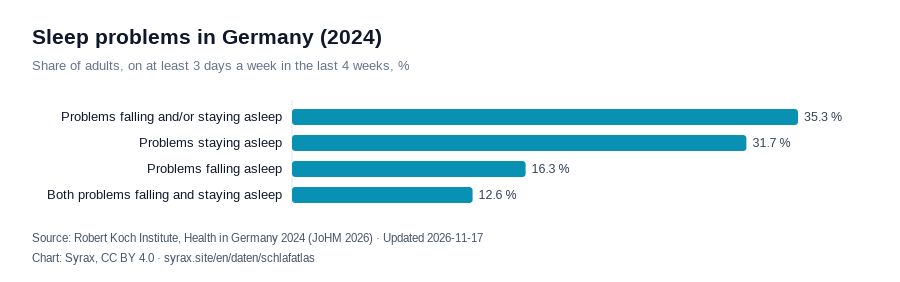
- Germany 2024: 35.3 % of adults have problems falling or staying asleep on at least 3 days a week; problems staying asleep (31.7 %) are almost twice as common as problems falling asleep (16.3 %). Source: RKI.
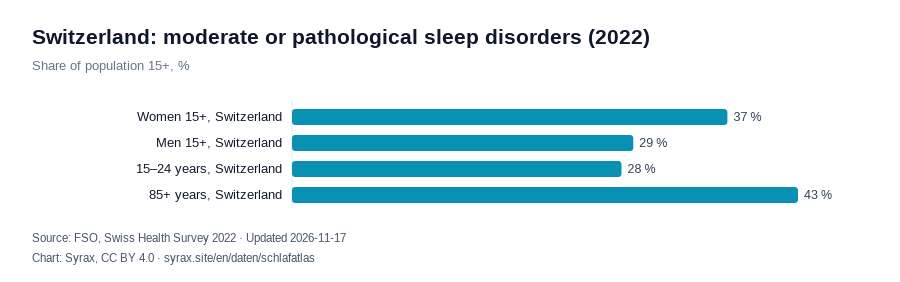
- Switzerland 2022: 26 % have moderate and 7 % pathological sleep disorders – together one third, 5 percentage points more than in 1997. Source: FSO.
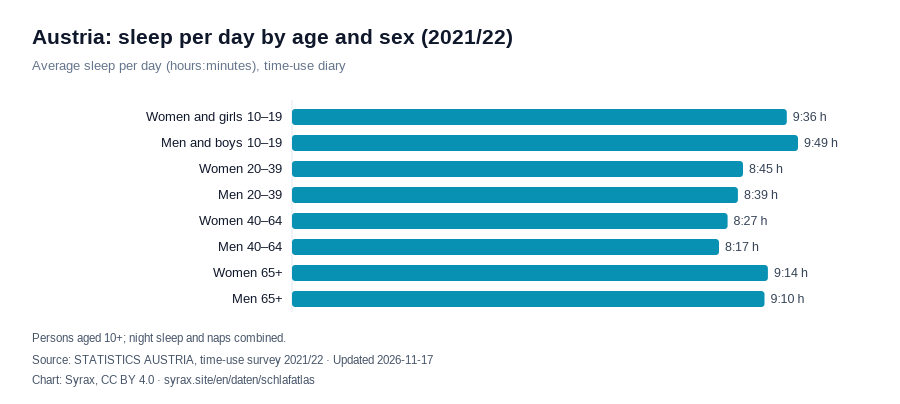
- Austria 2021/22: on weekdays women and girls sleep 8:32 hours, men and boys 8:21 hours a day; people aged 40–64 sleep least (8:27 and 8:17). Source: Statistics Austria, time-use survey.
- USA 2024: 30.5 % of adults sleep less than 7 hours; 18.1 % have trouble staying asleep on most days. Source: CDC/NCHS.
- In Germany, Switzerland and the USA, women report sleep problems more often than men – the most robust shared pattern, even though the values themselves are not comparable.
Four countries, four measurements
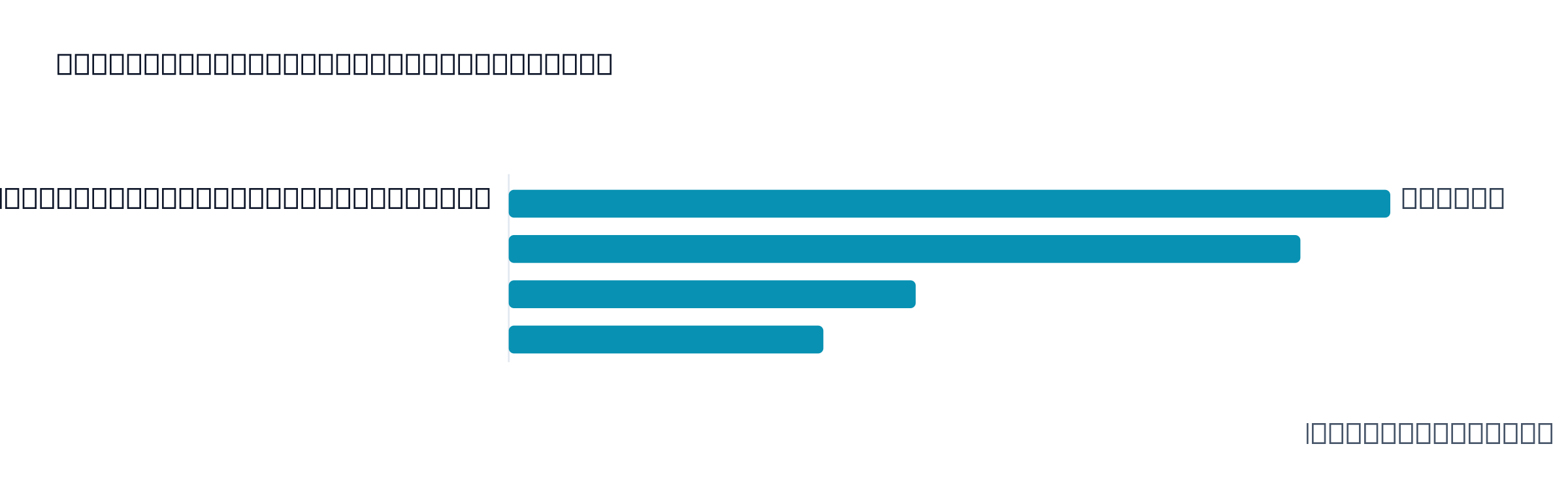
Sleep problems in Germany (2024)
Share of adults, on at least 3 days a week in the last 4 weeks, %. Source: Robert Koch Institute, Health in Germany 2024 (JoHM 2026).
- Problems falling and/or staying asleep35,3%
- Problems staying asleep31,7%
- Problems falling asleep16,3%
- Both problems falling and staying asleep12,6%
Gegevens als tabel
| Categorie | % |
|---|---|
| Problems falling and/or staying asleep | 35,3% |
| Problems staying asleep | 31,7% |
| Problems falling asleep | 16,3% |
| Both problems falling and staying asleep | 12,6% |
Share or embed this chart
Embed code (source and link included, no cookies, no tracking):
<iframe src="https://syrax.site/embed/schlaf-deutschland-probleme-2024?lang=en" title="Sleep problems in Germany (2024)" width="100%" height="300" style="border:0" loading="lazy"></iframe>
Please credit: Source: Robert Koch Institute, Health in Germany 2024 (JoHM 2026); chart: Syrax (CC BY 4.0).
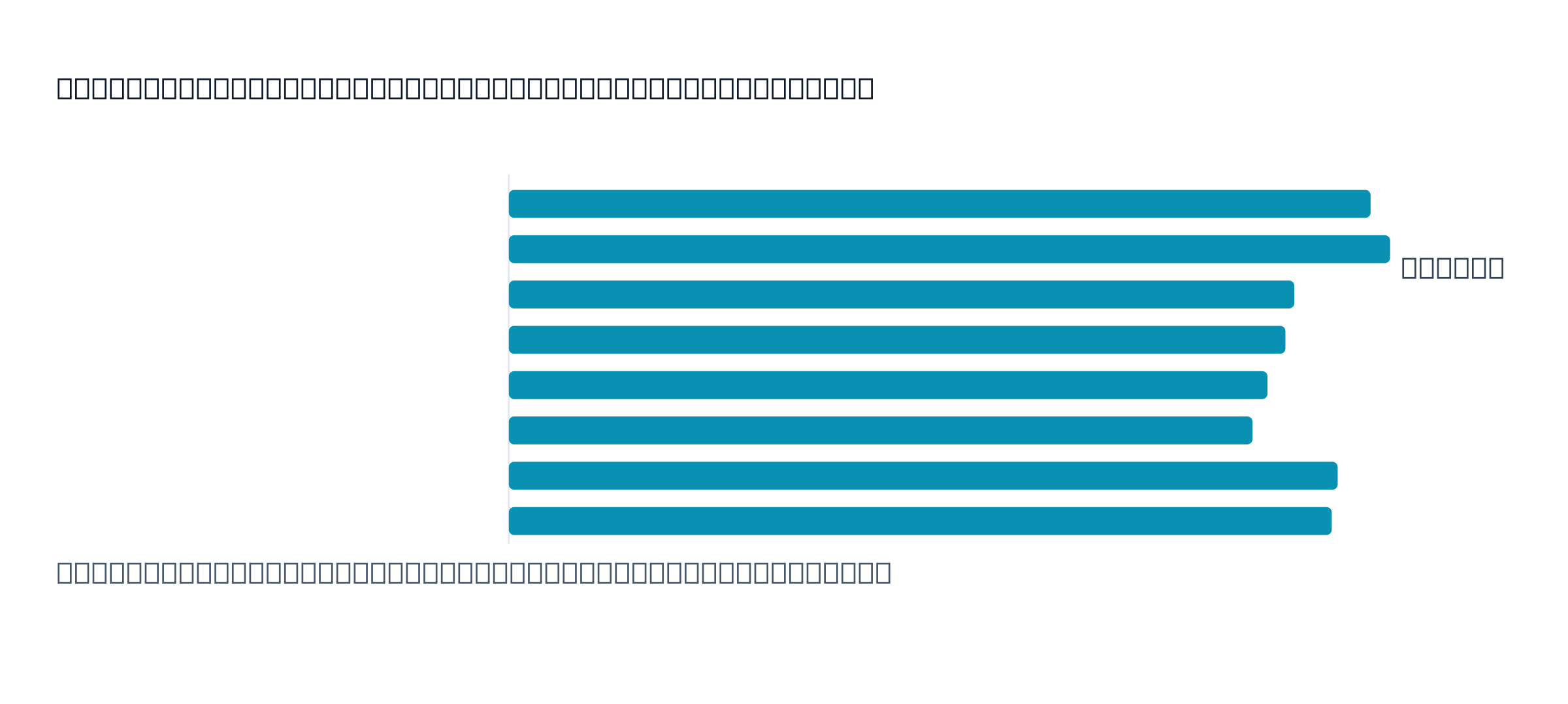
Austria: sleep per day by age and sex (2021/22)
Average sleep per day (hours:minutes), time-use diary. Source: STATISTICS AUSTRIA, time-use survey 2021/22.
- Women and girls 10–199:36 h
- Men and boys 10–199:49 h
- Women 20–398:45 h
- Men 20–398:39 h
- Women 40–648:27 h
- Men 40–648:17 h
- Women 65+9:14 h
- Men 65+9:10 h
Gegevens als tabel
| Categorie | |
|---|---|
| Women and girls 10–19 | 9:36 h |
| Men and boys 10–19 | 9:49 h |
| Women 20–39 | 8:45 h |
| Men 20–39 | 8:39 h |
| Women 40–64 | 8:27 h |
| Men 40–64 | 8:17 h |
| Women 65+ | 9:14 h |
| Men 65+ | 9:10 h |
Share or embed this chart
Embed code (source and link included, no cookies, no tracking):
<iframe src="https://syrax.site/embed/schlaf-oesterreich-alter-2021?lang=en" title="Austria: sleep per day by age and sex (2021/22)" width="100%" height="404" style="border:0" loading="lazy"></iframe>
Please credit: Source: STATISTICS AUSTRIA, time-use survey 2021/22; chart: Syrax (CC BY 4.0).
Switzerland: moderate or pathological sleep disorders (2022)
Share of population 15+, %. Source: FSO, Swiss Health Survey 2022.
- Women 15+, Switzerland37%
- Men 15+, Switzerland29%
- 15–24 years, Switzerland28%
- 85+ years, Switzerland43%
Gegevens als tabel
| Categorie | % |
|---|---|
| Women 15+, Switzerland | 37% |
| Men 15+, Switzerland | 29% |
| 15–24 years, Switzerland | 28% |
| 85+ years, Switzerland | 43% |
Share or embed this chart
Embed code (source and link included, no cookies, no tracking):
<iframe src="https://syrax.site/embed/schlaf-schweiz-gruppen-2022?lang=en" title="Switzerland: moderate or pathological sleep disorders (2022)" width="100%" height="300" style="border:0" loading="lazy"></iframe>
Please credit: Source: FSO, Swiss Health Survey 2022; chart: Syrax (CC BY 4.0).
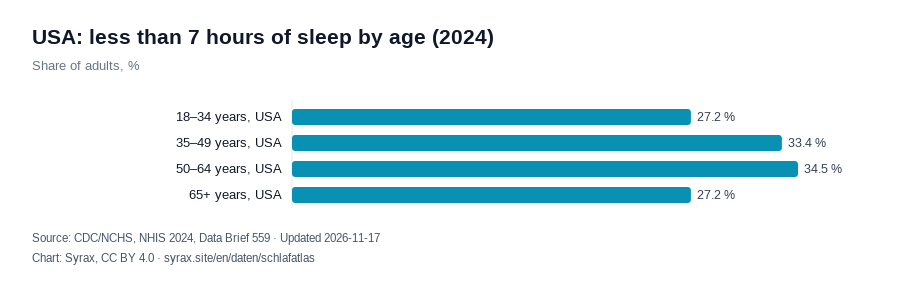
USA: less than 7 hours of sleep by age (2024)
Share of adults, %. Source: CDC/NCHS, NHIS 2024, Data Brief 559.
- 18–34 years, USA27,2%
- 35–49 years, USA33,4%
- 50–64 years, USA34,5%
- 65+ years, USA27,2%
Gegevens als tabel
| Categorie | % |
|---|---|
| 18–34 years, USA | 27,2% |
| 35–49 years, USA | 33,4% |
| 50–64 years, USA | 34,5% |
| 65+ years, USA | 27,2% |
Share or embed this chart
Embed code (source and link included, no cookies, no tracking):
<iframe src="https://syrax.site/embed/schlaf-usa-unter-7-stunden-2024?lang=en" title="USA: less than 7 hours of sleep by age (2024)" width="100%" height="300" style="border:0" loading="lazy"></iframe>
Please credit: Source: CDC/NCHS, NHIS 2024, Data Brief 559; chart: Syrax (CC BY 4.0).
Why the countries are not comparable
| Feature | Deutschland (RKI) | Austria (Statistics Austria) | Schweiz (BFS) | USA (CDC) |
|---|---|---|---|---|
| Measure | Problems falling/staying asleep on ≥ 3 days/week (RKI) | sleep duration from time-use diary only (Statistics Austria); no sleep-problem figure | 4-question index, “often” (FSO) | Problems “most days”; sleep < 7 h (CDC) |
| Time window | last 4 weeks | two diary days | no fixed window (frequency) | past 30 days |
| Age | 18–99 years | 10+ years | 15+ years | 18+ years |
| Survey | Panel 2024 (May 2024–Jan 2025), n = 27,038 | TUS 2021/22, 4,342 households | SHS 2022, written, n = 19,137 | NHIS 2024, interview |
| Ranking allowed? | no | no | no | no |
In the sleep atlas
Germany in detail
46 figures from RKI, Destatis and KKH: sleep problems, sleep duration, hospital cases, diagnoses.
Sleep problems
Problems falling and staying asleep in Germany, Switzerland and the USA – each with its own definition.
Sleep duration
Minutes of sleep from time-use surveys (DE, AT) and share below 7 hours (USA).
Methodology
Source selection, comparability, rounding and limits.
Frequently asked questions
How many people in Germany have sleep problems?
According to the RKI panel “Health in Germany” 2024, 35.3 % of adults have problems falling and/or staying asleep on at least three days a week, women (40 %) more often than men (30.4 %).
Do people sleep better in Switzerland than in Germany?
These data cannot answer that. The FSO asks how often four complaints occur without a fixed time window; the RKI asks about complaints on at least three days a week in the last four weeks. Different questions produce different shares.
How long do Austrians sleep?
According to Statistics Austria (time-use survey 2021/22), women and girls sleep 8:32 and men and boys 8:21 hours a day on weekdays, about an hour longer at weekends. There is no official figure on sleep problems for Austria.
How many Americans sleep less than 7 hours?
According to CDC/NCHS (NHIS 2024), 30.5 % of US adults sleep less than 7 hours in 24 hours on average – most often those aged 50–64 (34.5 %).
Sources
- Robert Koch-Institut: Ein- und Durchschlafstörungen bei Erwachsenen in Deutschland – Panel „Gesundheit in Deutschland“ 2024 (Journal of Health Monitoring, 03.06.2026). Licence: CC BY 4.0. Retrieved . The Journal of Health Monitoring is published under CC BY 4.0. Only figures with definition and confidence interval are used.
- Statistisches Bundesamt (Destatis): Zahl der Woche (Zeitverwendungserhebung 2022, Krankenhausstatistik 2019–2024). Licence: Datenlizenz Deutschland – Namensnennung – Version 2.0. Retrieved . Commercial reuse permitted with attribution (dl-de/by-2-0).
- Statistik Austria: Zeitverwendung 2021/22 – Ergebnisse der Zeitverwendungserhebung (Wien 2023), Kapitel 4.1 Schlafen. Licence: Wiedergabe und Bearbeitung mit Quellenangabe „STATISTIK AUSTRIA“ gestattet (Impressum der Publikation). Retrieved . Per the imprint, content may be reproduced, distributed and adapted with correct reproduction and attribution; adaptations are marked (conversion of h:min into minutes).
- KKH Kaufmännische Krankenkasse: Pressemeldung „Gedankenkarussell im Bett“, 23.09.2025. Licence: Pressemitteilung – Zitat einzelner Kennzahlen mit Quelle. Retrieved . Only individual published figures are cited with source; no text or images reused.
- Bundesamt für Statistik (BFS): Schweizerische Gesundheitsbefragung 1997–2022: Schlafstörungen nehmen seit 25 Jahren zu – Medienmitteilung vom 03.10.2024. Licence: BFS-Nutzungsbedingungen – Zitat veröffentlichter Kennzahlen mit Quellenangabe. Retrieved . Only figures from the press release with attribution; no BFS charts reused.
- CDC / National Center for Health Statistics: Ng AE, Black LI, Adjaye-Gbewonyo D. Short Sleep Duration and Sleep Difficulties Among Adults: United States, 2024. NCHS Data Brief No. 559, April 2026. Licence: Public Domain (US-Bundesbehörde). Retrieved . Per the report in the public domain and may be reproduced; citation appreciated.
Citation, licence and corrections
Syrax's selection, processing and charts are licensed under CC BY 4.0; the underlying data keep the licence of their primary source. For individual values, always also cite the primary source. Methodology · Source registry · Press & API
Syrax: „Syrax sleep atlas: how do Germany, Austria, Switzerland and the USA sleep?“, version 2026-11-17.2, as of 17 November 2026, syrax.site/nl/daten/schlafatlas
Found an error? Please email with a link to the source: syrax.shop@proton.me.
Explained in the magazine: Sleep & Shift Work · Recovery & HRV · Endurance & Running
Solution path · 5 steps
I sleep badly – where do I start?
Sleep atlas Germany → Shift work sleep planner → How accurately do trackers measure sleep? → Sleep trackers compared → …