
Creatine and Protein: Which Matters More – and Can Both Go in One Shake?
Creatine or protein? Werner Ludmann explains what really separates the two, whether you can mix creatine into your protein shake, what research says about the combination, what it costs per day and why creatine changes the creatinine value in your blood test.
 作者:Werner Ludmann
閱讀時間 9 分鐘

本文尚未提供繁體中文版,目前以 English 顯示。
重點摘要
Creatine and protein are not competitors; they do two different jobs. Protein is building material for muscle; depending on your training you need about 1.2 to 2.0 g per kilogram of body weight a day, ideally from meals, topped up with a shake if needed. Creatine is an energy store for short, intense efforts and, from 3 g a day, increases physical performance in high-intensity training – roughly one or two extra reps per set. Taking both together is sensible and safe, even in the same shake. Mix the creatine in fresh and drink the shake promptly, because creatine slowly breaks down to creatinine in liquid. Cost with Syrax products: about €0.17 for 3 g of creatine plus about €1.39 for a serving of whey. Important before a blood test: creatine can raise the lab value creatinine without your kidneys working any worse – tell your doctor.
目錄
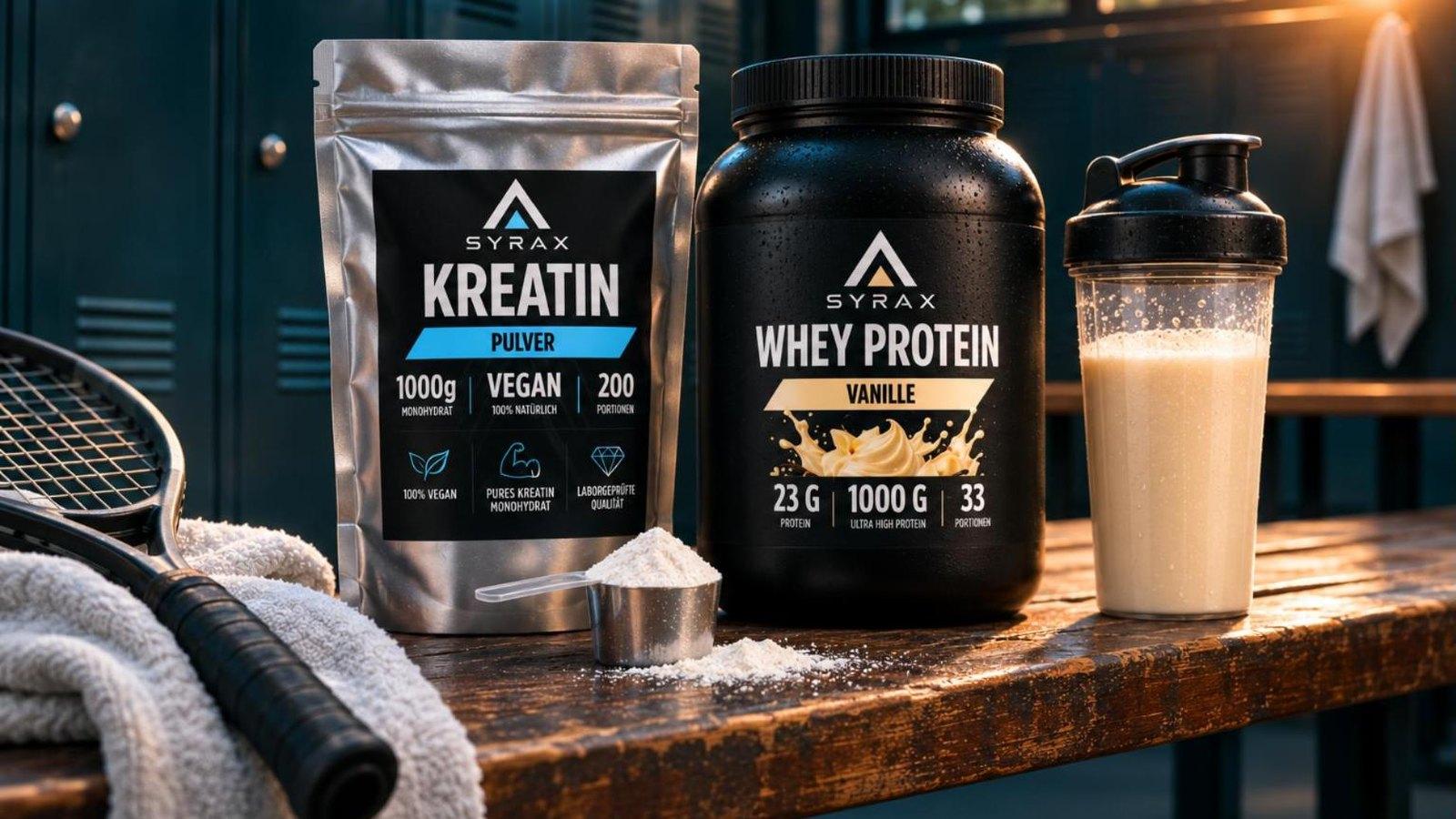
At my club I hear the question all the time, usually on the bench between two sets: "Should I take creatine or protein?" It sounds like an either-or. It isn't. Creatine and protein do two completely different jobs – a bit like a tennis racket and tennis shoes. Both belong to the game, but one doesn't replace the other.
In this article I explain what separates the two, what comes first, whether you can simply tip creatine into your protein shake and what it costs per day. Right at the end is a point almost nobody has on their radar: what creatine does to your blood test.
The short answer
- Protein is building material. Without enough protein no muscle grows – however hard you train.
- Creatine is an energy store in the muscle. It helps you perform a little more in short, hard efforts – more reps, more sprints, more training stimulus.
- Both together is sensible, safe and inexpensive. Yes, even in the same shake.
What is the difference between creatine and protein?
| Protein | Creatine | |
|---|---|---|
| What it is | macronutrient made of amino acids | substance made by the body from three amino acids |
| Job in the body | building material for muscles, enzymes, hormones | energy store (phosphocreatine) for efforts lasting seconds |
| Where from | meat, fish, milk, eggs, pulses, powder | meat and fish (little), own production, supplement |
| How much per day | approx. 1.2–2.0 g per kg body weight | 3–5 g |
| Noticeable after | weeks to months of training | approx. 3–4 weeks (without loading) |
| Approved EU claim | contributes to a growth in and the maintenance of muscle mass | increases physical performance in successive bursts of short-term, high-intensity exercise, from 3 g daily |
| Calories | 4 kcal per gram | practically none |
| Replaceable by food? | yes, completely | only partly – for 3 g you would need about 600 g of beef a day |
The last row is the key: you get protein easily from food, but hardly an effective amount of creatine. Beef contains about 0.5 g of creatine per 100 g raw, and some of it is lost when cooking.
Which is more important, creatine or protein?
If I have to put it in one sentence: first secure your protein intake, then add creatine. Without building material, the best energy store achieves nothing.
But note: "secure your protein" doesn't mean "buy protein powder". If you cover your needs with quark, eggs, meat, fish and pulses, you don't need powder – and then you gain more from creatine than from an extra shake. This is the decision aid I use when someone at the club asks me:
| Your situation | First | Then |
|---|---|---|
| You eat little protein (under approx. 1.2 g/kg) | change your meals or whey | creatine |
| You eat enough protein | creatine | whey only for convenience |
| Budget for only one product, protein fine | creatine (approx. €5–9 a month) | – |
| Budget for only one product, protein too low | low-fat quark instead of powder, plus creatine | whey later |
| Endurance sport without sprints | protein | creatine does little here |
| Racket sports, football, strength training | both | – |
Work out how much protein you need with How much protein per day?. How creatine works exactly and where its limits are is covered in the creatine guide.
What creatine actually does
Creatine fills the phosphocreatine stores in the muscle. They provide energy for the first seconds of a maximal effort: a heavy set, a sprint to the net, an acceleration. Full stores mean:
- one or two more reps in a hard set,
- slightly faster recovery between short sprints,
- more training volume over weeks – and therefore more stimulus for strength and muscle growth.
The ISSN position paper on creatine calls it the most effective legally available supplement for increasing performance in high-intensity exercise (Kreider et al., 2017). Still, don't expect miracles: we are talking about a few percent, not a new league.
Can creatine go into the protein shake?
Yes. It is actually the easiest way not to forget creatine. There are a few things you should know:
Mix fresh, drink promptly
As a powder, creatine is very stable. In liquid, however, it slowly breaks down to creatinine – the breakdown product that no longer has any effect. How fast depends on temperature and acidity: the warmer and the more acidic, the faster (Jäger et al., 2011). In a neutral shake drunk right away, it doesn't matter.
That leads to three simple rules:
- Don't prepare it the night before. A shake that sits for ten hours in a warm sports bag is the worst option for creatine.
- Drink acidic drinks promptly. Clear whey is acidified, and so is juice. Creatine can go in, but then drink it straight away.
- Powder in the bottle, water later. If you mix on the go, carry whey and creatine dry and only add water just before drinking.
Creatine dissolves poorly – that's normal
Creatine monohydrate dissolves only moderately in cold water, about 14 g per litre at room temperature. In a 300 ml shake with 5 g, some sediment often remains. That is not a quality problem. Micronised powder – our doypack is milled to 200 mesh – dissolves more easily. Swirling once more and drinking the rest is enough.
Taste: neutral
Pure creatine monohydrate tastes of almost nothing and doesn't change the taste of a vanilla or chocolate shake. In clear whey you sometimes notice it as a slight cloudiness.
Does the combination do more than each on its own?
This is where it gets interesting, and where advertising is often more generous than research.
What is proven: In one study, creatine was retained better in the body when taken with about 50 g of protein and 47 g of carbohydrates than creatine alone (Steenge et al., 2000). The reason is probably insulin, which promotes the uptake of creatine into the muscle.
What that means in practice: The effect was measured during a loading phase, i.e. in the first days with high amounts. If you take creatine daily for weeks, you reach full stores without a shake too – it just takes a little longer. The combination is therefore practical and perhaps minimally more efficient, but not a must.
What is not proven: that creatine and protein together somehow "work double". Each does its part: creatine enables more training, protein supplies the material for adaptation. They complement each other – nothing more.
When do you take what?
The good news: timing is secondary for both.
- Creatine works through full stores, not through the moment of intake. Take it every day, including rest days, at a time you can remember. According to current knowledge, whether before or after training makes no relevant difference.
- Protein is spread across three to four meals of 20 to 40 g each. After training a shake is practical if the next meal is still far away.
This is what it looks like in my everyday life:
| Day | Creatine | Protein |
|---|---|---|
| Training day | 3–5 g in the shake after training | shake after training, otherwise meals |
| Rest day | 3–5 g in yoghurt or water at breakfast | meals only |
| Tournament or travel | tablets or pre-portioned powder | shake if no meal is at hand |
More on timing after sport: Protein shake after training.
Three shakes with creatine
The classic after strength training 30 g vanilla whey, 5 g creatine, 300 ml low-fat milk, one banana. About 35 g of protein, 38 g of carbohydrates. The carbohydrates from milk and banana go well with creatine.
Light after tennis in summer 30 g Clear Whey Iced Tea Peach, 3 g creatine, 500 ml cold water. About 25 g of protein, 105 kcal. Drink immediately, because clear whey is acidic.
Rest day without a powder shake 250 g low-fat quark, 3 g creatine, berries, a teaspoon of honey. About 31 g of protein. The creatine disappears into the quark taste-wise.

What does it cost per day?
I calculate with our own products and regular prices, as of November 2026:
| Component | Amount | Cost per day | per month (30 days) |
|---|---|---|---|
| Creatine (doypack 1,000 g) | 3 g | approx. €0.17 | approx. €5.10 |
| Creatine (doypack 1,000 g) | 5 g | approx. €0.28 | approx. €8.50 |
| Premium Whey vanilla | 30 g | approx. €1.39 | approx. €41.70 |
| Low-fat quark instead of whey | 250 g | approx. €0.45–0.60 | approx. €14–18 |
Cost per day
Syrax products at regular prices, as of November 2026. Low-fat quark: German discount supermarket price, autumn 2026, varies with offers.
- Creatine 3 g€0.17
- Creatine 3 g + low-fat quarkapprox. €0.62–0.77
- Creatine 3 g + wheyapprox. €1.56
- Creatine 5 g + wheyapprox. €1.67
以表格顯示資料
| 類別 | Cost per day |
|---|---|
| Creatine 3 g | €0.17 |
| Creatine 3 g + low-fat quark | approx. €0.62–0.77 |
| Creatine 3 g + whey | approx. €1.56 |
| Creatine 5 g + whey | approx. €1.67 |
Creatine is by far the cheapest component – about €5 a month for the best-researched performance supplement. With protein, you decide how much convenience is worth to you.
Creatine and your blood test: the creatinine value
Many people don't know this point, and it can cause confusion at your next check-up. Creatine is broken down to creatinine in the body. Doctors use the creatinine value in the blood to estimate kidney function. Anyone who takes creatine – and anyone with a lot of muscle mass – often has a slightly higher creatinine value without the kidneys working any worse.
What you should do:
- Before a blood test, say that you take creatine.
- If a value looks abnormal, your doctor can measure another marker, such as cystatin C, which is hardly influenced by muscle mass.
- If you already have kidney disease, only take creatine after consulting your doctor.
The ISSN paper on common questions and misconceptions about creatine concludes that creatine at usual amounts does not harm kidney function in healthy people (Antonio et al., 2021).
Who should be careful
- Kidney disease: creatine and high protein amounts only after medical advice.
- Pregnancy and breastfeeding: there is too little data for creatine; better avoid it or seek medical advice.
- Children and adolescents: creatine products are usually designed for adults; follow the label.
- Milk protein allergy: avoid whey, use plant-based alternatives.
Common mistakes
- Taking creatine only on training days. The stores empty slowly; daily intake keeps them full.
- Mixing a shake with creatine in the morning and drinking it in the evening. In liquid, creatine breaks down over time.
- Buying protein powder although your meals are enough. The money is better spent on creatine.
- Relying on combination products with too little creatine. Under 3 g a day the performance claim does not apply.
- Not telling your doctor. A raised creatinine value is easy to explain if they know.
Conclusion: team players, not rivals
Creatine or protein is the wrong question. The right one is: do I get enough protein – and do I use the cheapest effective supplement there is? Anyone who can answer both with yes has the foundation on which training can really work. The rest is taste, routine and convenience.
If you decide on creatine, Creatine: powder, tablets or gummies? helps you choose the form. And if you want to know what's really in a whey, read Eduard's whey protein guide.
Sources: Kreider et al.: ISSN Position Stand – Creatine supplementation (2017) · Antonio et al.: Common questions and misconceptions about creatine supplementation (2021) · Steenge et al.: Protein- and carbohydrate-induced augmentation of whole body creatine retention in humans (2000) · Jäger et al.: Analysis of the efficacy, safety, and regulatory status of novel forms of creatine (2011) · Jäger et al.: ISSN Position Stand – Protein and Exercise (2017) · EU Register of nutrition and health claims · Labels and product specifications of Syrax products (as of November 2026)
常見問題
Which is more important, creatine or protein?
Protein, because it is a macronutrient without which no muscle is built. But you can cover it with normal meals. Creatine is the best-researched supplement for strength and power. If you eat enough protein, you gain more from creatine than from an extra protein powder.
Can you mix creatine into a protein shake?
Yes. Creatine works with whey, milk and water. Stir it in fresh and drink the shake within about an hour. In liquid, creatine slowly breaks down to creatinine, faster when warm and in acidic drinks such as clear whey or juice. Shakes prepared the night before are therefore not a good idea.
Does creatine work better with protein?
One study showed that creatine taken together with protein and carbohydrates was retained somewhat better in the body than creatine alone (Steenge et al., 2000). With daily intake over weeks, however, the stores fill up without a shake too. The combination is practical, but not a must.
When should I take creatine and protein?
Creatine every day, including rest days, at a fixed time. Protein spread across three to four meals. The shake after training is a convenient moment for both, but not decisive. Consistency matters more than the time of day.
Is creatine bad for the kidneys?
In healthy people, studies with 3 to 5 g a day over months to years have shown no kidney damage. However, creatine raises the lab value creatinine, which is used to estimate kidney function. If you have kidney disease, only take creatine after consulting your doctor.
What do creatine plus protein cost per day?
With the Syrax creatine doypack, 3 g of creatine cost about €0.17 and 5 g about €0.28. A serving of Syrax Premium Whey costs about €1.39. Together that is roughly €1.56 to €1.67 a day or around €47 to €50 a month (regular prices, as of November 2026).
Do you gain weight with creatine and protein?
At first the scale often shows 0.5 to 2 kg more, because creatine binds water in the muscle. That is not fat. Protein only makes you gain weight if you eat more calories overall than you burn.
標籤
- Creatine
- Protein
- Whey protein
- Protein shake
- Supplements
- Muscle building
Syrax 雜誌
延伸閱讀
 完整指南
補充品
Creatine: Effects, Dosage and Myths Fact-Checked
Creatine is the most thoroughly researched sports supplement in the world – and still surrounded by myths. What it really does, how to dose it correctly, whether you need a loading phase and what is true about hair loss, kidney damage and water retention.
閱讀時間 13 分鐘English

補充品
Whey Protein: What It Is, What It Does and How Much You Really Need
Eduard Boehm's complete whey guide: what whey protein is, the difference between protein and whey, nutrition and calories, effects, the right amount, water or milk, side effects and whether too much whey is harmful – with label values, cost per 25 g of protein and clear decision aids.
閱讀時間 14 分鐘English
補充品
Creatine: Powder, Tablets or Gummies? An Honest Comparison with Lab Results
Creatine powder, creatine tablets or creatine gummies: Werner Ludmann compares the three forms by active ingredient per serving, cost per 3 g of creatine, additives, everyday practicality and lab results – with label evidence for every Syrax product.
閱讀時間 10 分鐘English