
Electrolytes in Sport: When You Really Need Them – the Situation Matrix for Tennis, Running & Co.
Water, electrolytes or a sports drink? Werner Ludmann shows when sodium, potassium and magnesium really need replacing during training – with a situation matrix by duration and heat, a DIY sweat test, amounts per litre and an honest assessment of the Syrax electrolyte products.
 作者:Werner Ludmann
閱讀時間 9 分鐘

本文尚未提供繁體中文版,目前以 English 顯示。
重點摘要
For most training sessions under 60 to 90 minutes, water is enough – you only need to replace electrolytes when you sweat for a long time, intensely and in the heat. The most important mineral in sweat is sodium: depending on the person, 230 to over 2,000 mg is lost per litre of sweat, while potassium and magnesium play a much smaller role. For long sessions, the American College of Sports Medicine recommends drinks with around 460 to 690 mg of sodium per litre (20–30 mmol/L) plus carbohydrates. A simple weigh-in before and after training shows how much you sweat. The Syrax electrolyte products are mineral complexes focused on potassium and magnesium with only moderate sodium – good as a mineral base on sweaty days, but not a complete sodium replacement for a tournament day in the heat; for that, add a pinch of salt or something salty.
目錄
There are those matches in midsummer when, after the second set, you notice that your shirt no longer dries and your cap is getting white edges. That's exactly when "drink a bit of water" turns into a real question: do I need electrolytes now – and if so, which ones and how much?
How much you personally sweat per hour takes two weigh-ins – the free sweat rate calculator turns them into sweat rate, sodium loss and a drinking plan.
The honest answer is: much less often than advertising and social media suggest. For a large part of training, water is completely enough. But there are situations in which missing sodium costs performance and, in extreme cases, can even become dangerous. This article sorts out what makes sense when – with a situation matrix by duration and heat, a sweat test for home and an honest assessment of our own products.

What electrolytes are – and what is really lost in sweat
Electrolytes are minerals dissolved in the body as charged particles: sodium, chloride, potassium, magnesium and calcium. They regulate fluid balance, the excitation of nerves and muscles and many metabolic processes.
When you sweat, they are lost in very different amounts:
| Mineral | Loss per litre of sweat (typical range) | Relevance in sport |
|---|---|---|
| Sodium | approx. 230–2,070 mg (10–90 mmol/L) | By far the largest loss, decisive for long sessions |
| Chloride | Lost together with sodium | Automatically replaced via table salt |
| Potassium | approx. 80–310 mg (2–8 mmol/L) | Small loss, easily balanced with fruit and vegetables |
| Magnesium, calcium | Low | Easily covered by a normal diet |
The range for sodium is enormous: some people lose almost nine times as much per litre of sweat as others. On top of that comes the amount of sweat itself – depending on heat, intensity and training, roughly 0.5 to over 2 litres per hour. A heavy sweater with salty sweat can lose several grams of sodium on a tournament day.
The situation matrix: water, electrolytes or sports drink?
The following overview combines duration and conditions. It doesn't replace individual advice, but it covers most training situations in club and recreational sport.
| Session | Cool, moderate intensity | Warm or indoors, intense | Heat, tournament, salty sweater |
|---|---|---|---|
| Up to 60 minutes | Water | Water | Water, then a salty meal |
| 60–90 minutes | Water | Water, possibly a light electrolyte drink | Drink with sodium |
| 90 minutes to 3 hours | Water plus something salty | Drink with sodium and carbohydrates | Drink with sodium and carbohydrates, plan deliberately |
| Over 3 hours, several matches | Drink with sodium and carbohydrates | Drink with sodium and carbohydrates | Actively replace sodium, check your weight, avoid hyponatraemia |
A drink "with sodium" means, according to the recommendation of the American College of Sports Medicine: around 20 to 30 mmol of sodium per litre, i.e. roughly 460 to 690 mg, plus some potassium (2 to 5 mmol, roughly 80 to 200 mg per litre) and carbohydrates. In sessions longer than 60 to 90 minutes, the carbohydrates provide energy, which often limits performance more than the minerals do.
Typical situations from club life
Tennis practice in the evening, 90 minutes, 20 degrees: water is enough. Afterwards a normal meal, done.
League match in July, singles plus doubles, four hours on court: a plan pays off here – a drink with sodium and carbohydrates, something salty between matches, weighing yourself before and after.
Easy run, 45 minutes: water before and after is enough, usually nothing at all on the way.
Half marathon in late summer: a sodium-containing drink at the aid stations, not litres of water. How to structure long runs in general is covered in The long run.
The sweat test: your personal number
Whether you are a heavy or light sweater can be found out in one training session:
Determining your own sweat rate
- 1
步驟 1
Weigh yourself beforehand
Right before a typical session of about 60 minutes, weigh yourself naked or in dry underwear, after using the toilet.
- 2
步驟 2
Note your drinks
During the session, drink only from a bottle with a known volume and note at the end how much you drank.
- 3
步驟 3
Weigh yourself afterwards
Right after the session, towel off and weigh yourself again under the same conditions, without going to the toilet in between.
- 4
步驟 4
Calculate your sweat rate
Weight before minus weight after plus the amount you drank gives your sweat loss; 1 kg is roughly 1 litre. Convert to one hour.
- 5
步驟 5
Repeat under different conditions
Repeat the test in the heat, indoors and in the cold – your sweat rate can double depending on conditions.
Example calculation: 76.0 kg before, 74.9 kg after, 0.5 litres drunk, 60 minutes of tennis. Sweat loss: 1.1 kg + 0.5 l = 1.6 litres per hour. With an average sodium content of around 900 mg per litre, that's a good 1,400 mg of sodium per hour – a relevant loss on a long tournament day.
Signs of salty sweat: white edges on your cap and shirt, stinging eyes, a salty taste on your lips, cravings for salty food after exercise. If that sounds familiar, plan sodium more deliberately on long days.

How much to drink? Less dogma, more scales
Performance drops noticeably when you lose more than about 2 percent of your body weight in fluid during exercise – at 75 kg, from around 1.5 kg. That doesn't result in a fixed number of litres but in a goal: keeping the loss within this range during long sessions.
Too much is also a problem. If you drink considerably more than you sweat during sessions lasting several hours – especially plain water – you dilute the sodium in your blood. Such hyponatraemia shows up as headache, nausea and confusion and can be life-threatening. It occurs mainly in slow marathon and ultra runners who drink "just in case" at every station. Rule of thumb: drink to thirst and don't gain weight during exercise.
After exercise: drink about 1.25 to 1.5 litres per kilogram of weight lost over the next few hours, together with a meal containing some salt. Bread with cheese, soup or a normal main meal replaces sodium more reliably than any powder. General information on drinking can be found in How much should you drink a day?
The Syrax electrolyte products: what's inside and what they're for
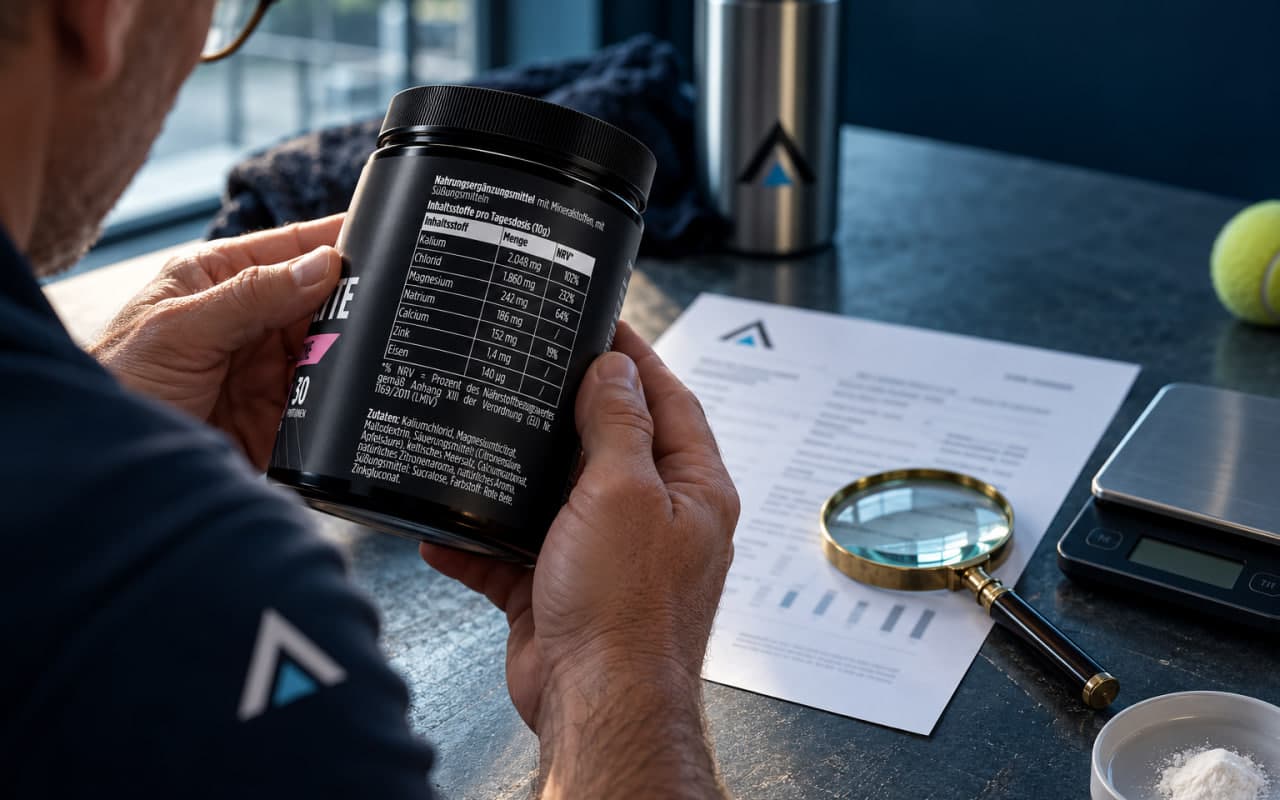
We stock two electrolyte products. Because sodium content is so decisive in sport, I convert both to the finished drink. All values come from the labels, prices from the shop (October 2026).
| Electrolyte powder (Tropical Mango / Strawberry Lemon) | Electrolyte Complex tablets | |
|---|---|---|
| Daily dose according to label | 10 g in 400 ml water | 2 tablets with 250 ml water |
| Sodium | 186 mg | 103 mg |
| Potassium | 2,048 mg | 300 mg |
| Chloride | 1,860 mg | 450 mg |
| Magnesium | 242 mg | 75 mg |
| Calcium | 152 mg | 150 mg |
| Other | Zinc 1.4 mg, iron 0.14 mg, maltodextrin | B vitamins (B1, B2, B5, B6, folic acid, B12) |
| Sodium per litre of finished drink | approx. 465 mg (at 400 ml) | – (tablet to swallow) |
| Potassium per litre of finished drink | approx. 5,100 mg (at 400 ml) | – |
| Allergen note | May contain traces of peanuts | – |
| Price per daily dose | approx. €0.80 | approx. €0.42 |
| Lab report | March 2026, no objections | March 2026, no objections |
My honest assessment
The powder is a potassium-focused mineral drink, not a classic sports drink. For sodium, at around 465 mg per litre of finished mix, it is at the lower end of the ACSM recommendation. For potassium, on the other hand, it is far above it – around 2 grams per serving equals about half the daily requirement (DGE estimate for adults: 4,000 mg) and four times what Germany's Federal Institute for Risk Assessment proposes as the maximum for food supplements (500 mg). On top of that come 242 mg of magnesium, practically the entire BfR recommendation for magnesium from supplements.
For healthy people with normal kidney function, one serving a day is no acute risk – potassium is excreted via the kidneys, and many people eat fewer fruit and vegetables than recommended anyway. But it also means:
- No more than one serving a day, as stated on the label – not several bottles spread over a tournament.
- No other magnesium supplement that day, otherwise it quickly becomes too much.
- Not with kidney disease and not with medication such as ACE inhibitors, sartans or potassium-sparing diuretics without consulting a doctor.
The tablets are a mineral base for everyday life. With 300 mg of potassium and 75 mg of magnesium they are moderate, plus a B-vitamin complex. They aren't intended for the bottle during exercise – you swallow them with a glass of water, for example after training.
For a long tournament day in the heat, neither product alone is enough to replace sodium in the amounts heavy sweaters lose. Here is my practical approach:
- 750 ml of water, a portion of carbohydrates (e.g. 300 ml of apple juice or 30–40 g of sugar) and a scant quarter teaspoon of salt (about 1.5 g of salt ≈ 600 mg of sodium) – that makes a simple, sodium-focused sports drink.
- Plus something salty between matches: pretzels, a cheese sandwich, a broth.
- On such days, the Syrax powder fits in once, for example as a mineral drink after the last match – not as a drink all day long.
How to compare any electrolyte product yourself by sodium per litre and price per litre – with a label check to work through – is shown in Electrolyte powders compared.
Who should be careful
Electrolyte products seem harmless, but they aren't for everyone:
- Kidney disease: potassium and magnesium are excreted via the kidneys – consulting a doctor is a must.
- High blood pressure and cardiovascular disease: coordinate sodium and potassium specifically with your doctor.
- Medication such as ACE inhibitors, sartans or potassium-sparing diuretics raises potassium levels – potassium-rich products only after consultation.
- Children: don't need electrolyte products for normal sport; water and food are enough.
Common mistakes
- Electrolytes with every session. For an hour of training they are usually superfluous – and the money is better spent on a good meal.
- Focusing on magnesium instead of sodium. The relevant loss in sweat is sodium.
- Litres of water on long runs. The risk of hyponatraemia rises if no sodium is added.
- Combining several products. Electrolyte powder plus magnesium supplement plus multivitamin – you can quickly exceed sensible amounts of magnesium and potassium.
- Automatically blaming cramps on electrolytes. Fatigue is the more common cause. More on that in Dosing magnesium correctly.
Conclusion: electrolytes are a tool for long, hot days
Electrolytes aren't an everyday drink but a tool for specific situations: long sessions, heat, tournament days and people who sweat a lot and saltily. For everything else, water and a normal meal are the best combination. If you know your own sweat rate, planning the rest is easy – and in the third set you'll notice your legs lasting longer.
Next, I'll look at how creatine works in endurance and racket sports and why it draws water into the muscles in Creatine for endurance and racket sports. How to check supplement labels in general is explained by Eduard in How to assess supplements.
Sources: American College of Sports Medicine: Exercise and Fluid Replacement (Sawka et al., 2007) · Baker: Sweating Rate and Sweat Sodium Concentration in Athletes (Sports Medicine, 2017) · BfR: Maximum level proposals for potassium (German) · Verbraucherzentrale: BfR maximum level proposals (statement 006/2024, German) · Labels and lab reports of the Syrax products (as of October 2026)
常見問題
When do I need electrolytes during exercise?
Usually only in sessions over 60 to 90 minutes with heavy sweating, in the heat, on tournament days with several matches or if you are a so-called salty sweater. For shorter sessions water is usually enough; the minerals come back with your next meal.
Which electrolyte is most important when sweating?
Sodium. It is the mineral lost in sweat in the largest amounts – depending on the person, around 230 to over 2,000 mg per litre. Potassium, magnesium and calcium are lost in much smaller amounts.
How much sodium should a sports drink contain?
For long sessions, the American College of Sports Medicine recommends around 20 to 30 mmol of sodium per litre, which is roughly 460 to 690 mg. Ideally there are also carbohydrates for energy.
How do I find out how much I sweat?
Weigh yourself naked before and after a typical session of about an hour without going to the toilet in between. Weight lost plus the amount drunk roughly equals your sweat loss per hour – 1 kg is about 1 litre.
Can you drink too much?
Yes. If you drink large amounts of plain water during long sessions and take in hardly any sodium, you can develop hyponatraemia – a dangerously low sodium level in the blood. Rule of thumb: drink to thirst and don't gain weight during exercise.
Are electrolyte tablets or powder better?
Powder can be used in your bottle during exercise; tablets are rather swallowed with a glass of water as a daily mineral supplement. What matters is the composition per litre, especially the sodium content.
Who should be careful with electrolyte products?
People with kidney disease, cardiovascular disease or high blood pressure, and anyone taking medication such as ACE inhibitors, sartans or potassium-sparing diuretics. Potassium-rich products in particular should then only be taken after consulting a doctor.
What is the difference between an electrolyte drink and an isotonic drink?
Isotonic describes the concentration: the drink contains roughly as many dissolved particles as blood. Isotonic sports drinks usually contain carbohydrates and sodium. An electrolyte drink can also be carbohydrate-free. For long sessions a drink with sodium and carbohydrates makes sense; for short ones water is enough.
When should I drink electrolytes – before, during or after exercise?
In long, sweaty sessions mainly during exercise, in sips according to thirst. Afterwards, a salty meal with enough fluid reliably replaces the sodium. Before short sessions you don't need electrolytes.
標籤
- Electrolytes
- Sodium
- Hydration
- Tennis
- Running
- Supplements
Syrax 雜誌
延伸閱讀

補充品
Dosing Magnesium Correctly in Sport: Requirements, Upper Limit, Cramps – and Which Product Fits
How much magnesium do athletes really need, when is it too much and does it help with cramps or poor sleep? Eduard Boehm explains elemental magnesium, reference values and the BfR upper limit and compares tablets, capsules, shots and gummies by dose, tolerance and price per 100 mg.
閱讀時間 10 分鐘English
 完整指南
補充品
How to Assess Supplements: Reading the Label, Dose, Upper Limits and Lab Report
How good is a dietary supplement really? Eduard Boehm shows step by step how to read labels, check the dose against reference values and BfR maximum levels, understand lab reports, assess additives and calculate the price per effective serving – explained using real labels and analyses of Syrax products.
閱讀時間 14 分鐘English

補充品
Omega-3 for Athletes: Reading EPA and DHA per Capsule – 18/12 or High-Strength?
How much EPA and DHA do you need, when do omega-3 capsules make sense and how do you recognise good fish oil? Eduard Boehm explains requirements, approved health claims, triglyceride form, oxidation and lab values, and compares Syrax Omega 3 18/12 and Omega 3 Max 35/25 by content and price per gram of EPA + DHA.
閱讀時間 9 分鐘English