
How to Stack Supplements: Putting Together a Sensible Stack – With Three Examples
Which supplements suit your goals – and which don't? We explain how a good supplement stack is put together, how our free Stack Builder checks dosage, timing, interactions and upper limits, and show three example stacks from strength athlete to shift worker.
 作者:Michael Lohrberg
閱讀時間 8 分鐘
本文尚未提供繁體中文版,目前以 English 顯示。
重點摘要
A good supplement stack is small, evidence-based and coordinated: two to five items that fit your goals, don't overlap and together don't exceed any upper limit. Best supported are creatine (3–5 g daily), enough protein, caffeine before training and – in winter – vitamin D. Our free Supplement Stack Builder asks about goals, diet, training days, coffee and health details, suggests items with dose and timing, adds up all products against EFSA and BfR upper limits, warns about interactions and creates a weekly plan as PDF. It doesn't replace medical advice and deliberately builds no stack during pregnancy and breastfeeding.
目錄
Most supplement cupboards don't grow to a plan but through recommendations: a booster from a training partner, magnesium for cramps, zinc for winter, plus a multivitamin "just in case". In the end there are six tubs on the shelf, two of them contain the same thing – and nobody knows any more which of them actually does anything.
That's exactly why we built the Supplement Stack Builder. It answers three questions everyone should ask before buying anything: What fits my goal? How much and when? And do the products go together? In this article we explain how a good stack is built, how the tool calculates and where its limits are.
What makes a good supplement stack
A stack is the combination of supplements you take regularly – with dose and timing. Three rules separate a sensible stack from an expensive shelf:
And a fourth that comes before all others: supplements add, they don't replace. Sleep, enough protein from food and a sensible training plan do more than any tub. That's why the Stack Builder shows the basics first for each goal.
How the Stack Builder works – step by step
The process takes about two minutes and needs no sign-up.
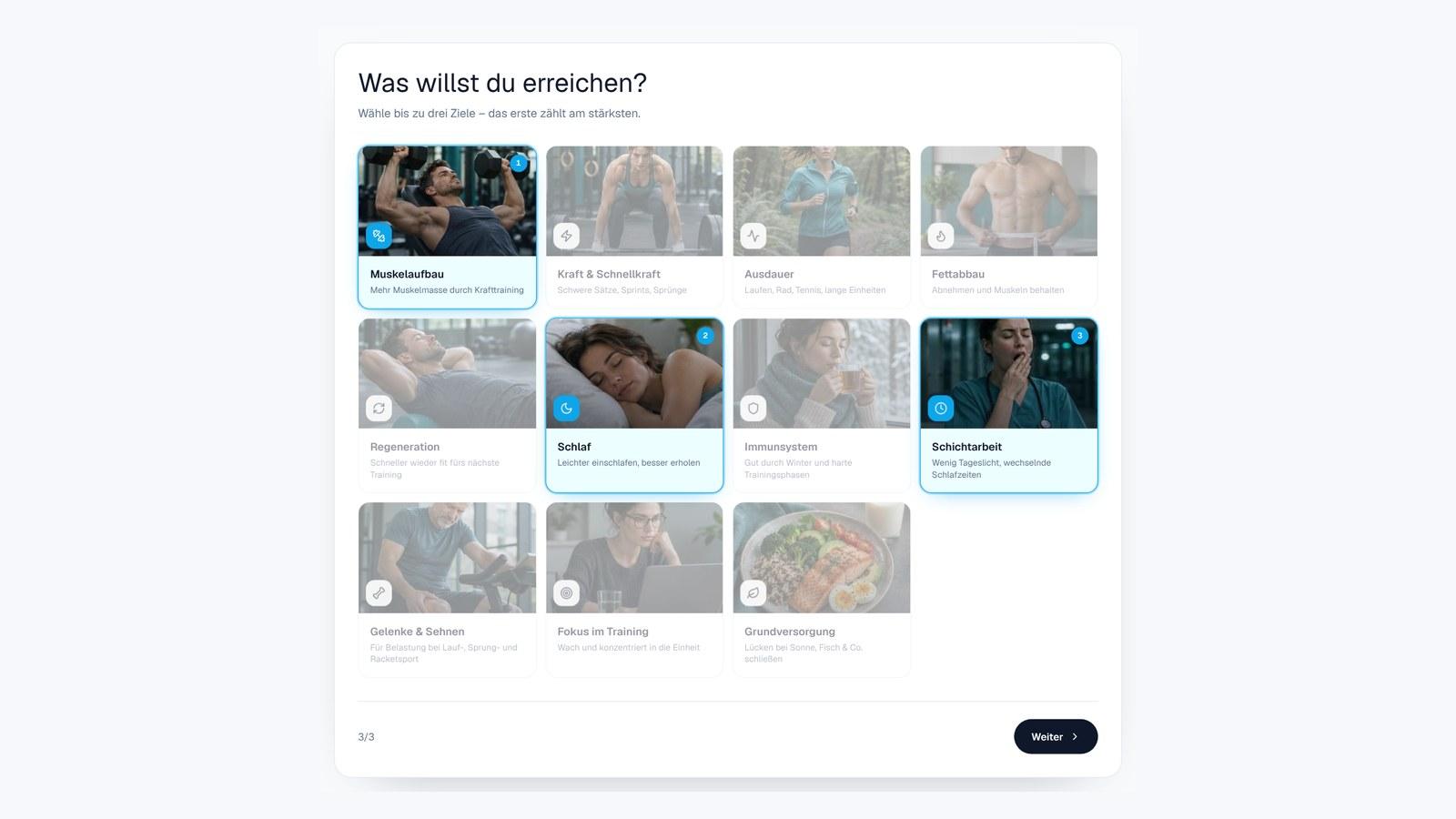
1. Choose goals. There are eleven goals to choose from, from muscle gain and strength to endurance and fat loss, sleep, immune system, joints and shift work. You pick up to three, and the order counts: the first goal counts fully, the second at 80 per cent, the third at 65 per cent.
2. Profile. Body weight, age, diet (with meat, vegetarian, vegan), whether you regularly eat oily fish, lactose, training days, training time, long sessions, coffee per day and an optional monthly budget. Each of these changes the result – more on that in a moment.
3. Health. Blood thinners, high blood pressure, kidney, liver or thyroid conditions, antidepressants and sleeping pills, allergies to fish, shellfish or milk protein, coeliac disease. These exclude ingredients or trigger notes. During pregnancy and breastfeeding the tool deliberately builds no stack.
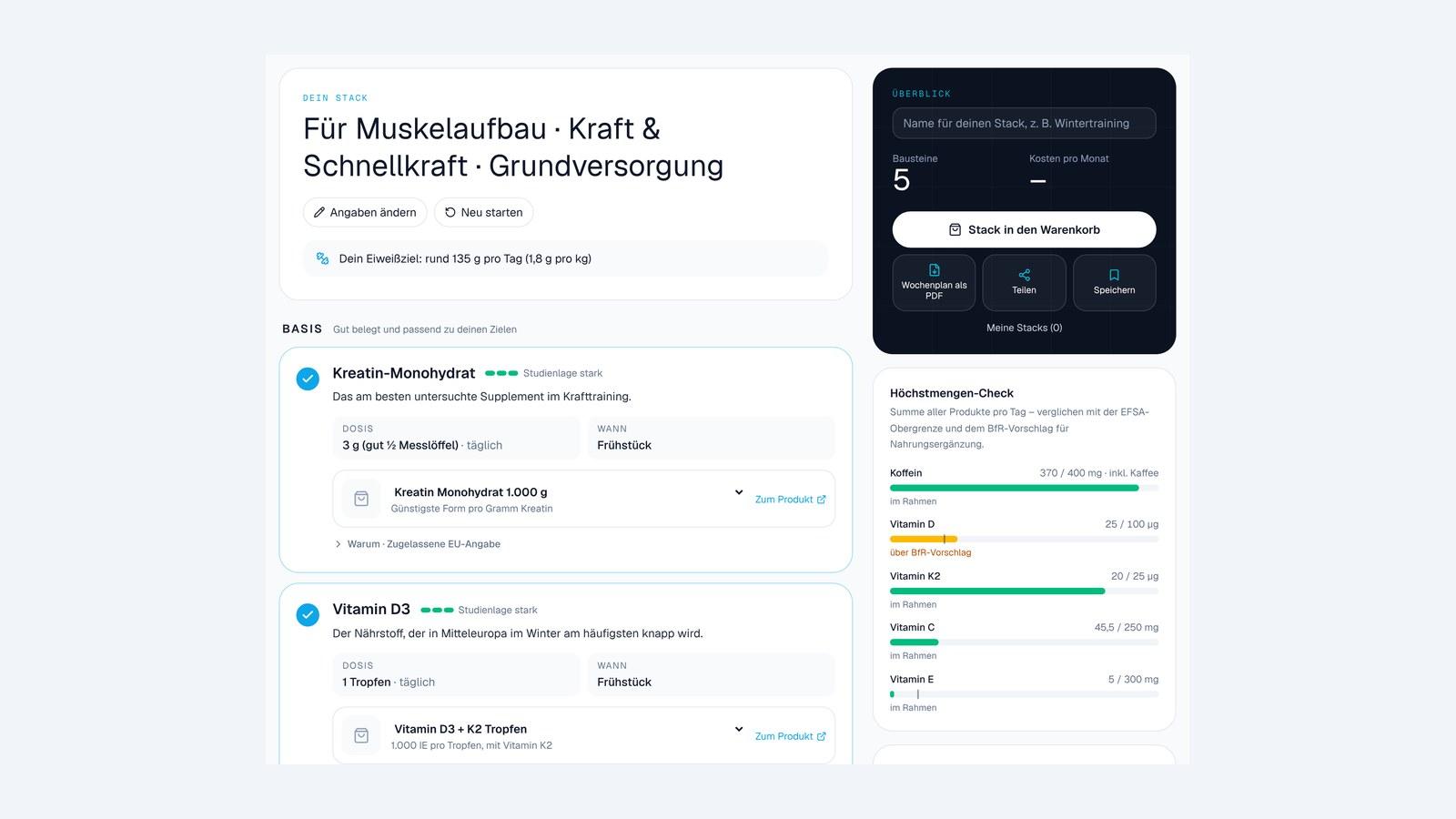
4. Your stack. Items appear in three levels – Core, Worth adding and Optional – each with dose, timing, evidence level, a matching Syrax product, monthly cost and the authorised EU claim, where there is one.
What the tool calculates in the background
Goals and evidence
Every ingredient has a value from 0 to 3 for each goal – creatine for example 3 for muscle gain and strength but only 1 for endurance, because it mainly supports short, intense efforts. This value is weighted by the evidence:
| Evidence | Meaning | Examples |
|---|---|---|
| Strong | several large meta-analyses and position stands, consistent results | creatine, protein, caffeine, vitamin D when low |
| Moderate | good data for specific situations | electrolytes in long sessions, melatonin for falling asleep, omega-3 with little fish |
| Limited | small or mixed studies | collagen for joints, magnesium without deficiency, ashwagandha |
Your profile changes recommendation and dose
- Season: from October to March the Central European sun barely suffices for vitamin D synthesis – vitamin D moves up. If you spend a lot of time outdoors in summer, it's suggested less often.
- Diet: without meat and fish creatine stores are usually lower, so creatine matters more. On a vegan diet iodine and a note on vitamin B12 are added, while whey and fish oil drop out.
- Fish: if you regularly eat oily fish, you need omega-3 capsules less often – the dose is halved.
- Body weight: the caffeine amount is based on about 3 mg per kilogram. Lighter people get half a booster serving; from 85 kg creatine rises to 5 g.
- Coffee: each cup counts as about 90 mg in the caffeine check. If you already drink plenty of coffee, you don't need a booster.
- Training time: booster, shake and electrolytes only appear on training days – and if you train in the evening, you get a note about sleep.
- Age: from 55 there's a specific authorised EU claim for creatine: daily creatine consumption can enhance the effect of resistance training on muscle strength (3 g daily, at least three resistance sessions per week).
The upper-limit check
This is the part missing from most supplement routines. The tool adds up the nutrients of all selected products – including shop products you add yourself and your coffee – and compares the total with two limits:
| Nutrient | German BfR proposal for supplements per day | EFSA upper level per day |
|---|---|---|
| Vitamin D | 20 µg | 100 µg |
| Magnesium | 250 mg (split into 2 servings) | 250 mg from supplements |
| Zinc | 6.5 mg | 25 mg |
| Vitamin B6 | 0.9 mg | 12 mg |
| Iodine | 100 µg | 600 µg |
| Caffeine | – | 400 mg, up to 200 mg in one go |
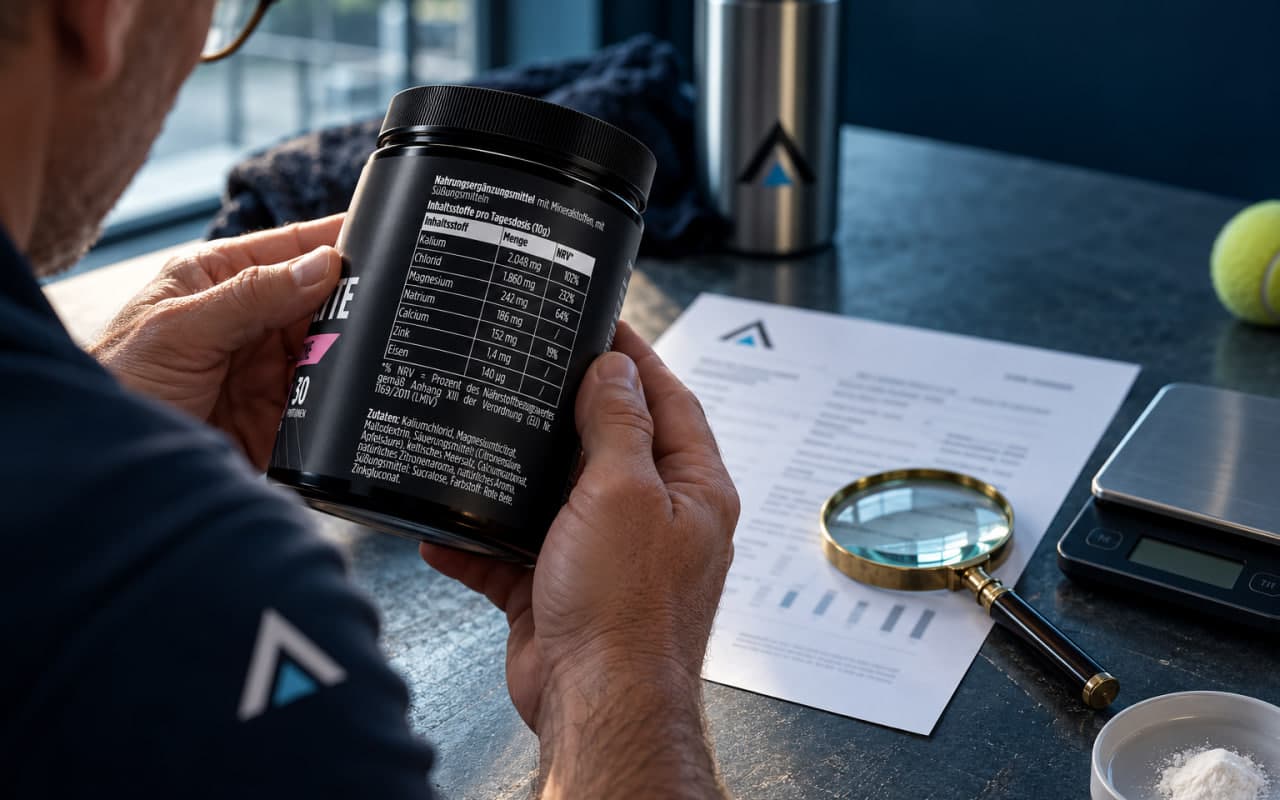
The EFSA upper level is the safety line: if it's exceeded, the tool shows a red warning – and automatically deselects the weaker item among its own suggestions. An example: electrolyte powder (242 mg magnesium) plus magnesium tablets (200 mg) would make 442 mg of magnesium from supplements. The Stack Builder keeps the product that matters more for your goal and explains why the other is missing.
The BfR values are cautious proposals for individual products that already factor in intake from food. If a stack is above them, a note appears instead of a warning – which, by the way, also applies to some of our own products, such as the vitamin D drops with 25 µg per drop. We show it anyway because you should know.
Interactions
Besides the totals, the tool checks known combinations that call for caution:
- Blood thinners: vitamin K can affect vitamin K antagonists – the tool then chooses vitamin D without K2 and advises checking with your doctor, likewise for omega-3.
- Kidney disease and blood pressure drugs: potassium from electrolytes and magnesium are excreted by the kidneys; with ACE inhibitors, ARBs or potassium-sparing diuretics there's a note.
- Thyroid: iodine and ashwagandha drop out with thyroid conditions.
- Antidepressants, sleeping pills and sedatives: no melatonin and no ashwagandha without medical advice.
- High blood pressure or caffeine sensitivity: no booster.
- Minerals: zinc, magnesium and calcium compete for absorption – the weekly plan puts them at different meals.
Three example stacks
How different the results are is shown by three typical profiles – as the Stack Builder suggests them in November.
| Profile | Core | Worth adding | Tool notes |
|---|---|---|---|
| Muscle gain and strength, 78 kg, training Mon/Wed/Fri evenings, 2 cups of coffee | Creatine 3 g, whey after training, vitamin D | Caffeine booster before training | After 5 pm only half a booster or none – because of sleep |
| Endurance and basics, vegan, 60 kg, long morning runs | Vitamin D, iodine | Electrolytes after long sessions, creatine, booster | Magnesium automatically deselected (too much with the electrolytes), vitamin B12 from a pharmacy, get ferritin checked |
| Shift work, sleep, immune system, 85 kg, 4 cups of coffee | Vitamin D, melatonin before main sleep | Magnesium in the evening, vitamin C | Caffeine only in the first half of the shift, no booster |
What we deliberately don't recommend
What's missing from the stack matters as much as what's in it. For each goal the tool shows what's often advertised but has no proven extra benefit:
- BCAA: if you eat enough protein, you get them anyway. More in BCAA or EAA?
- Glutamine: no proven benefit for muscle gain or recovery in healthy athletes.
- Fat burners and green tea extract: no meaningful effect on body fat; high-dose green tea extract can stress the liver according to EFSA. The calorie deficit does the work – see Lose fat, keep muscle.
- Testosterone boosters: tribulus, maca and co. don't measurably raise testosterone in healthy men.
Save, share, print
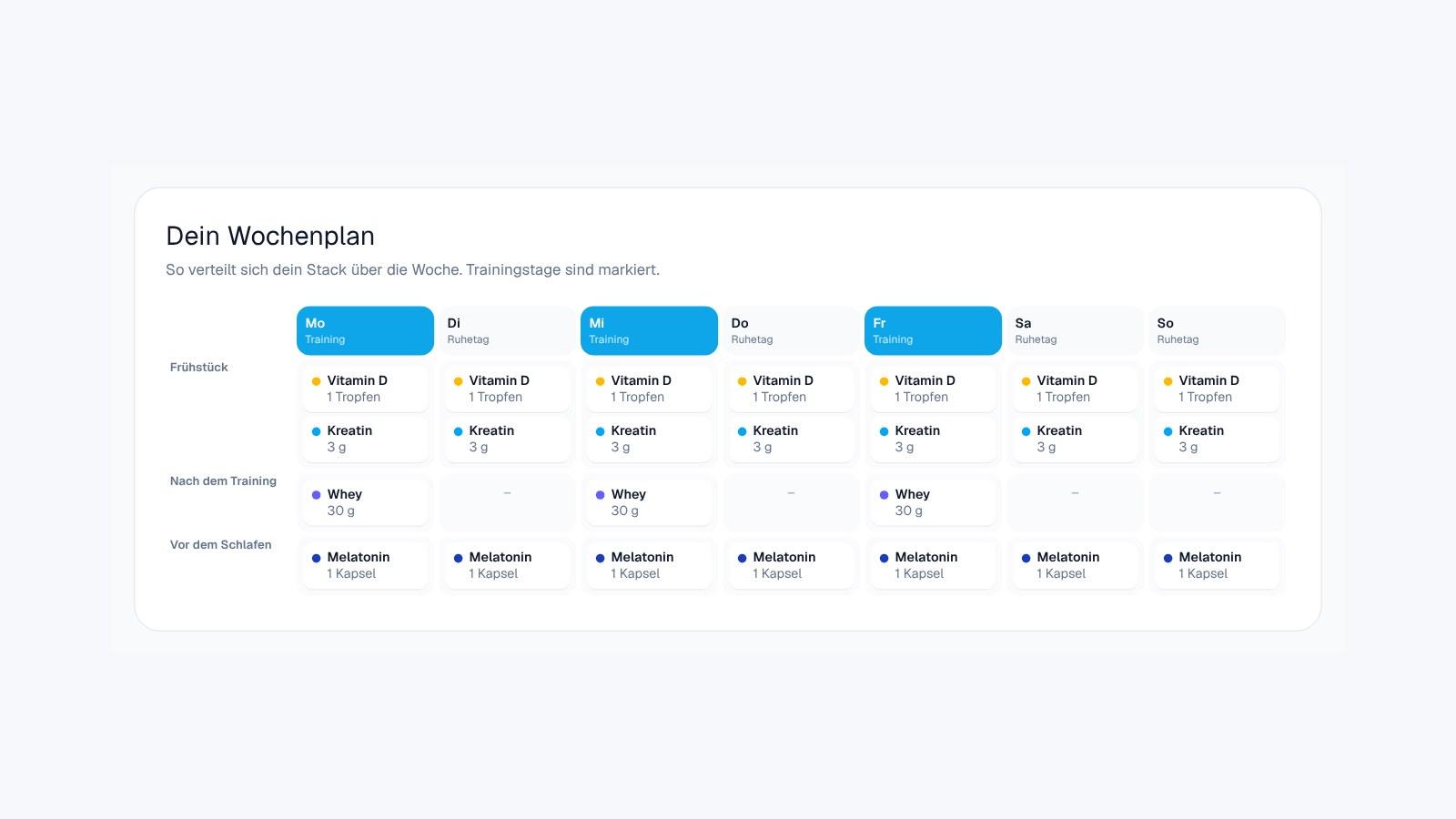
- Weekly plan as PDF: seven days, all meals and training days, plus every item with dose, timing and notes. The PDF is created in your browser.
- Share: the link contains all settings – whoever opens it sees your stack and can keep editing it. Handy for training partners or your doctor.
- Save: "My stacks" are stored in your browser. You don't need an account.
- Your own products: you can add more Syrax products from the shop; they appear in the plan, and known products count towards the upper-limit check.
And because supplements are only ever as good as the training behind them: the Stack Builder stores goals and training days so that the workout plan generator picks them up – and vice versa. Plan and stack fit together automatically: in the workout plan you see for every day what your stack schedules. If you work shifts, the shift work sleep optimizer gives you a matching sleep plan.
The tool's limits
The Stack Builder is designed for healthy adults. It doesn't know your blood values, it replaces no diagnosis and no medical advice. If you take medication, have a chronic condition, are pregnant or breastfeeding, check every supplement with your doctor first. That's why the tool never recommends iron, only advising you to have ferritin and a blood count checked. How to interpret lab values as an athlete is covered in Blood values for athletes.
Conclusion
The most important question when buying supplements isn't "What's good?" but "What's good for me – and does it fit with what I already take?". The Supplement Stack Builder answers exactly that question in two minutes. Try it, print out your weekly plan – and if you find you don't need half of your shelf, the tool has already paid off.
Sources: Regulation (EU) No 432/2012 – authorised health claims · Implementing Regulation (EU) 2017/672 – creatine from 55 · Verbraucherzentrale: BfR maximum level proposals (opinion 006/2024, German) · Kreider et al.: ISSN Position Stand Creatine (2017) · Guest et al.: ISSN Position Stand Caffeine (2021) · Morton et al.: Protein supplementation – meta-analysis (2018)
常見問題
What is a supplement stack?
A supplement stack is the combination of supplements you take regularly – with dose and timing. A good stack has few items that fit your goals and don't overlap.
Which supplements belong in a muscle-building stack?
Best supported are creatine monohydrate at 3–5 g daily and enough protein – a shake helps if your diet falls short. In winter vitamin D comes on top, and caffeine is optional if you train in the morning or afternoon. BCAA, glutamine or testosterone boosters bring no proven extra benefit when protein intake is sufficient.
How many supplements are too many?
There's no fixed number, but more than five items are rarely needed by healthy people. More important than the number is the total: if several products contain the same nutrient, such as magnesium or zinc, the daily amount can exceed the upper limit.
Which supplements shouldn't be combined?
Duplicate nutrients are the main issue, for example magnesium from an electrolyte drink plus magnesium tablets, or caffeine from a booster plus lots of coffee. Zinc, magnesium, calcium and iron should be taken at different meals. Anyone on blood thinners should check vitamin K and larger amounts of omega-3 with their doctor.
Does the Stack Builder cost anything?
No. The Stack Builder is free and works without signing up. Your answers stay in your browser; saving and sharing work without an account.
標籤
- Supplements
- Supplement stack
- Tool
- Creatine
- Vitamin D
- Interactions
Syrax 雜誌
延伸閱讀
 完整指南
補充品
How to Assess Supplements: Reading the Label, Dose, Upper Limits and Lab Report
How good is a dietary supplement really? Eduard Boehm shows step by step how to read labels, check the dose against reference values and BfR maximum levels, understand lab reports, assess additives and calculate the price per effective serving – explained using real labels and analyses of Syrax products.
閱讀時間 14 分鐘English
 完整指南
補充品
Creatine: Effects, Dosage and Myths Fact-Checked
Creatine is the most thoroughly researched sports supplement in the world – and still surrounded by myths. What it really does, how to dose it correctly, whether you need a loading phase and what is true about hair loss, kidney damage and water retention.
閱讀時間 13 分鐘English

補充品
Vitamin D3 + K2 Drops: What I Wanted to Know About Dosage and the Combination
Since the clocks went back it's dark by five – time for the vitamin D question. Selina Karl explains why D3 and K2 are often combined, what 1,000 IU per drop means, which maximum amounts the BfR and EFSA state and who should ask a doctor first. Part 2 of Selina's Sport Edit.
閱讀時間 6 分鐘English