
12-Week Workout Plan: How Your Plan Is Built – With Deloads, Volume Check and Log
How a good workout plan is built and how our free workout plan generator calculates: split by your days, exercises by equipment and aches, volume per muscle, time per session, 12 weeks with deloads, a log with progression tips and a link to your supplement stack.
 ByMichael Lohrberg
8 min read

In short
A good workout plan fits your days and your time, gives every muscle enough hard sets, gets heavier in a planned way and includes recovery weeks. Our free workout plan generator asks for goal, experience, training days, time per session, equipment, aches and focus areas and builds a 12-week plan: a split based on the number of days, 70 exercises organised by movement pattern, sets, reps, RIR and rest by goal, a time calculation including warm-up, a volume check per muscle and three blocks with a deload every fourth week. In the log you enter load and reps, and the tool suggests your next progression. Plan and supplement stack share the same profile. No sign-up, with a printable PDF log.
Contents
Most workout plans don't fail because of the exercises. They fail because they don't fit the week: the plan from the internet wants five days of 90 minutes, life has three evenings of 50 minutes. After three weeks you improvise, after six weeks the plan is forgotten.
That's why we built the workout plan generator. It doesn't start with exercises, it starts with you: how many days do you have, how much time per session, what equipment, what aches? From that it calculates a 12-week plan that really fits your life – and a log that tells you when to add weight. In this article I explain how the tool calculates, why it does it that way and where its limits are.
What makes a good workout plan
Before we get to the tool: a plan has to do four things. Everything else is taste.
The generator checks exactly these four points for every plan – and shows you where yours stands.
How the generator works – in five steps
It takes about two minutes and needs no sign-up.
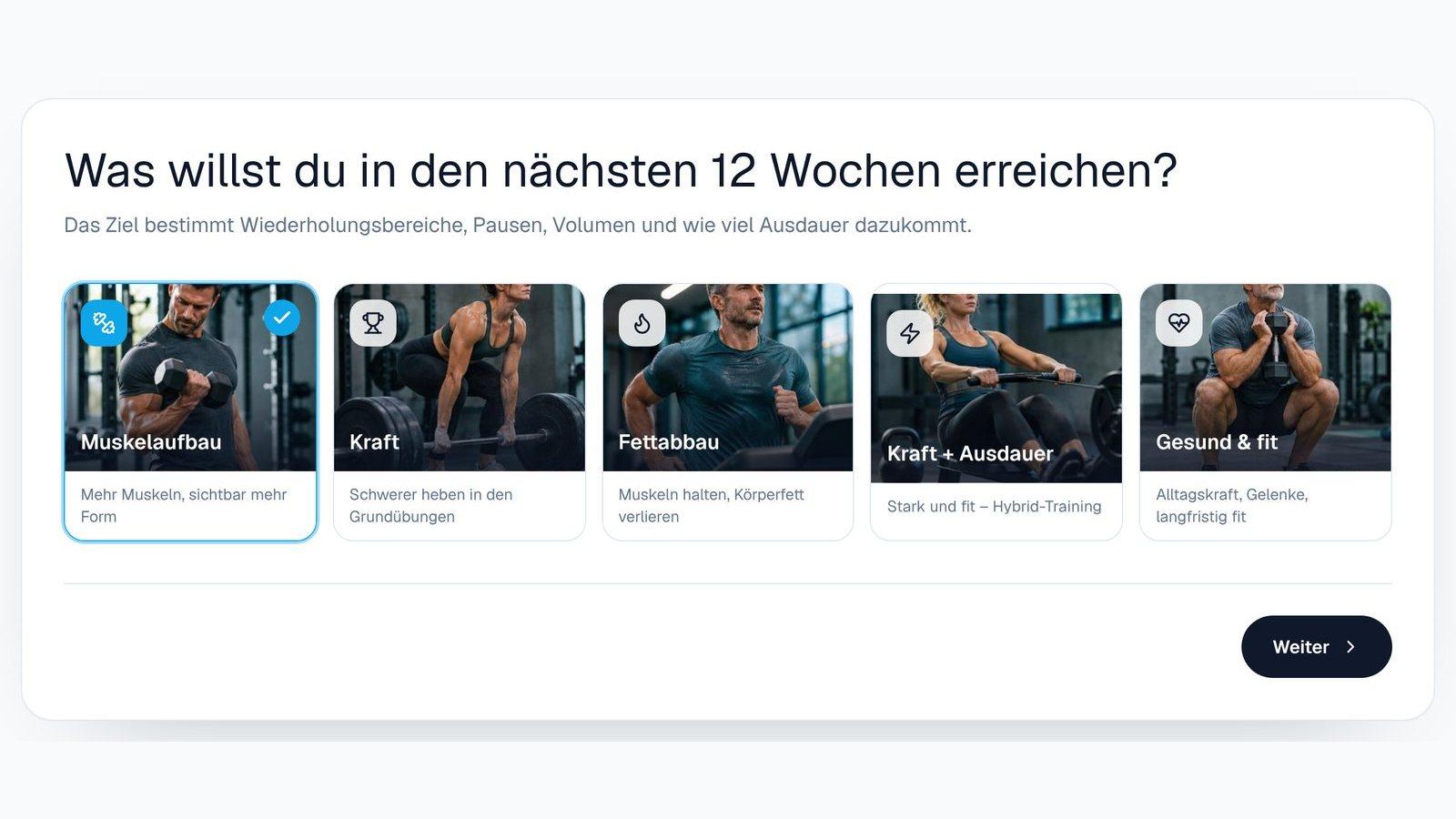
1. Goal. Build muscle, strength, lose fat, strength plus endurance (hybrid) or "healthy & fit". For strength, main lifts sit at 3–5 reps with longer rest, for muscle at 6–10, for "healthy & fit" at 8–12 with more in reserve. For fat loss, heavy lifting stays in – it keeps the muscle while your diet creates the deficit.
2. You. Experience (beginner, intermediate, advanced), age, sex, body weight. Experience matters most: beginners get technically simpler exercises, fewer sets and more reps in reserve.
3. Week. Which days, how long per session (30 to 90 minutes) and what time of day. The plan itself doesn't need the time of day – it goes to the supplement stack, more on that shortly.
4. Equipment. Gym, home gym, dumbbells with a bench or no equipment – plus extras like a pull-up bar, bands or a kettlebell. Optionally add aches (knee, lower back, shoulder, wrist), up to two focus areas and your favourite cardio.
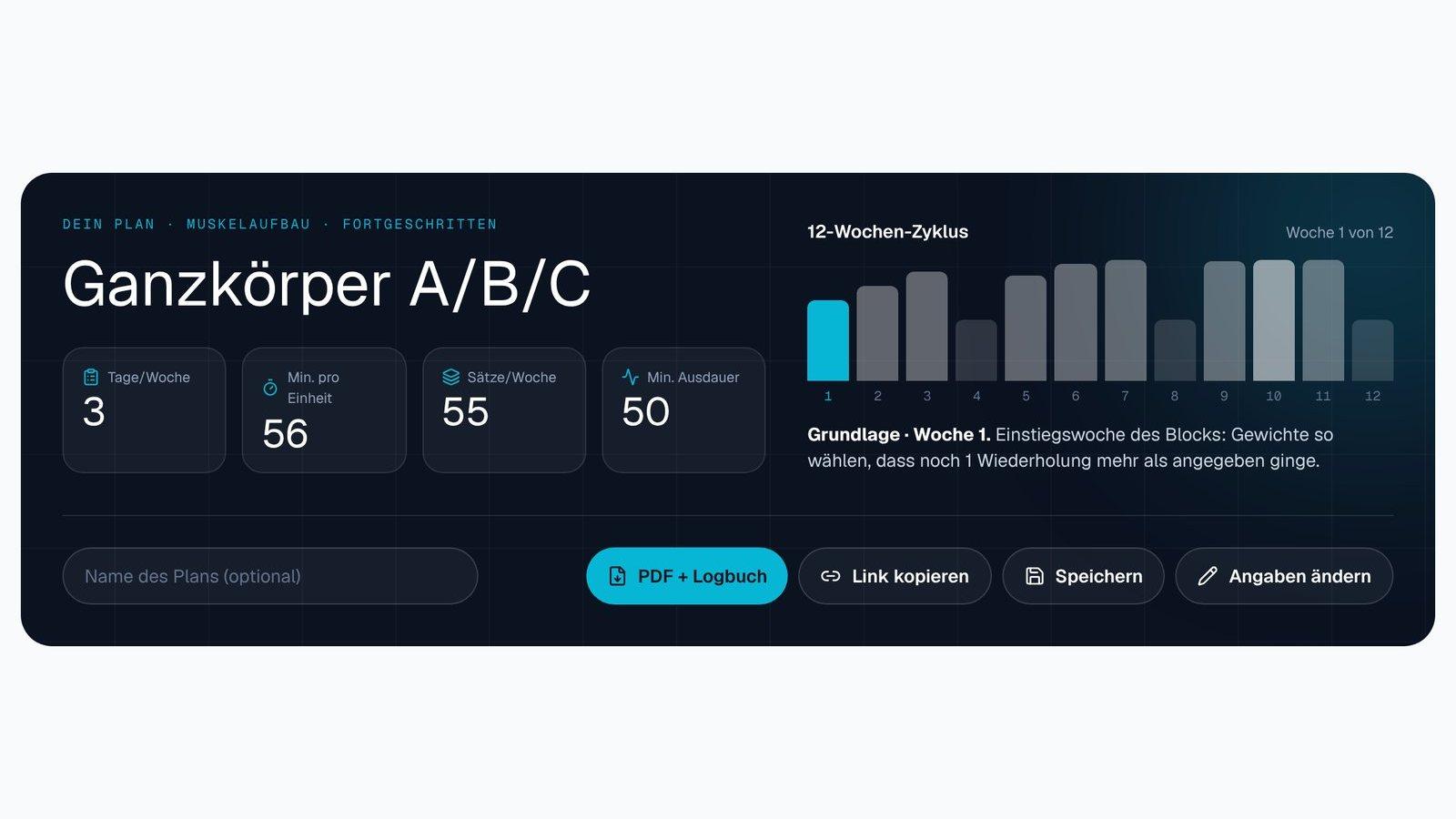
5. Plan. Weekly overview, each session with warm-up, exercises, sets, reps, RIR and rest, plus volume per muscle, the 12-week cycle, cardio on free days, a step goal and your supplement timing.
What gets calculated behind the scenes
The split follows your days
| Training days | Split | Each muscle per week |
|---|---|---|
| 2 | Full body A/B | 2× |
| 3 | Full body A/B/C | 2–3× |
| 4 | Upper/lower ×2 | 2× |
| 5 | Upper/lower + push/pull/legs | 2× |
| 6 | Push/pull/legs ×2 | 2× |
That spreads the weekly volume over several shorter sessions instead of exhausting a muscle once a week. More on the variants in Upper/lower split and the push pull legs plan.
Exercises from movement patterns
Each session is a template of patterns: squat, hinge, lunge, horizontal and vertical push, horizontal and vertical pull, plus arms, shoulders and core. For each pattern the generator knows several of its 70 exercises – with equipment, minimum experience and the aches they often aggravate.
If you tick "shoulder", the barbell bench press becomes the dumbbell bench press and the barbell overhead press becomes the landmine press. Tick "lower back" and a chest-supported row replaces the bent-over barbell row. You can swap any exercise yourself – alternatives that don't suit your aches are flagged.
Sets, reps, RIR and rest
Every exercise has a role – main, secondary, accessory or isolation – and that sets the dose. RIR stands for reps in reserve: how many clean reps you could still have done at the end of the set. The scale goes back to Zourdos and colleagues (2016) and is much more practical in the gym than percentages of your max.
Typical rep ranges of the main lift by goal
Upper end of the main lift's rep range in the generator (intermediate). The lower end is 3 reps for strength, 6 for muscle and fat loss, 5 for hybrid and 8 for healthy & fit.
- Strength3–5
- Strength + endurance5–8
- Build muscle6–10
- Lose fat6–10
- Healthy & fit8–12
Show data as table
| Category | Reps |
|---|---|
| Strength | 3–5 |
| Strength + endurance | 5–8 |
| Build muscle | 6–10 |
| Lose fat | 6–10 |
| Healthy & fit | 8–12 |
Time is actually calculated
This is where most generators stop. Our tool adds up for each session: warm-up (7 to 10 minutes, depending on the first exercise), every set with work time and rest, doubled for single-side exercises, plus one minute of changeover per exercise. If the total exceeds your time, this happens in order:
- Accessory and isolation exercises are paired into supersets – two exercises for different muscles alternated, one rest per pair.
- Sets are trimmed from the end, isolation first, never below two.
- Only then is the last isolation exercise dropped.
Main lifts always stay. At 45 minutes you get a plan with supersets that is doable in 45 minutes – not a 70-minute plan with a tick next to "45 minutes".
The volume check per muscle
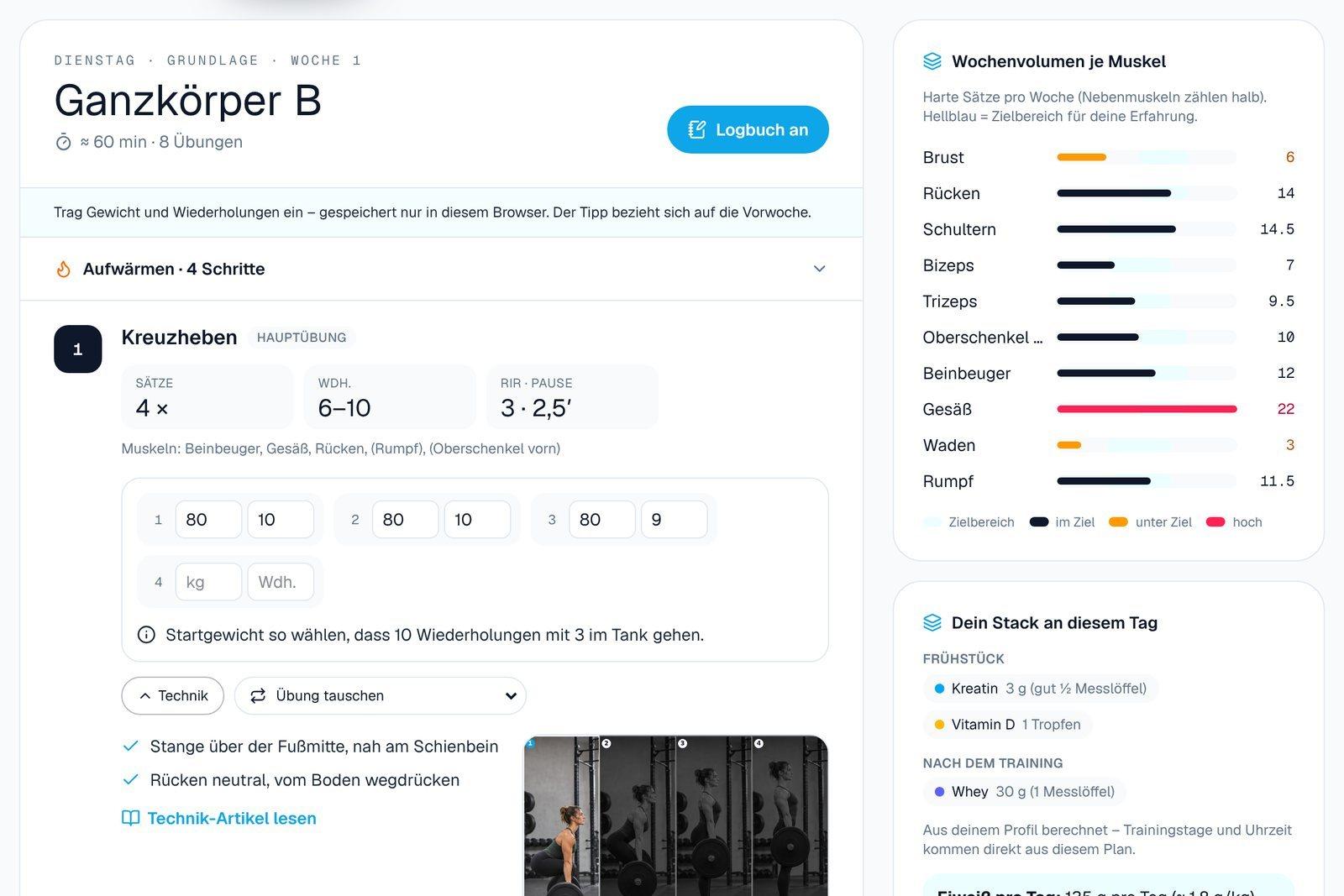
Finally, the generator counts the hard sets per week for every muscle: full sets for an exercise's prime movers, half sets for the assisting muscles. Squats count fully for quads and glutes, half for the core.
| Experience | Large muscle groups | Small muscles (arms, calves, shoulders, core) |
|---|---|---|
| Beginner | 6–12 sets | 4–10 sets |
| Intermediate | 10–16 sets | 6–14 sets |
| Advanced | 12–20 sets | 8–16 sets |
The ranges are based on the meta-analysis by Schoenfeld and colleagues (2017): with ten or more sets per muscle per week, muscles grew more than with fewer than five. If a muscle is below its range, the generator adds sets as long as time allows. If it is well above, it trims accessories. Whatever is still missing shows up in the chart – honest, not glossed over. Background in Training volume: how many sets per week?.
Twelve weeks, three blocks, three deloads
Instead of a rigid weekly plan, there's a cycle. Each block has four weeks: in week 1 you keep one more rep in reserve, week 2 is normal, week 3 the hardest. Week 4 is a deload with about 40 percent fewer sets and slightly lighter loads. In the second block ("build"), main and secondary lifts get an extra set; in the third ("intensify", "strength peak" for the strength goal), the main lift gets heavier and the rep range drops. Week 12 is deload and review – then you re-plan.
Tap a week in the result and sets and RIR adjust immediately. More on the idea in Progressive overload.
The log tells you when to add weight
With "Log" every exercise gets fields for load and reps. Everything is stored only in your browser. From the second week, the generator compares with the previous week and gives one of four tips:
- All sets at the top of the range: add load (about 2.5–5 kg on barbell leg lifts, 1–2.5 kg on upper-body lifts, the next dumbbell, the next plate on a machine) and start at the bottom again.
- Within the range: same load, aim for one more rep.
- One set below: keep the load until every set is in the range.
- Several sets below: go 5–10 percent lighter and build back up cleanly.
That's classic double progression – simple, robust and easy to stick with. For main lifts the tool also plots your estimated max (Epley) as a small curve. Prefer tracking in an app? Tracking strength training compares the options.
Cardio, steps, warm-up
The World Health Organization recommends 150 to 300 minutes of moderate cardio per week plus strength training on at least two days for adults, with balance training added from 65. The generator puts cardio on your free days – from two short easy sessions for the strength goal up to three sessions plus intervals for fat loss. Where possible, hard intervals don't land on the day before a leg day.
There's also a step goal: in the large analysis by Paluch and colleagues (2022), the benefit of extra steps levelled off at around 8,000 to 10,000 steps for people under 60, and at 6,000 to 8,000 for those over 60.
Each session starts with a warm-up of three to six steps: get warm, mobility for upper or lower body, an extra block if you have aches, and ramp-up sets for the first exercise. Why it matters: Warming up for strength training.
Plan and stack share one profile
The generator and the supplement stack builder use the same profile in your browser. Two consequences:
- Pick "build muscle" in the workout plan and the stack builder already has the matching goal. Training days and time are carried over.
- In the plan you see for every day what your stack schedules – for example creatine at breakfast and the shake after training, with no post-workout slot on rest days. Plus your daily protein target.
If you work shifts, the shift work sleep optimizer helps: it plans sleep, naps, light and caffeine around your shifts – and with it, when training fits into your day.
Share, save, print
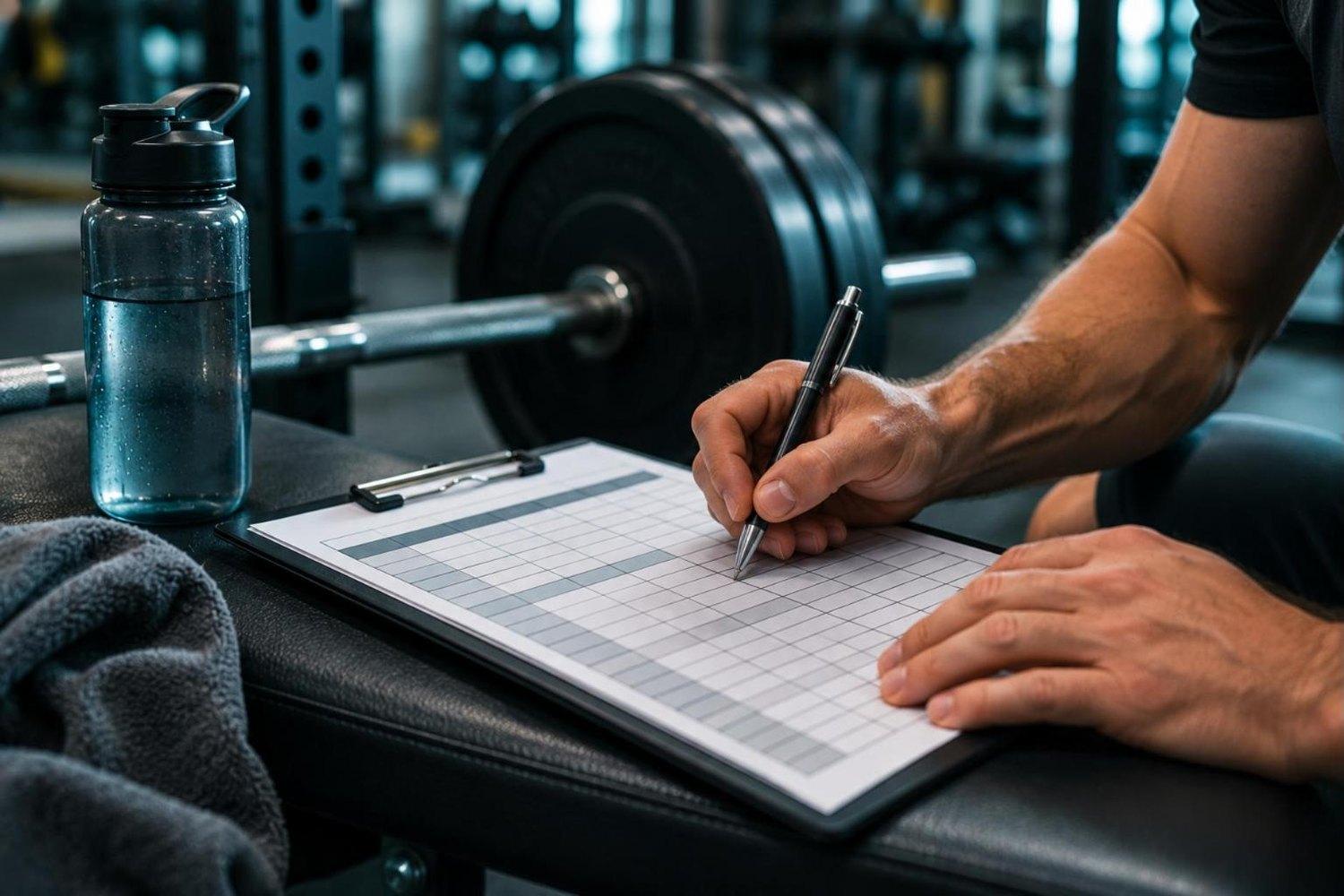
PDF + log gives you an overview page with week, 12-week cycle and volume, plus one sheet per session with exercises, targets and fields for four weeks – to take to the gym. Copy link packs the whole plan into a link, including swapped exercises. Save stores up to eight plans in your browser.
The limits of the tool
The generator is meant for healthy adults. It doesn't know your medical history and doesn't replace a doctor or physiotherapist. With aches it swaps out exercises that often aggravate them – pain that gets worse with training still needs checking. And it isn't a coach: it can't see your technique. The cues, movement sequences and linked articles help, but they don't replace a trained eye in the gym.
Conclusion
Over the years I've seen many workout plans that looked great and were never followed through. The workout plan generator flips the order: your life first, then the exercises. Try it, print the log and write down for twelve weeks what you manage. When you compare week 12 with week 1, you'll know whether the plan works – and the next cycle is two minutes away.
Sources: Schoenfeld, Ogborn & Krieger: Dose-response relationship between weekly resistance training volume and increases in muscle mass (2017) · American College of Sports Medicine: Progression models in resistance training for healthy adults (2009) · Zourdos et al.: Novel resistance training-specific RPE scale measuring repetitions in reserve (2016) · WHO: Guidelines on physical activity and sedentary behaviour (2020) · Paluch et al.: Daily steps and all-cause mortality (2022)
Frequently asked questions
How do I create a workout plan?
Set your goal, training days and time per session first. That gives you the split: two to three days full body, four days upper/lower, five or six days push/pull/legs. Then pick exercises from the basic patterns for each session – squat, hinge, push, pull –, set sets and reps, and plan a progression rule plus deload weeks. Our workout plan generator does these steps in two minutes.
How many sets per muscle per week make sense?
Beginners do well with about 6 to 12 hard sets per large muscle group per week, intermediates usually land at 10 to 16, advanced lifters at 12 to 20. In the meta-analysis by Schoenfeld and colleagues (2017), muscles grew more with ten or more sets per week than with fewer than five.
What is a deload?
A lighter week with fewer sets and slightly lighter loads. It sheds fatigue without losing form. In the generator, every fourth week is a deload.
Does the generator work for training at home?
Yes. You choose between gym, home gym, dumbbells with a bench and no equipment. A pull-up bar, resistance bands and a kettlebell can be added. The plan only uses exercises you have the equipment for.
Is the workout plan generator free?
Yes, completely. No account, no email. Plan and log stay in your browser; you can share the plan via a link and print it as a PDF.
Tags
- Workout plan
- Workout plan generator
- Tool
- Strength training
- Muscle building
- Progression
- Deload
About the author
Michael Lohrberg· Founder of Syrax
Michael Lohrberg founded Syrax in 2026. Military service with a deployment abroad, in industry since 2010, shift work and two jobs in parallel – the LEEK Pulse Pro grew out of the question of how much recovery is really left in everyday life. In the magazine he writes about training, sleep and regeneration – practical and grounded in the research.
More about MichaelThis article is for general information and does not replace medical advice. If you have pre-existing conditions, pain or any doubts, talk to your doctor before changing your training or diet.
Also available in: Deutsch
Syrax Magazine
Read next
Muscle Building & Strength
Training Volume: How Many Sets per Muscle per Week?
How many sets per muscle group per week you need to build muscle: what research says, how to count sets correctly, when more stops being better and how to adjust your volume step by step.
5 min read
Muscle Building & Strength
Progressive Overload: The Most Important Principle for Strength and Muscle
No progression, no progress – but progression does not just mean "more weight". The seven ways to apply progressive overload, the best progression models for beginners and intermediates, and what to do when nothing moves any more.
13 min read

Muscle Building & StrengthSyrax
Tracking Strength Training: What a Fitness Tracker Can – and Can't – Do
Which data really matter in strength training, why wrist heart rate is inaccurate when lifting, what belongs in your training log and how sleep, HRV and recovery data improve your training decisions – using the LEEK Pulse Pro as an example.
5 min read