
Creatine for Tennis Players and Runners: What It Does – and What It Doesn't
Creatine in tennis, padel, squash and running: Werner Ludmann explains when creatine helps endurance and racket-sport athletes, what the tennis study shows, how much weight to expect and how to use creatine sensibly across the season.
 Höfundur:Werner Ludmann
6 mín lestur

Þessi grein er ekki enn til á íslensku. Hún er sýnd á: English.
Í stuttu máli
Creatine helps with short, repeated, maximal efforts and with strength training – not with long, steady runs. In running, intervals, hill sprints, final kicks and supporting strength work benefit most. In tennis, the game profile with many short bursts sounds like a perfect fit, but the best study so far with competitive players found no improvement in serve, forehand or backhand velocity, repeated sprints or strength after five weeks. To be honest: for racket-sport players, creatine is mainly a tool for athletic training, not a match winner. Expect one to two kilograms of extra weight from water in the muscle. Dosage: 3 to 5 grams of creatine monohydrate daily, no loading phase. Test it in the off-season, not before an important competition.
Efnisyfirlit
I've played club tennis for many years and run to balance it out. Two sports that seem to have little in common at first glance – and yet both raise the same question I keep hearing in the clubhouse and at the running group: does creatine do anything if you're not a strength athlete?
My honest answer up front: it depends on which effort you want to improve. And in tennis the evidence is more sobering than many people think. In this article I take a close look at both. The basics of creatine are covered in the creatine guide.

How creatine works – in two sentences
Creatine is stored in muscle as phosphocreatine and supplies energy for short, maximal efforts of a few seconds, such as a sprint, a jump or a serve. With 3 to 5 grams daily these stores can be topped up by around 20 to 40 percent; for long, steady efforts, aerobic metabolism does most of the work instead.
That gives us the most important rule of this article: creatine helps where you work short and hard – and hardly at all where you go long and steady.
Where creatine can help tennis players and runners
Simplified classification of the possible benefit based on the evidence. For tennis itself, no benefit was measurable in the best study so far.
- Strength, athletic traininghigh
- Running intervals, hill sprintsmedium to high
- Final kick, pace changesmedium
- The tennis match itselfunclear
- Long, steady runlow
Sýna gögn sem töflu
| Flokkur | |
|---|---|
| Strength, athletic training | high |
| Running intervals, hill sprints | medium to high |
| Final kick, pace changes | medium |
| The tennis match itself | unclear |
| Long, steady run | low |
Creatine in tennis: the honest evidence
Tennis sounds like the textbook case for creatine. A rally usually lasts only a few seconds, with breaks of up to 25 seconds in between and a changeover after every second game. Lots of short, explosive bursts, serves and changes of direction – exactly the energy system creatine fills.
Still, the most meaningful study so far with competitive players reached a clear result. A research group led by Babette Pluim gave 36 male tournament players either creatine or a placebo in a double-blind design: six days of loading, followed by four weeks of maintenance. They measured serve velocity, forehand and backhand velocity, repeated 20-metre sprints and strength on bench press and leg press.
The authors therefore advised tennis players against creatine. In fairness: the study was small, only 24 players remained at the end, and small effects are hard to detect that way. A lab test also doesn't measure how fresh you feel in the third set. But there is no evidence that creatine wins you matches either.
Where creatine can still help tennis players
That's why I don't see creatine in tennis as a match supplement but as a tool for athletic training. If you do strength, plyometric and sprint training off the court, you can benefit from creatine there – that's well established in strength sports. More strength in legs and core then indirectly shows up on court too. The same goes for padel, squash and badminton, which have a similar load profile.
Creatine for running: intervals yes, long distance not really
In running the picture is clearer. The shorter and more intense the effort, the more likely creatine helps:
- Intervals and hill sprints: full creatine stores can help you hold performance better in later repetitions. More quality in interval training means more progress over time.
- Final kick and pace changes: in races decided by a sprint finish or climbs, a small advantage is possible.
- Supporting strength training: strength training improves running economy and helps prevent injuries. Creatine makes that training more effective. More in Running and muscle building.
- Long, steady runs: creatine does little here. It won't make your marathon faster.
If you combine running with strength, for example in Hyrox or CrossFit, you're right in the zone where creatine makes the most sense. How to combine the two is described in the hybrid training plan.
The weight issue
Creatine draws water into the muscles. In the first weeks, body weight therefore often rises by about one to two kilograms. That's not fat, but it's mass you have to carry with every step.
| Sport | Role of body weight | Assessment of creatine |
|---|---|---|
| Marathon, ultra | very high | rather not for competition |
| 5 to 10 km with final kick | high | weigh it up, test in training |
| Mountain running, trail | very high | rather critical |
| Tennis, padel, squash | medium | useful for athletic training, unclear for the match |
| Hybrid, Hyrox, CrossFit | medium | useful |
| Team sports | medium | useful |
In tennis, an extra kilogram matters less than when running uphill. Still, pay attention to how your bursts and footwork feel.
Dosage and intake
- Form: creatine monohydrate is the best-researched and cheapest form. Other variants have no proven advantage.
- Amount: 3 to 5 grams per day, including rest days.
- Loading phase: not necessary. Without loading, the stores are full after three to four weeks, and the weight gain comes more gradually.
- Timing: secondary. A fixed habit matters more.
- Drinking: normal amounts according to your needs. For long matches in summer heat, the usual rules for fluids and salt apply – see Electrolytes for exercise.
At these amounts creatine is considered safe for healthy adults. If you have kidney disease, check with a doctor before taking it.
Powder or tablets – what fits in your kit bag?
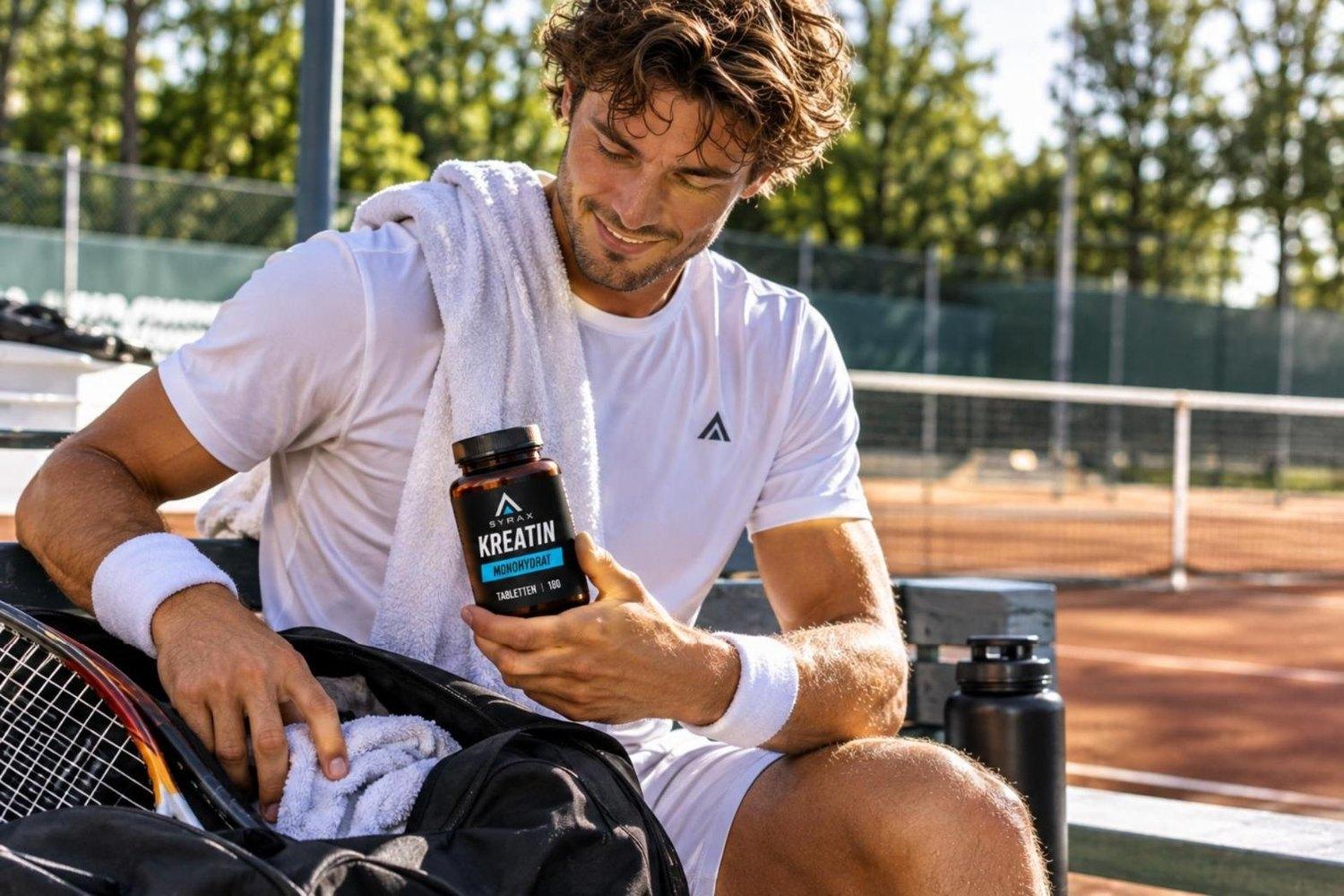
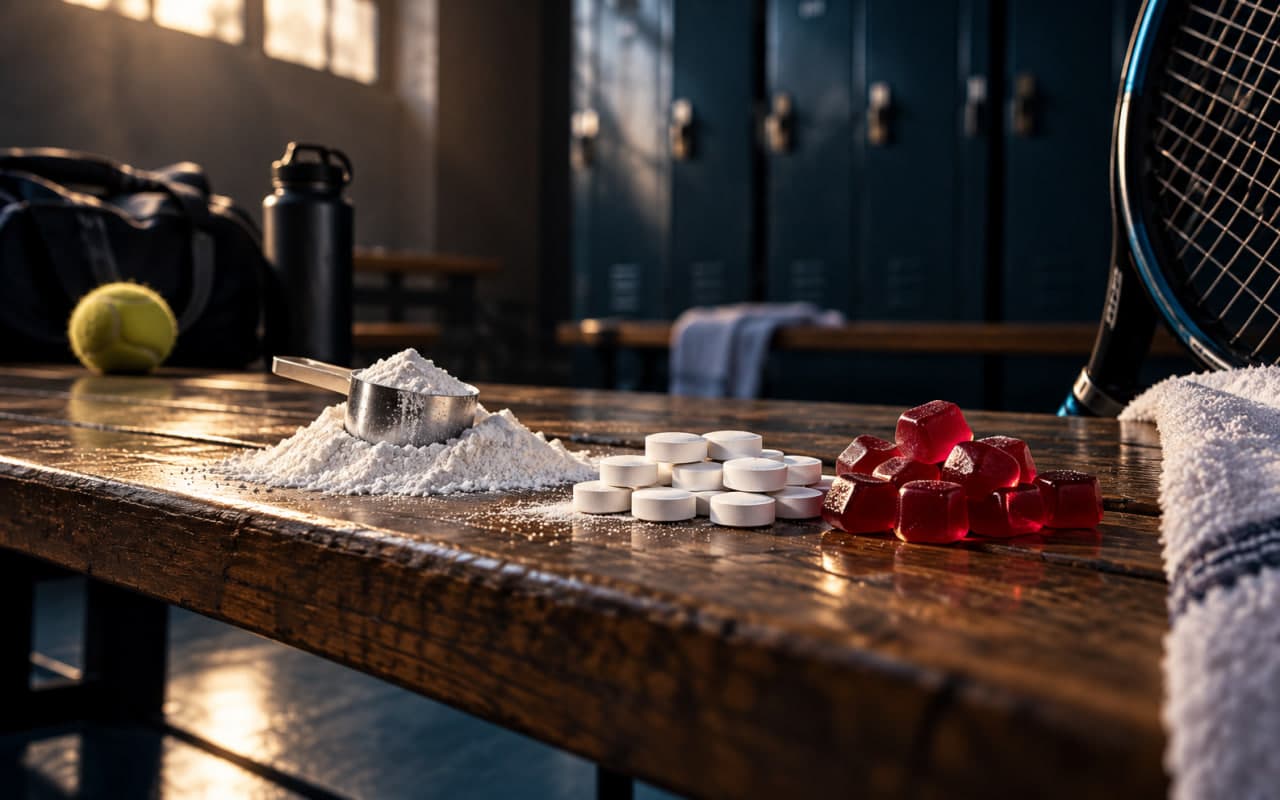
For a daily routine at home, powder is unbeatably cheap: a level teaspoon in water, juice or yoghurt. If you're often on the move between work, training and tournaments, tablets are often easier. With our creatine tablets you do have to count: six tablets provide 4,500 mg of creatine monohydrate. A detailed comparison of all forms with lab values and price per serving is in Creatine: powder, tablets or gummies.
Planning creatine across the season
For tennis players and runners, using it in phases makes sense:
| Phase | Typical training | Creatine |
|---|---|---|
| Winter preparation | lots of strength, athletics, intervals | useful |
| Indoor season, league matches, track races | match practice, short races | continue if tested in training |
| Marathon or mountain race preparation | long runs, tempo runs | stop four to six weeks before the race |
| Transition phase | easy training | optional |
After stopping, it takes about four to six weeks for stores and water weight to return to baseline.
Common mistakes
- Expecting miracles in matches: creatine won't increase your serve speed overnight.
- Starting just before the tournament: creatine works through full stores, which takes weeks.
- Irregular intake: daily intake matters more than timing.
- Buying expensive special forms: monohydrate is all you need.
- Ignoring the weight gain: plan for it, especially before running races.
Conclusion: a training tool, not a match winner
For me as a tennis player and runner, creatine is not a must. If you do a lot of athletic and strength training, run intervals or compete in hybrid events, you can benefit from it. If, on the other hand, you hope it will get you to the ball faster in a match, temper your expectations – the evidence doesn't support that. If you try it, do so deliberately during a training block, with a notebook, and not three days before the most important match of the season.
Sources: Pluim et al. (2006): The effects of creatine supplementation on selected factors of tennis specific training, British Journal of Sports Medicine · ISSN position stand on creatine (Kreider et al., 2017) · ISSN: Common questions and misconceptions about creatine (Antonio et al., 2021) · Labels and lab reports of the Syrax products (as of October 2026)
Algengar spurningar
Does creatine help tennis players?
The best study so far with competitive players found no improvement in stroke velocity, repeated sprints or strength after six days of loading and four weeks of maintenance. Creatine can be useful for the athletic and strength training that tennis players do on the side.
Does creatine help runners?
For intervals, hill sprints, final kicks and supporting strength training, yes. For long, steady runs the direct benefit is small, and the extra weight can even be a drawback.
Does creatine make you gain weight?
Often by about one to two kilograms, mainly due to extra water in the muscles. That's not fat, but you have to carry it when running.
How much creatine should endurance athletes take?
3 to 5 grams of creatine monohydrate per day. A loading phase is not necessary; without it, it takes about three to four weeks for the stores to fill.
When should I take creatine?
Timing is secondary; what matters is taking it daily. A fixed habit works best, for example with breakfast or after training.
Do I need to drink more when taking creatine?
Normal intake according to your needs is enough. In heat and during long matches or runs, the usual rules for fluids and electrolytes apply.
Should I stop creatine before a marathon or tournament?
Before a marathon or mountain race, many stop four to six weeks beforehand so the water weight disappears. In tennis the weight is less critical; what matters is that you have tested it in training first.
Merki
- Creatine
- Tennis
- Running
- Endurance sport
- Racket sports
- Supplements
Um höfundinn
Werner Ludmann· Höfundur um þjálfun, félagsíþróttir og fæðubótarefni í framkvæmd
Werner Ludmann er ástríðufullur tennisspilari og hefur verið virkur í félagsíþróttum um árabil. Hann finnur líka íþróttalegt jafnvægi í hlaupum. Í Syrax tímaritinu deilir hann reynslu sinni og eldmóði fyrir hreyfingu, líkamsrækt og virkum lífsstíl – með augum iðkandans: hvað gerir fæðubótarefni í raun í daglegri þjálfun?
Meira um WernerÞessi grein er almennar upplýsingar og kemur ekki í stað læknisráðgjafar. Ef þú ert með sjúkdóma, verki eða efasemdir skaltu ræða við lækni áður en þú breytir þjálfun eða mataræði.
Syrax Tímarit
Lestu áfram
 Stór leiðarvísir
Fæðubótarefni
Creatine: Effects, Dosage and Myths Fact-Checked
Creatine is the most thoroughly researched sports supplement in the world – and still surrounded by myths. What it really does, how to dose it correctly, whether you need a loading phase and what is true about hair loss, kidney damage and water retention.
13 mín lesturEnglish
Fæðubótarefni
Creatine: Powder, Tablets or Gummies? An Honest Comparison with Lab Results
Creatine powder, creatine tablets or creatine gummies: Werner Ludmann compares the three forms by active ingredient per serving, cost per 3 g of creatine, additives, everyday practicality and lab results – with label evidence for every Syrax product.
10 mín lesturEnglish

Fæðubótarefni
Electrolytes in Sport: When You Really Need Them – the Situation Matrix for Tennis, Running & Co.
Water, electrolytes or a sports drink? Werner Ludmann shows when sodium, potassium and magnesium really need replacing during training – with a situation matrix by duration and heat, a DIY sweat test, amounts per litre and an honest assessment of the Syrax electrolyte products.
9 mín lesturEnglish